QTestBench: A New Framework for Evaluating LLMs' Ability to Generate Quantum Code Tests

QTestBench reveals LLM-generated quantum tests are executable but lack real bug-detection power.
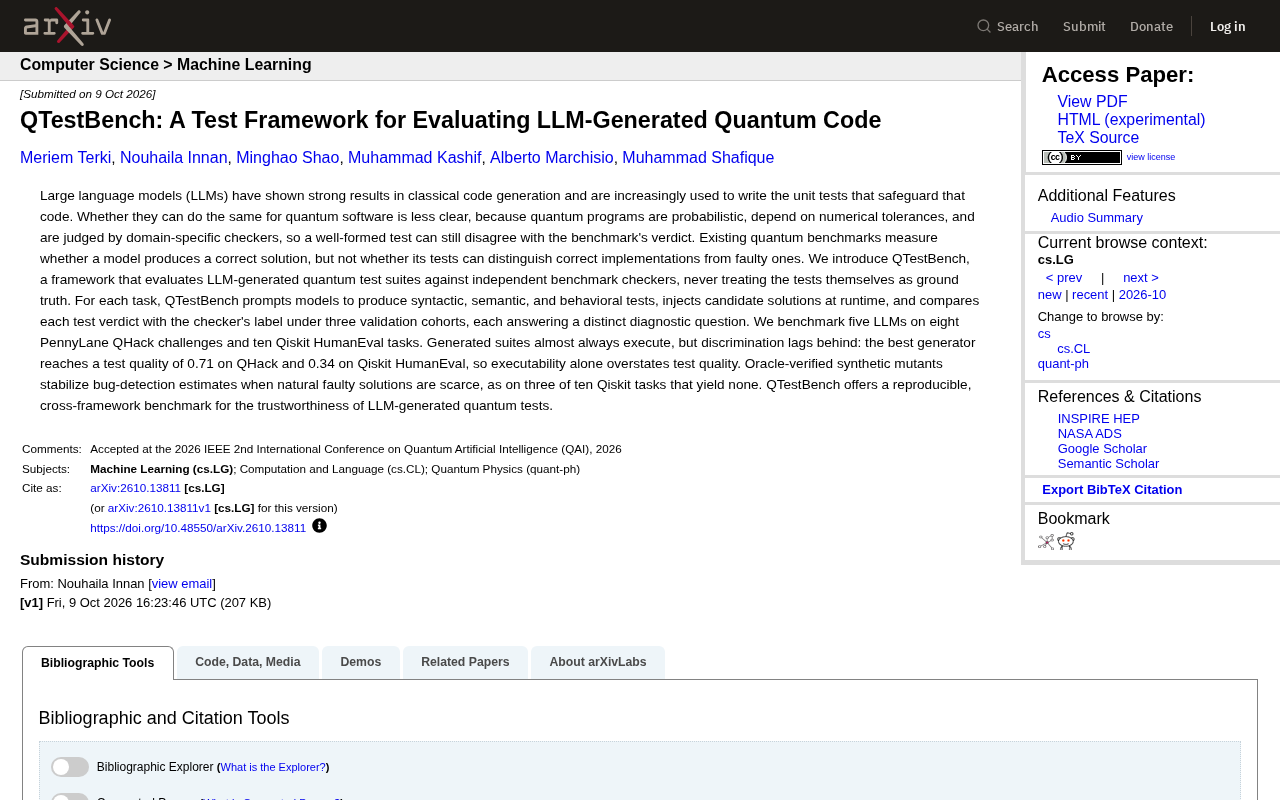
QTestBench is a new framework for evaluating the true quality of LLM-generated quantum tests. Unlike classical code, quantum programs are probabilistic, yet existing benchmarks only measure whether models produce correct solutions — ignoring whether tests can distinguish correct from buggy implementations. Using independent checkers as ground truth, QTestBench generates syntactic, semantic, and behavioral tests and applies layered diagnostics across three validation cohorts. Tests of five LLMs show near-perfect executability but severely lacking discriminative power: the best model scored only 0.71 on QHack and 0.34 on Qiskit HumanEval, confirming that executability alone greatly overstates test quality.
Large language models have already proven their value in classical code generation, and are increasingly being used to write the unit tests that guard that code. But when the context shifts to quantum software, things become far less clear. A new study introduces the QTestBench framework, designed to answer a question that existing benchmarks have overlooked: can LLM-generated quantum tests actually distinguish between correct implementations and buggy ones?
Why Quantum Tests Are Harder to Evaluate Than Classical Tests
Classical code correctness is typically deterministic, but quantum programs are inherently probabilistic, depend on numerical tolerances, and require domain-specific checkers to validate results. This means a syntactically correct, successfully running test can still contradict the verdict of a ground-truth checker.
Most existing quantum benchmarks only measure whether a model can produce a correct solution — they don't answer the more critical question: does the generated test actually have the discriminative power to tell a correct implementation from a flawed one? In other words, a test that runs is not the same as a test that adds value. The research team identified this blind spot and designed an evaluation methodology that does not treat the generated test itself as the ground truth.
The probabilistic nature of quantum programs stems from the fundamental principles of quantum superposition and measurement: even with identical inputs, running the same quantum circuit multiple times yields results that follow a probability distribution rather than a deterministic value. Quantum tests therefore typically require multiple samples, statistical comparison of results, and numerical tolerances to determine whether two probability distributions are "close enough." This is fundamentally different from classical unit tests, which assert that a return value equals a specific constant. Domain-specific checkers — tools based on fidelity, trace distance, or expectation value comparisons — exist precisely to handle this uncertainty, serving as arbiters of "quantum correctness." A test that is syntactically valid and runs without error is therefore no proof that it genuinely verifies quantum behavior — it could simply pass for any input, making it a hollow test with zero discriminative power.
The Core Design of QTestBench
The central idea behind QTestBench is simple: always use an independent ground-truth checker as the source of truth, never the LLM-generated test itself. For each task, the framework prompts the model to generate three categories of tests — syntactic, semantic, and behavioral — covering different dimensions from code form to actual runtime behavior.
The framework then injects candidate solutions at runtime and compares each test's verdict against the checker's labels. This comparison is organized into three validation cohorts, each answering a distinct diagnostic question. This layered design means evaluation goes beyond a single aggregate score — it pinpoints which category of tests a model struggles with most.
Addressing the Scarcity of Buggy Samples with Synthetic Mutants
A practical challenge is that naturally occurring buggy solutions are scarce or entirely absent for some tasks. The research team addresses this gap using Oracle-validated synthetic mutants. Across the ten Qiskit tasks, three produced no naturally occurring incorrect solutions at all — synthetic mutants reliably fill this gap, providing stable estimates of bug-detection capability and making the evaluation results more robust.
The concept of synthetic mutants is borrowed from classical software engineering's mutation testing methodology: predefined small modifications are applied to correct code (e.g., flipping gate operations, substituting rotation angles, removing an instruction) to artificially create "known-buggy" implementation variants, providing controlled counterexamples for test suites. In the quantum setting, Oracle validation is a critical additional step — each mutant must be confirmed by the ground-truth checker to be genuinely incorrect, rather than an equivalent transformation that still produces the correct quantum state. This validation step prevents "false bugs" from contaminating the evaluation data. The core metric of mutation testing — the mutation score — measures what proportion of mutants a test suite can "kill," and this directly feeds into QTestBench's test quality scores.
Benchmark Results Across Five LLMs
The study evaluated five LLMs across two different quantum programming frameworks: eight tasks from PennyLane QHack challenges and ten Qiskit HumanEval tasks.
The results reveal a concerning gap. Generated test suites almost always execute successfully — executability is rarely an issue. But genuine discriminative power lags significantly behind: the best-performing generator achieved a test quality score of only 0.71 on QHack, and just 0.34 on Qiskit HumanEval.
These numbers point to a clear conclusion — relying solely on executability dramatically overestimates true test quality. There is a considerable gap between a test that runs and a test that catches bugs. The stark difference between the two frameworks (0.71 vs. 0.34) also shows that LLM quantum testing capability is inconsistent across different ecosystems and task difficulty levels.
Implications for Quantum Software Engineering
QTestBench provides a reproducible, cross-framework benchmark specifically designed to measure the trustworthiness of LLM-generated quantum tests. Its value lies not in ranking model strength, but in quantifying whether tests can be trusted.
For researchers and engineers exploring AI-assisted quantum program development, this work delivers a clear signal: before incorporating LLM-generated tests into a quality assurance pipeline, their discriminative power must be independently verified — not merely whether they run successfully. As the quantum software ecosystem matures, evaluation methods focused on test trustworthiness like this one may become an indispensable part of the toolchain.
Related articles

Felix Rieseberg Personal Homepage
Felix Rieseberg's personal homepage sparks attention on Hacker News. This article covers the Slack engineer's technical background, the rise and fall of nativefier, and the value of a developer homepage as a tech calling card.

@ai-sdk/vue 3.0.306 Patch Release Syncs with [email protected] Update
@ai-sdk/vue 3.0.306 released, synced with [email protected]. A routine patch release for the Vercel AI SDK ecosystem with no public API changes; the Vue adapter layer stays version-aligned with the core package.

Gemini 4 Argon API Launches: The Era of Million-Token Output Begins
Google launches Gemini 4 Argon with sparse MoE architecture, up to 1M output tokens, and a 68.90% Vals Index score, available across API, AI Studio, and the Gemini app.