QUANTA: Agentic AI Enables Autonomous Measurement of Quantum Materials

QUANTA uses agentic AI plus a deterministic safety layer to achieve closed-loop autonomous measurement for quantum materials characterization.
Quantum materials characterization has long relied on expert experience and tacit knowledge that is hard to transfer systematically. The QUANTA framework, built on the PPMS platform, combines retrieval-augmented scientific literature with dedicated agents for experiment planning, troubleshooting, and data interpretation to form a closed-loop "measure—evaluate—adjust" workflow. Its key design is an independent deterministic control layer that performs hard safety validation on AI-proposed instrument operations, separating intelligent decision-making from auditable safeguards. Validated on TaP transport and Co2MnGa nonlinear response, QUANTA emphasizes generalizability over single-point breakthroughs and shows a path for AI to move from data analysis tool to experimental decision participant, though reliability still needs more practical validation.
The characterization of quantum materials has long relied on expert experience and repeated trial and error, with experimental knowledge difficult to record and transfer. A recent study proposes the Quantum Agent (QUANTA) framework, which attempts to change this situation with agentic AI: it enables AI not only to execute instructions, but also to plan experiments, diagnose problems, and interpret data like an experienced researcher, forming a closed-loop autonomous measurement system.
From "Tool" to "Experimental Partner": The Core Architecture of QUANTA
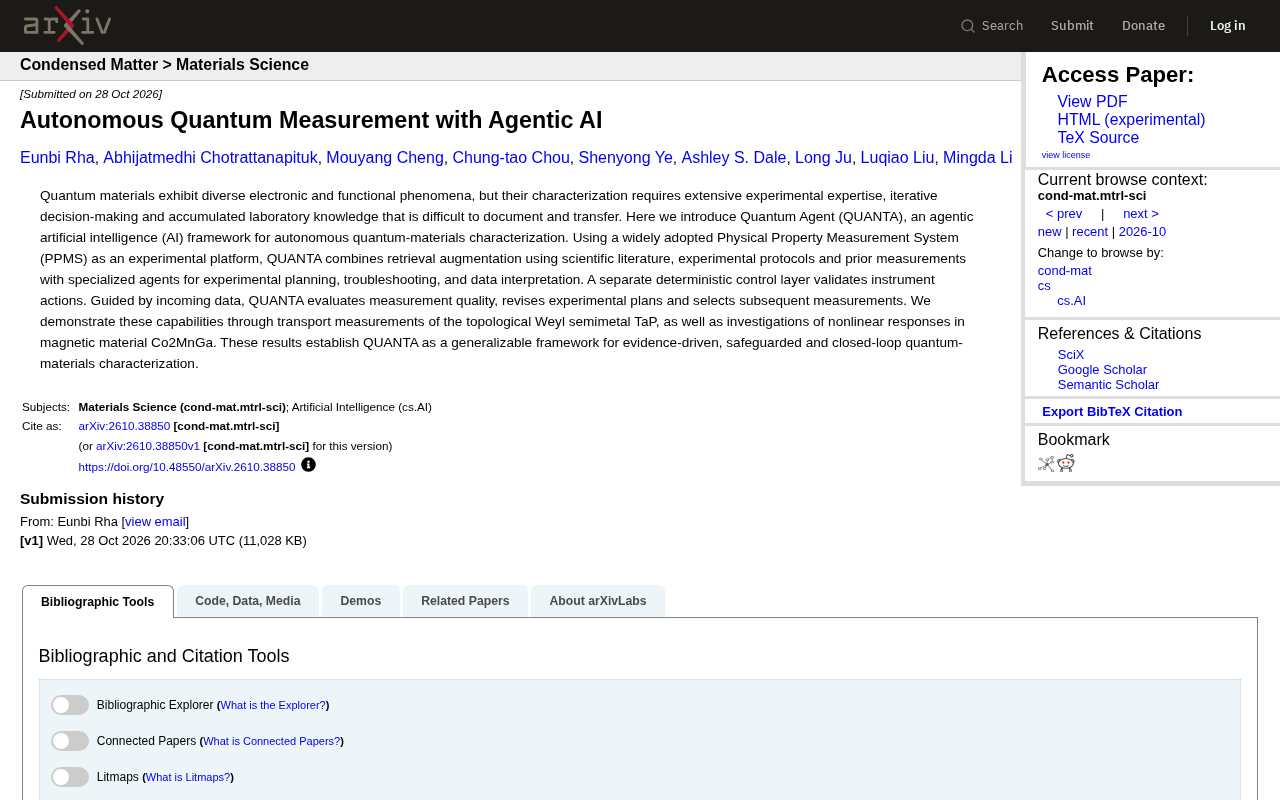
QUANTA is not a simple automation script. It is built on the widely used Physical Property Measurement System (PPMS), integrating scientific literature, experimental protocols, and historical measurement data into the decision-making process through retrieval augmentation. This means that when planning the next measurement, the AI can draw on existing domain knowledge rather than relying solely on preset rules.
The framework has a clear internal division of labor: tasks such as experiment planning, troubleshooting, and data interpretation are handled by dedicated agents that collaborate with one another. More critically, the system includes an independent deterministic control layer specifically designed to verify the legitimacy of instrument actions—any operational suggestion proposed by the AI must pass validation through this layer before it can actually be executed. This two-tier design of "intelligent decision-making + hard safety validation" provides auditable safeguards for autonomous experimentation.
PPMS (Physical Property Measurement System) is a commercial comprehensive physical property measurement platform widely used in quantum materials research. It can automatically measure various physical properties such as electrical transport, magnetic susceptibility, and specific heat under extreme conditions including low temperatures and strong magnetic fields. Its advantages lie in standardized hardware interfaces and pluggable measurement modules, which is why it is often regarded as a "universal foundation" for materials characterization. QUANTA chose to build on PPMS precisely because of the stability of its interfaces and its prevalence in laboratories—AI agents do not need to directly control the raw hardware; instead, they issue measurement commands through the PPMS software layer, which greatly lowers the deployment barrier.
Retrieval-Augmented Generation (RAG) is a technique that combines an external knowledge base with a language model: the system first retrieves relevant passages from literature, protocols, or historical data, then injects these passages as context into the model to guide it toward generating evidence-based decisions. In QUANTA, RAG allows agents to "cite" domain knowledge when planning measurements, rather than acting solely from parameter memory or preset rules, which is particularly critical for the traceability of experimental knowledge.
Closed-Loop Workflow: Dynamic Adjustment Driven by Data
QUANTA's operating logic revolves around a "measure—evaluate—adjust" cycle. The system evaluates measurement quality based on real-time incoming data, determines whether results are credible and whether supplementary measurements are needed, then revises the experimental plan and selects subsequent measurement steps. This process mimics how human experts continuously fine-tune their strategies based on intermediate results during experiments.
This closed-loop capability is not common in traditional automation. Conventional automation platforms typically execute fixed procedures and often require human intervention when encountering anomalous data or equipment state deviations. QUANTA attempts to have the AI take on judgment responsibilities within the loop, delegating the decision of "what to do next" to agents while using the control layer to guard the safety boundary.
The deterministic control layer refers to a software module that validates, item by item, the operational suggestions output by agents using fixed rules (rather than probabilistic models). Unlike relying on large models to "judge," the deterministic control layer is typically implemented with hard-coded safety constraints, instrument range checks, and state machine logic, making its behavior fully predictable and auditable. In autonomous experimental systems, this layer serves as the "final gate": agents can propose bold measurement plans, but only actions that pass deterministic rule filtering are sent to the instrument. This layered design allows the system to retain AI flexibility while keeping irreversible hardware risks within a verifiable range.
Validation on Real Materials: TaP and Co2MnGa
The research team demonstrated QUANTA's capabilities through two specific case studies. The first was transport measurement of the topological Weyl semimetal TaP, and the second was a study of nonlinear response in the magnetic material Co2MnGa. These two systems involve different measurement requirements and physical phenomena, and QUANTA was able to complete measurement planning and execution under data guidance in both cases, adjusting strategies based on results.
According to the original article, QUANTA evaluates data quality and revises experimental plans during the measurement process, reflecting its evidence-driven characteristics. The significance of these cases lies not in any specific material, but in validating the framework's generalizability—when facing different material systems, agents can make adaptive decisions by combining literature knowledge with real-time data.
Weyl semimetals are a class of topological quantum materials whose electronic band structure contains paired "Weyl points"—magnetic-monopole-like structures in momentum space. These nodes give rise to unique transport phenomena such as the chiral anomaly (negative magnetoresistance) and Fermi arc surface states. TaP (tantalum phosphide) is a typical Weyl semimetal, and its transport measurements require systematic data collection under different magnetic field directions and temperatures to isolate Weyl-point-related signals—precisely where QUANTA's closed-loop planning capability comes into play.
Nonlinear response refers to higher-order signals generated by a material under external excitation (such as current or magnetic field) that are not proportional to the excitation, such as second-harmonic voltage or nonlinear Hall response. Co2MnGa is a magnetic Heusler alloy whose nonlinear transport behavior is sensitive to magnetic domain structure and band topology. Measuring such signals typically requires sophisticated excitation configurations and signal extraction schemes and is highly dependent on experimental design, making it well suited for testing whether agents can adjust measurement parameters based on real-time data.
Why "Generalizability" Matters More Than "Single-Point Breakthroughs"
A practical pain point in quantum materials research is that high-level experimental skills are concentrated in a few laboratories and experts, and the tacit knowledge involved in experiments—such as whether an anomalous signal indicates a sample problem or instrument drift—is difficult to systematically record and transfer. QUANTA's approach is to embed this knowledge into the measurement process through retrieval augmentation and agent collaboration, enabling the AI to invoke and accumulate experimental experience in its decisions.
The original article positions QUANTA as "an evidence-driven, safety-guaranteed, closed-loop general framework for quantum materials characterization." The key word in this description is "general." If the framework could only serve a single material or a single measurement type, its value would be limited; only a system that can integrate with general platforms like PPMS and adapt to different experimental needs by swapping knowledge bases and agent configurations has the potential for broad deployment in materials laboratories.
Of course, there is still a gap between demonstration and everyday research tool. Whether agents' judgments of measurement quality are sufficiently reliable, whether the control layer can cover enough anomalous situations, and whether retrieval-augmented generation is effective in highly specialized niche directions—these questions require more practical use to answer. But QUANTA at least demonstrates a clear path: turning AI from an execution tool into a participant in the experimental decision-making chain, while retaining human-verifiable safety constraints.
Implications for AI for Science
QUANTA reflects a shift in the AI for Science field: from "using AI to analyze existing data" to "using AI to participate in the experimental process itself." Tasks such as experiment planning, fault diagnosis, and real-time data interpretation, previously regarded as responsibilities that must be borne by human experts, are now beginning to be systematically addressed by agent frameworks.
The difficulty of this shift lies not in model capability but in reliability design. QUANTA's introduction of an independent control layer to validate instrument actions shows that researchers are well aware of the risks of autonomous systems—AI can propose plans, but final execution must pass through deterministic rule filtering. This architectural approach is also valuable for other autonomous experimental platforms: intelligence and safety can be handled in layers rather than mixed together in a black box.
One-line Summary
QUANTA uses agentic AI plus a deterministic safety layer to achieve closed-loop autonomous measurement for quantum materials characterization.
Paragraph Summary
Quantum materials characterization has long relied on expert experience and tacit knowledge that is difficult to systematically transfer. The QUANTA framework, built on the PPMS experimental platform, combines retrieval-augmented scientific literature with dedicated agents for experiment planning, troubleshooting, and data interpretation to form a closed-loop "measure—evaluate—adjust" workflow. Its key design is an independent deterministic control layer that performs hard safety validation on AI-proposed instrument operations, achieving a separation between intelligent decision-making and auditable safeguards. The study validated the framework's adaptability through two case studies—TaP transport measurement and Co2MnGa nonlinear response—and emphasizes that "generalizability" is more valuable than single-point breakthroughs. QUANTA demonstrates a path for AI to move from a data analysis tool to a participant in experimental decision-making, though its reliability still requires more practical validation.
Related articles

Vibe Coding Full-Stack in Practice: AI Programming from Beginner to Enterprise Deployment
From Cursor to Claude Code, this Bilibili AI programming course uses four progressive projects to cover full-stack development, open-source secondary development, and team collaboration. The article analyzes the shock to frontend roles, the efficiency shift from 50 people to 5, and the methodology required for enterprise-grade projects.

David Blaine's Global Quest for Real Magic: From South Africa to Japan and India
David Blaine travels to South Africa, Japan, and India in his Do Not Attempt special, documenting Spinning drivers, black mamba rescuers, iaijutsu masters, and ascetics—exploring the boundary between magic and real human极限 challenges.

Is a Touchscreen MacBook Coming? Vergecast Reveals Apple Executive's Response
Vergecast podcast reveals a conversation between a reporter and Apple executive John Ternus about a touchscreen MacBook and Apple Pencil support. Ternus says iPad is the best device for a stylus, while the reporter bets MacBook will eventually support Apple Pencil.