Quantile Distributional Reinforcement Learning Achieves Near Minimax Rates: Theoretical Breakthrough and Statistical Accuracy Analysis

The paper establishes non-asymptotic error bounds and local minimax risk for quantile distributional reinforcement learning, revealing the impact of resolution on statistical accuracy.
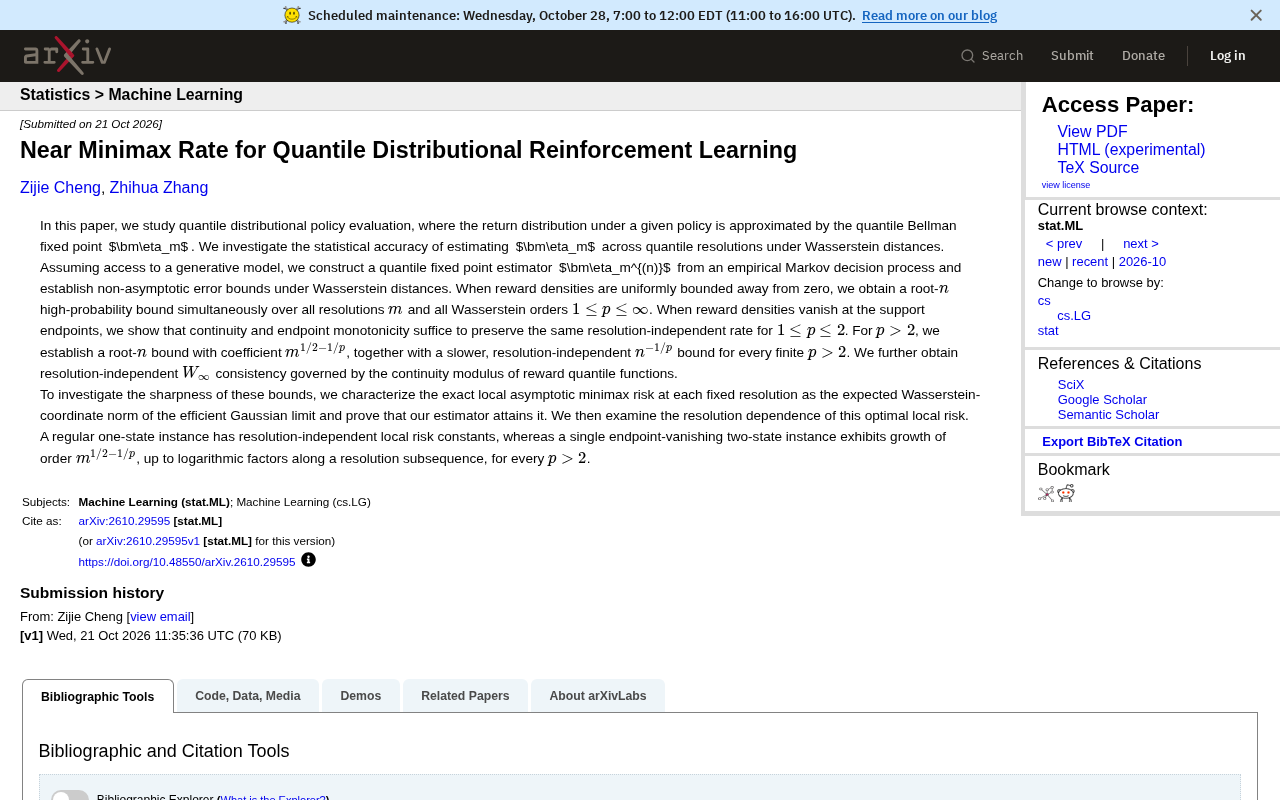
This paper studies the quantile distributional policy evaluation problem, analyzing the statistical accuracy of the quantile Bellman fixed-point estimator under the Wasserstein distance. The authors establish non-asymptotic error bounds: when the reward density is uniformly bounded away from zero, the estimation error converges at the root-n rate, independent of the resolution m and the Wasserstein order p; when the reward density vanishes at the endpoints, for p>2, the rate is affected by a coefficient of m^{1/2-1/p}. Furthermore, the authors characterize the local asymptotic minimax risk, prove that the proposed estimator is optimal, and reveal that in the vanishing-endpoint instance the risk grows with m. These results clarify the fundamental trade-off between resolution and statistical accuracy, providing theoretical guidance for the design of quantile reinforcement learning algorithms.
Research Background and Problem Setup
Distributional Reinforcement Learning (DRL) focuses on return distributions rather than just expected values, and has made significant progress in both theory and methodology in recent years. Among these, quantile methods approximate return distributions using a finite number of quantiles and are favored for their computational efficiency and ease of implementation. However, how much statistical accuracy is lost due to this approximation? How does the quantile resolution m affect estimation error? These questions have not yet been systematically answered.
A recent paper, "Near Minimax Rate for Quantile Distributional Reinforcement Learning," provides an in-depth study of the quantile distributional policy evaluation problem. The authors consider approximating the return distribution using the quantile Bellman fixed point η_m under a given policy, and examine the statistical accuracy of estimating η_m under the Wasserstein distance. The study assumes access to a generative model, enabling the construction of an estimator η_m^(n) from an empirical Markov decision process (MDP).
Distributional Reinforcement Learning (DRL) differs from traditional expected-value reinforcement learning in that it learns the full distribution of returns rather than only their expectation. This idea was first systematized by Bellemare et al. in the C51 algorithm, and subsequent methods such as QR-DQN and IQN belong to this line. The advantage of DRL lies in its ability to capture return uncertainty, providing a basis for risk-sensitive decision-making.
Quantile methods are one approach to implementing DRL: discretizing the return distribution using m quantiles (typically equally spaced in probability). The quantile Bellman fixed point η_m is the Bellman optimal solution under this discrete distribution. A larger resolution m yields a finer approximation but also higher computational cost.
Wasserstein distance is a metric for measuring the difference between two probability distributions, particularly suitable for comparing distributions with different supports or shapes. In DRL, the Wasserstein distance is often used as a contraction metric for distributional Bellman operators. Its order p controls the penalty on tail differences: the larger p is, the more sensitive it is to differences in the distribution tails.
The generative model assumption allows the algorithm to sample next states and rewards at any state-action pair, simplifying theoretical analysis and enabling researchers to focus on statistical estimation error rather than exploration issues.
Non-Asymptotic Error Bounds and Rate Analysis
One of the paper's core contributions is establishing non-asymptotic error bounds for the quantile fixed-point estimator under the Wasserstein distance. When the reward density is uniformly bounded away from zero, the authors obtain a root-n high-probability bound that holds simultaneously for all resolutions m and all Wasserstein orders p (1 ≤ p ≤ ∞). This means that regardless of the quantile resolution chosen, the estimation error converges at the parametric rate n^{-1/2}.
When the reward density vanishes at the support endpoints, the situation becomes more complex. The authors prove that for 1 ≤ p ≤ 2, as long as the reward quantile function satisfies continuity and endpoint monotonicity, the resolution-independent root-n rate is still maintained. However, for p > 2, they establish a root-n bound with a coefficient of m^{1/2-1/p}, while also obtaining a slower but resolution-independent n^{-1/p} bound for each finite p > 2. In addition, they obtain a resolution-independent W_∞ consistency controlled by the modulus of continuity of the reward quantile function.
These results indicate that the statistical accuracy of quantile approximation is sensitive to the Wasserstein order and the characteristics of the reward distribution. In particular, at higher-order distances, the choice of resolution m significantly affects the convergence rate.
Non-asymptotic error bounds refer to high-probability upper bounds on error that hold for any sample size n, rather than describing only the limiting behavior as n→∞. Such bounds typically decay at a rate of n^{-1/2} and explicitly include constant factors such as the confidence level and the size of the state space.
Reward density vanishing at the support endpoints means that the probability density function of the reward distribution tends to zero at the boundaries of its range. For example, in sparse reward settings, rewards are often concentrated near zero, and the density of positive rewards may be zero at the origin. This endpoint behavior affects the accuracy of quantile estimation because quantiles near the endpoints require more samples to estimate stably.
The parametric rate n^{-1/2} is the classical rate in statistical estimation, corresponding to the optimal convergence rate under regular parametric models. When an estimator achieves this rate, it is called "root-n consistent." This paper shows that when the reward density is bounded away from zero, the quantile estimator achieves this rate regardless of resolution.
Local Asymptotic Minimax Risk and Sharpness
To investigate the sharpness of these bounds, the authors characterize the exact local asymptotic minimax risk at each fixed resolution. They prove that this risk equals the expectation of the Wasserstein coordinate norm of the efficient Gaussian limit, and further prove that the proposed estimator attains this risk. This establishes the asymptotic optimality of the estimator.
Subsequently, the authors analyze the dependence of the optimal local risk on the resolution. In a regular single-state instance, the local risk constant is independent of the resolution; in a two-state instance with vanishing endpoints, for each p > 2, the local risk grows at an order of m^{1/2-1/p} (up to logarithmic factors along subsequences of resolutions). This finding reveals an intrinsic limitation of quantile methods under higher-order Wasserstein distances: increasing the resolution m does not indefinitely reduce risk and may instead increase it due to endpoint effects.
Local asymptotic minimax risk is a core concept in statistical decision theory, used to characterize the worst-case asymptotic risk lower bound among all estimators near a point in the parameter space. If an estimator attains this lower bound, it is called asymptotically optimal. This paper uses this framework to prove the optimality of the proposed estimator at fixed resolution.
The efficient Gaussian limit refers to the Gaussian process to which the estimation error, after appropriate scaling, converges as the sample size tends to infinity. Its covariance structure is determined by the score function and Fisher information. In this paper, the expectation of the Wasserstein coordinate norm of this limit is the local minimax risk.
The two-state instance with vanishing endpoints is a simplified model constructed by the authors to reveal the effect of resolution on risk. In this instance, the reward distribution has mass at only two points, and the density vanishes at the endpoints, causing the risk under higher-order Wasserstein distances to grow with the resolution m. This counterexample shows that increasing resolution does not always improve statistical accuracy.
Multi-Source Perspectives and Domain Significance
Although this paper is a single-source theoretical study, its conclusions corroborate other work in the field of distributional reinforcement learning. For example, the C51 algorithm proposed by Bellemare et al. and QR-DQN by Dabney et al. are both based on quantile approximation, and this paper provides rigorous statistical accuracy guarantees for such methods. At the same time, the paper's analysis of the vanishing-endpoint case resonates with recent discussions on the robustness of DRL under heavy-tailed distributions.
From a practical perspective, this research suggests that practitioners need to balance computational cost and statistical accuracy when choosing the quantile resolution. Especially when the reward distribution has vanishing-endpoint characteristics (such as in sparse reward settings), an excessively high resolution may not bring the expected benefits. In addition, the paper's minimax analysis provides a theoretical basis for designing adaptive resolution strategies.
The C51 algorithm, proposed by Bellemare et al. in 2017, was the first algorithm to successfully apply distributional reinforcement learning to Atari games. It approximates the return distribution using 51 fixed support points and updates the distribution through a projection step. The theoretical analysis in this paper provides a statistical basis for resolution selection in C51-type methods.
QR-DQN, proposed by Dabney et al. in 2018, uses quantile regression to learn the quantiles of the return distribution. Unlike C51, QR-DQN directly parameterizes quantiles, avoiding projection error. The quantile fixed-point estimator in this paper can be regarded as the theoretical counterpart of QR-DQN, and its rate analysis explains why QR-DQN performs well in practice.
Robustness of DRL under heavy-tailed distributions is a recent research hotspot. Heavy-tailed reward distributions lead to infinite variance, causing traditional expected-value methods to fail. Quantile methods have a certain robustness because they directly model the distribution, but this paper points out that when the density vanishes at the endpoints, the risk under higher-order Wasserstein distances still grows with resolution, providing a new perspective for robustness analysis.
Conclusion and Outlook
Through rigorous non-asymptotic analysis and local minimax theory, this paper reveals the fundamental relationship between resolution and statistical accuracy in quantile distributional reinforcement learning. The established rates are considered near minimax, laying a theoretical foundation for future research. Future work could explore more general reward distribution assumptions, quantile methods under function approximation, and translating theoretical guidance into practical algorithm design.
One-line Summary
This paper establishes non-asymptotic error bounds and local minimax risk for quantile distributional reinforcement learning, revealing the impact of resolution on statistical accuracy.
Paragraph Summary
This paper studies the quantile distributional policy evaluation problem, analyzing the statistical accuracy of the quantile Bellman fixed-point estimator under the Wasserstein distance. The authors establish non-asymptotic error bounds: when the reward density is uniformly bounded away from zero, the estimation error converges at the root-n rate, independent of the resolution m and the Wasserstein order p; when the reward density vanishes at the endpoints, for p>2, the rate is affected by a coefficient of m^{1/2-1/p}. Furthermore, the authors characterize the local asymptotic minimax risk, prove that the proposed estimator is optimal, and reveal that in the vanishing-endpoint instance the risk grows with m. These results clarify the fundamental trade-off between resolution and statistical accuracy, providing theoretical guidance for the design of quantile reinforcement learning algorithms.
Related articles

Transitioning from Traditional Development to LLM Application Development: Avoiding the Three Hurdles 90% of Courses Don't Teach
Traditional backend developers transitioning to LLM application development face three real hurdles—model capability boundaries, requirement judgment, and effect evaluation—not math. This article breaks down the core engineering skills 90% of courses don't teach and offers a practical transition path.

LLM WIKI in Practice: Making Agents Truly Understand Enterprise Business — Building a Troubleshooting Agent from Scratch
Inaccurate agent responses stem from a lack of business understanding. Based on a real order customer service troubleshooting agent case, this article explains how LLM WIKI builds a business knowledge base from codebases, uses incremental updates, and connects to agents via MCP server to achieve business understanding and troubleshooting with zero documentation.

A Computer Science PhD's Take: AI Career Planning for New Graduates — Algorithm vs. Application Development
A CS PhD advises new graduates on AI careers: try algorithm roles first but don't fixate; application development has more openings. Focus on LLM fine-tuning/deployment and agent frameworks (MetaGPT, LangChain), and watch AI + industry implementation to broaden job paths.