Quantprobe: An Open-Source Tool for Running 30B LLMs on 6GB GPUs

Quantprobe enables 30B LLMs to run at 22 tokens/s on 6GB GPUs via per-layer quantization optimization.
Quantprobe is an open-source memory allocation optimization framework that lets resource-constrained consumer hardware run massive LLMs. Using per-layer quantization layouts, intelligent CPU/GPU weight splitting, and mathematical performance modeling, it nearly doubles inference speed on old GPUs like the GTX 1060, achieving 22 tokens/s for 30B models with just 6GB VRAM and 16GB RAM.
When deploying large language models (LLMs) locally, hardware requirements are often the biggest barrier for ordinary users. Models with tens or hundreds of billions of parameters typically demand high-end GPUs and large amounts of VRAM to run smoothly. However, an open-source project called Quantprobe is challenging this conventional wisdom — it claims to run 30B-class models at 22 tokens/s on an aging machine with just 6GB of VRAM and 16GB of RAM.
What Is Quantprobe
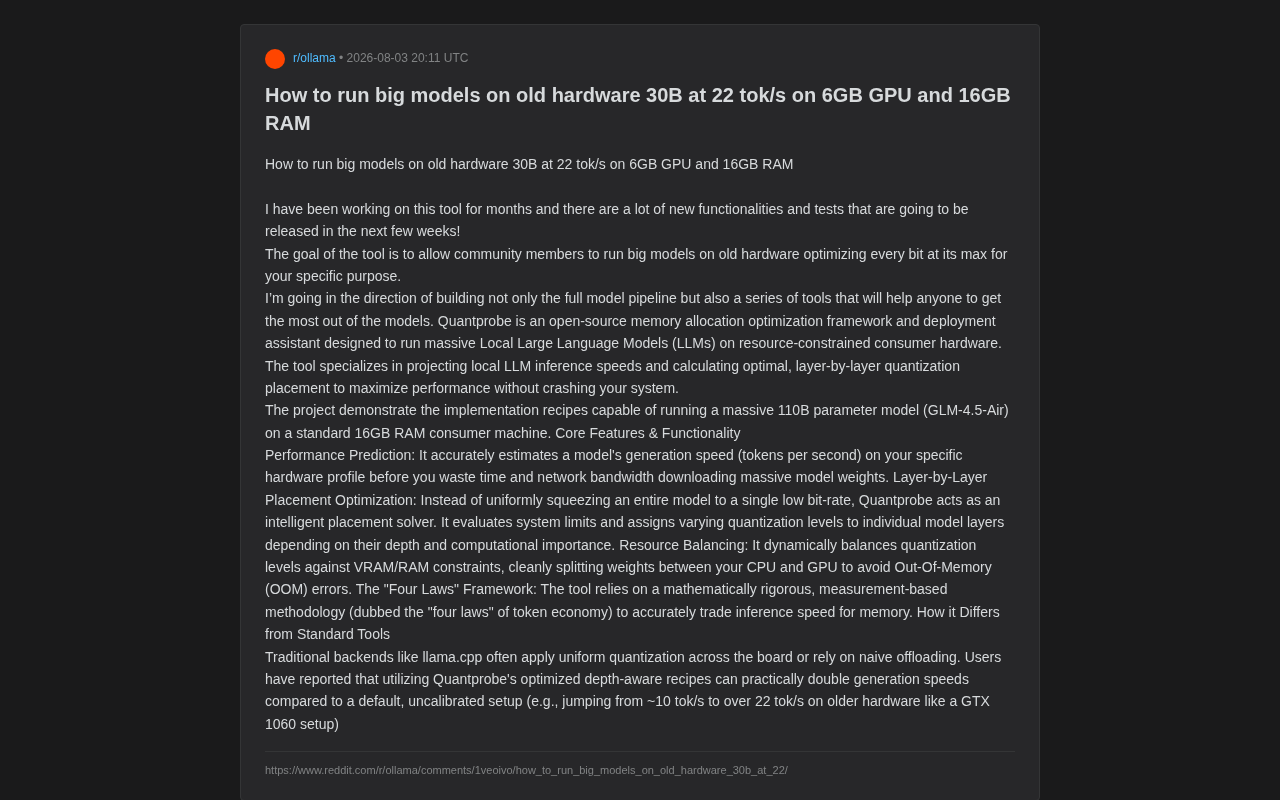
According to the project author's introduction on Reddit, Quantprobe is an open-source memory allocation optimization framework and deployment assistant, specifically designed for running extremely large local LLMs on resource-constrained consumer hardware. Its core value lies in accurately predicting a model's inference speed on specific hardware and calculating the optimal per-layer quantization configuration — all before you actually download the tens of gigabytes of model weights — thereby squeezing maximum performance without crashing your system.
The author revealed that this tool has been in development for months, with a steady stream of new features and test results planned for release over the coming weeks. The ultimate goal is not only to build a complete model execution pipeline but also to create a comprehensive toolkit helping community members make the most of what they have. One of the project's most eye-catching achievements is demonstrating a working implementation of the 110B-parameter GLM-4.5-Air model running on a standard consumer machine with 16GB of RAM.
Core Feature Breakdown
Quantprobe's capabilities can be decomposed into four key components, each directly addressing pain points in local LLM deployment.
Performance Prediction: Do the Math Before You Download
For users with limited bandwidth, downloading tens of gigabytes of model weights only to discover the model can't run is an extremely frustrating experience. Quantprobe can accurately estimate generation speed (tokens/s) based on your specific hardware configuration before any download begins. This means users can perform a "feasibility assessment" first, avoiding wasted time and network bandwidth.
Behind this prediction capability lies precise modeling of the entire inference pipeline — including the computational load (FLOPs) of each model layer, transfer latency of weights between different storage tiers (constrained by PCIe bandwidth and memory bandwidth), and the GPU's actual compute utilization. LLM inference is fundamentally a memory-bound task, especially during the generation phase, where producing each token requires reading through all model weights. Therefore, inference speed is largely determined by data movement speed rather than raw compute power. Precisely modeling these physical bottlenecks is what enables reliable speed estimates without actually running the model.
Per-Layer Quantization Layout Optimization
This is where Quantprobe differs most significantly from conventional approaches. The standard practice is to uniformly compress the entire model to a single low bit-rate, but Quantprobe acts as an intelligent layout solver. It evaluates system constraints and assigns different quantization levels to different layers based on each layer's depth and computational importance.
In other words, the more critical layers in the model retain higher precision, while less important layers can be compressed more aggressively. This "depth-aware" fine-grained strategy achieves a better overall quality-speed balance within the same memory budget.
This approach has solid theoretical support. Different layers in a Transformer model do not contribute equally to final output quality — research shows that shallow layers near the input handle basic vocabulary and grammatical feature extraction, while deep layers near the output handle high-level semantic reasoning and final predictions, making them more sensitive to quantization errors. The numerous middle layers often exhibit high representational redundancy and can withstand more aggressive compression without significantly affecting output quality. Quantization techniques themselves (such as GPTQ, AWQ, and similar methods) can reduce model memory footprint by 4-8x by compressing FP16 weights to INT4 or even lower bit-widths, but uniform quantization ignores inter-layer differences and may introduce unacceptable precision loss at critical layers. Quantprobe's per-layer differentiated strategy is a systematic solution to precisely this problem.
Resource Balancing and Intelligent CPU/GPU Splitting
Quantprobe dynamically balances quantization levels between VRAM and RAM constraints, cleanly splitting model weights between CPU and GPU to avoid the most common OOM (out-of-memory) errors. For users with old GPUs that have minimal VRAM, this intelligent splitting is the key to successful execution.
To understand the importance of this feature, one needs to grasp the mechanics of CPU/GPU hybrid inference. When GPU VRAM cannot accommodate all model weights, the common "layer offloading" strategy stores some Transformer layers' weights in CPU memory, transferring them on demand via the PCIe bus during inference. However, PCIe 3.0 bandwidth is only about 12-16 GB/s, far below GPU VRAM bandwidth (e.g., 192 GB/s for the GTX 1060), meaning every layer offloaded to the CPU significantly slows inference. Furthermore, OOM issues don't only occur during model loading — the dynamically growing KV Cache (which stores attention key-value pairs for previously generated tokens) continuously consumes VRAM during inference and may suddenly trigger crashes during long conversations. Quantprobe's intelligent splitting comprehensively considers model weights, KV Cache growth, and intermediate activation values to produce truly reliable memory planning.
The "Four Laws" Methodology
Quantprobe doesn't rely on guesswork but is built upon a mathematical, measurement-based methodology the author calls the "Four Laws of Token Economy". Through this framework, the tool can precisely make trade-offs between inference speed and memory usage.
This rigorous quantitative modeling approach is what fundamentally distinguishes it from "naive offloading" solutions. Traditional inference frameworks like llama.cpp — currently one of the most popular local LLM inference engines, implemented in pure C/C++ with CPU/GPU hybrid inference support — typically employ one-size-fits-all uniform quantization or rely on simple layer offloading strategies (sequentially placing the first N layers on GPU and the rest on CPU), lacking fine-grained assessment of each layer's actual contribution. This simplistic strategy works acceptably when hardware resources are abundant, but reveals obvious efficiency losses in extremely constrained scenarios like 6GB of VRAM. Quantprobe replaces empirical rules with mathematical modeling, providing a more systematic solution path for this problem.
Real-World Results: Nearly Doubling Inference Speed
According to user feedback cited by the author, using Quantprobe's depth-aware optimization recipe can nearly double generation speed compared to default, uncalibrated settings. A typical example: on aging hardware like the GTX 1060, speed jumped from approximately 10 tokens/s to over 22 tokens/s.
For a GTX 1060 — released in 2016 with just 6GB of VRAM — being able to run a 30B-class model at this speed is indeed a remarkable achievement. For reference, a generation speed of 22 tokens/s is roughly equivalent to outputting 15-20 Chinese characters per second, which already exceeds normal human reading speed and provides a smooth interactive experience. This also demonstrates that hardware barriers are not entirely determined by physical performance — the optimization potential at the software level is often severely underestimated.
It's worth noting that this performance improvement doesn't come from a single trick but from the synergistic effect of per-layer quantization optimization, intelligent layer splitting, and precise memory planning. Each layer is placed on the most appropriate device and runs at the most suitable precision, bringing the overall pipeline close to theoretically optimal efficiency.
Significance and Outlook
The emergence of Quantprobe reflects an increasingly important trend in the local LLM community: democratizing large models so they're no longer an exclusive game for high-end hardware owners. As open-source model quality continues to improve, how to efficiently run them on limited hardware is becoming an independent and valuable technical direction.
From a broader perspective, this trend is closely related to the overall direction of the AI industry. While cloud API calls are convenient, they involve data privacy concerns, network dependencies, and ongoing costs. Local deployment offers users complete data control and offline capabilities. However, the compute gap between consumer hardware and frontier large models continues to widen — frontier models in 2024 have reached tens or even hundreds of billions of parameters, while mainstream consumer GPU VRAM still hovers around 8-12GB. In this context, software optimization solutions like Quantprobe fill a critical ecological niche: enabling ordinary users whose hardware upgrade cycles can't keep pace with model size inflation to participate in the open-source AI wave.
Of course, as a rapidly iterating early-stage open-source project, its claimed performance figures still need more independent testing for verification, especially regarding actual performance across different models and hardware combinations. Additionally, the impact of per-layer differentiated quantization on model output quality requires systematic evaluation — whether models can maintain sufficient reasoning ability and factual accuracy under extreme compression is a question that deserves serious attention. But its core idea — replacing brute-force uniform compression with per-layer quantization layouts and mathematically grounded resource balancing — undoubtedly provides valuable inspiration for the entire field.
For users holding onto aging GPUs who want to experience local LLM deployment, Quantprobe is worth keeping an eye on. It may not turn your GTX 1060 into a 4090, but it can at least help it reach far beyond its expected potential.
Key Takeaways
Related articles

Python 3.15 New Feature: Is the sentinel Type Better Than None?
Python 3.15 adds the sentinel type, using named unique sentinel objects to replace None and bare object(), resolving confusion among missing values, explicit emptiness, and invalid input while avoiding type hint failures.

Deep Learning's Three Architectures and the Universal Approximation Theorem: A Complete Guide to MLPs, CNNs, and Transformers
Explaining the inductive bias differences among MLP, CNN, and Transformer, the existence meaning of the Universal Approximation Theorem (UAT), and the role of Taylor expansion in approximation analysis, while clearing up common misconceptions.

GitLab Emergency Patch Release: Analysis of Critical Security Fixes
GitLab releases critical patch 19.5.1, sparking 355 points of discussion on Hacker News. This article analyzes the background, upgrade steps for self-hosted instances, and verification points to help DevOps teams respond quickly to security updates.