Quantum Machine Learning for Content Recommendation: 1/379 the Parameters of BiLSTM

A quantum recommendation model matches a 17.8M-parameter BiLSTM using only 47k parameters, validated on real quantum hardware.
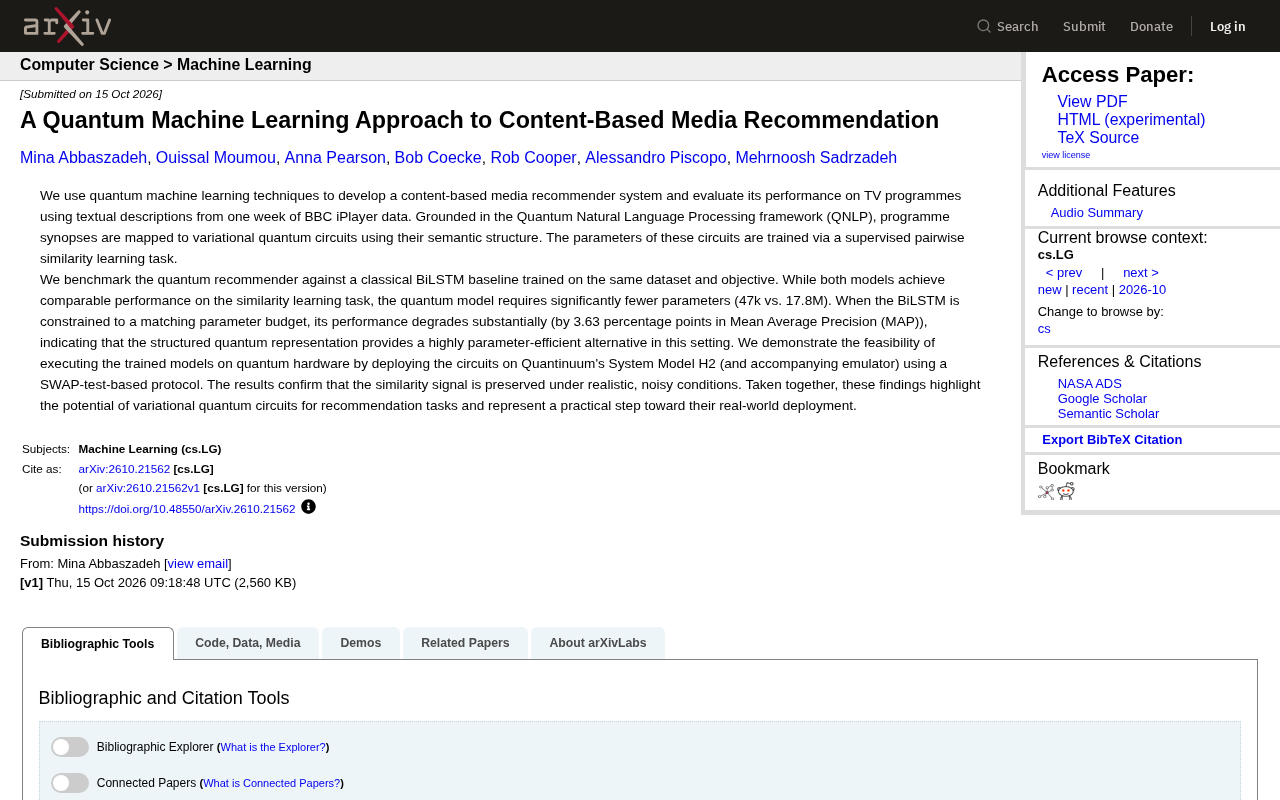
This paper proposes a content recommendation approach based on Quantum Natural Language Processing (QNLP), mapping BBC iPlayer program synopses into variational quantum circuits and training them via pairwise similarity learning. The quantum model achieves comparable performance to a classical BiLSTM with only 47k parameters—about 1/379 of BiLSTM's 17.8M; in a reverse experiment, BiLSTM's MAP dropped 3.63 points under a matched parameter budget. The study also validates on Quantinuum System Model H2 and its simulator using SWAP-test, with similarity signals preserved under noise. The work remains limited to a one-week content-based recommendation scenario, leaving scalability, dynamic content adaptation, and hardware availability open.
One of the core challenges in content recommendation systems is efficiently representing user preferences and content features under limited compute. A recent paper proposes a recommendation approach based on a Quantum Natural Language Processing (QNLP) framework, using variational quantum circuits instead of traditional neural networks to perform program similarity learning, achieving order-of-magnitude compression in parameter count.
Method: Mapping Program Synopses to Quantum Circuits
The research team used one week of program text synopses from BBC iPlayer as the dataset, mapping program synopses to variational quantum circuits through their semantic structure. This process relies on the QNLP framework—the grammatical and semantic relationships of the text are encoded as quantum gate operations, and the syntactic structure directly determines the circuit topology.
The circuit parameters are trained through a supervised pairwise similarity learning task. Simply put, the model must determine whether two program synopses are similar and adjust parameters such as the rotation angles of quantum gates accordingly. This training approach aligns with the contrastive learning ideas commonly used in classical recommendation systems, but the medium shifts from matrix operations to quantum state evolution.
Quantum Natural Language Processing (QNLP) is a class of theoretical frameworks that directly map the grammatical and semantic structure of natural language into quantum circuits, with representative work based on categorical compositional distributional semantics (DisCoCat) proposed by Coecke et al. Under this framework, word semantics are encoded as quantum states, while grammatical rules (such as how noun phrases and verb phrases combine) correspond to quantum gates or tensor contraction operations, so the syntactic tree of a sentence naturally determines the circuit's wiring topology. Unlike the classical pipeline of converting text into word vectors and then feeding them into a neural network, QNLP's representation and computation are one and the same—semantic composition is quantum state evolution. This "structure as circuit" property is precisely the key to why this method can achieve similarity learning with extremely few parameters: the model does not need to learn grammar from scratch, as the grammatical prior is already embedded in the circuit structure.
Performance Comparison: Overwhelming Advantage in Parameter Efficiency
The quantum recommender and a classical BiLSTM baseline were benchmarked on the same dataset and with the same objective function. Both models achieved comparable performance levels on the similarity learning task, but the gap in parameter scale was dramatic: the quantum model requires only 47k parameters, while the BiLSTM requires 17.8M—the former is about 1/379 of the latter.
Even more convincing is the reverse experiment: when the BiLSTM was constrained to a parameter budget matching the quantum model, its performance dropped substantially, with mean average precision (MAP) falling by 3.63 percentage points. This shows that the quantum model's structured representation is not a compromise that performs poorly because it has fewer parameters, but rather offers a highly parameter-efficient alternative path in this scenario.
Variational quantum circuits (VQC) are the most commonly studied model form in recent quantum machine learning: they consist of a series of quantum gates with tunable parameters, which are iteratively updated by a classical optimizer to minimize some loss function. Their trainable parameters typically correspond to the rotation angles of quantum gates (such as the angles of RX, RY, and RZ gates). Because each parameter acts on the entire quantum state, the "expressive capacity" of parameters is often highly shared, which is fundamentally different from the structure of classical neural networks where each weight connects only a small number of neurons. It should be noted that a small parameter count does not automatically mean low inference cost: VQCs on real hardware still require many measurements to estimate expectation values, with each measurement corresponding to one circuit execution. Therefore, the advantage of "parameter efficiency" in the paper is mainly reflected in fewer trainable degrees of freedom and lower overfitting risk, while end-to-end latency and energy advantages still need to be evaluated in combination with specific hardware and batching strategies.
Hardware Validation: Signal Still Preserved Under Noise
The paper did not stop at simulation. The research team deployed the trained circuits onto Quantinuum's System Model H2 quantum computer and its accompanying simulator, using a SWAP-test-based protocol to perform similarity comparisons.
SWAP-test is a classic quantum state comparison method that estimates the degree of overlap between two quantum states through interferometric measurement. Under the noisy conditions of real hardware, the experimental results confirmed that the similarity signal was still preserved. This means the approach is not merely at the level of theoretical feasibility, but has taken a verifiable step toward practical deployment.
SWAP-test is a quantum circuit primitive for estimating the overlap (i.e., the square of the inner product) of two quantum states: using an ancillary qubit and controlled-SWAP gates, it converts the similarity of the two states into an observable interference fringe on the ancillary qubit, and then obtains an estimate through repeated sampling statistics. Compared with first performing quantum state tomography and then computing the inner product classically, SWAP-test requires only one preparation of each pair of quantum states, greatly reducing measurement overhead. However, it faces clear challenges on current noisy intermediate-scale quantum (NISQ) hardware: controlled-SWAP gates have relatively deep circuits, and decoherence and gate errors directly weaken the contrast of the interference fringes, thereby underestimating similarity. The paper's conclusion that "the signal is still preserved under noisy conditions" was obtained precisely by comparing interference visibility on the simulator and real hardware. It indicates that at the circuit scale of this task, noise has not yet completely drowned out the signal, but it also implies that if the circuit scale continues to grow, error mitigation will become unavoidable.
Practical Significance and Limitations
The value of this work lies in demonstrating a technical path different from "larger models, more parameters." When recommendation systems face constraints on latency, energy consumption, or hardware resources, parameter-efficient quantum representations may provide an attractive complementary approach.
However, there is still a gap between one week of BBC iPlayer data and a production-grade recommendation system. The availability of quantum hardware, circuit compilation efficiency, and scalability in the face of a dynamic content library are all unanswered questions. In addition, the current experiment focuses on content-based recommendation and does not involve more complex recommendation paradigms such as collaborative filtering.
This study at least proves one thing: for specific tasks, quantum machine learning does not have to wait for the full arrival of "quantum advantage" before it becomes useful. Parameter efficiency itself is a practical advantage worth noting.
Content-based recommendation and collaborative filtering are the two classic paradigms of recommendation systems. Content-based recommendation uses features such as text and images of the items themselves to calculate similarity between items, and then recommends similar content based on the user's historical interests. Its advantage is that it does not rely on massive user behavior data and remains usable in cold-start scenarios; collaborative filtering relies on the user-item interaction matrix and recommends based on the assumption that "similar users like similar items," typically capturing more fine-grained personalized signals but facing sparsity and cold-start problems. This paper's program synopsis representation based on pairwise similarity learning essentially belongs to the content-based paradigm, so its conclusions cannot be directly extrapolated to collaborative filtering scenarios that require modeling user-item interactions. To extend this method to a full recommendation system, it is still necessary to solve how to encode user behavior sequences within the quantum circuit framework and how to integrate them with classical recall/ranking pipelines.
One-line Summary
A quantum recommendation model achieves similarity learning performance comparable to a 17.8M-parameter BiLSTM with only 47k parameters, validated on real quantum hardware.
Paragraph Summary
This paper proposes a content recommendation approach based on Quantum Natural Language Processing (QNLP), mapping the grammatical and semantic structure of BBC iPlayer program synopses into variational quantum circuits and training circuit parameters through pairwise similarity learning. In comparison with a classical BiLSTM baseline, the quantum model achieves comparable performance with only 47k parameters, about 1/379 of BiLSTM's 17.8M; in a reverse experiment, BiLSTM's MAP dropped by 3.63 percentage points after matching the parameter budget, highlighting the parameter efficiency advantage of quantum structured representations. The study also completed hardware validation on the Quantinuum System Model H2 quantum computer and simulator using a SWAP-test protocol, with similarity signals still preserved under noisy conditions. The authors also note that the work is limited to a content-based recommendation scenario with one week of data, and that scalability, adaptation to dynamic content, and quantum hardware availability remain open questions.
Related articles

Chain of Thought Isn't Just for AI: How Humans Can Use CoT to Improve Thinking Quality
Chain of Thought isn't just a prompt trick for large models. Starting from a Hacker News discussion, this article analyzes why CoT works for human thinking too, breaks down actionable ways to transfer it, and highlights the key differences between human CoT and machine CoT.
Cloudflare Teams Up with OpenAI: Closi…
Cloudflare Teams Up with OpenAI: Closing the Loop from Vulnerability Discovery to Defense with AI
Cloudflare uses OpenAI Daybreak to investigate security vulnerabilities and generate reviewable remediation plans, while developers use Codex to boost coding efficiency and quality.

Orca Multi-Agent Orchestration in Practice: A Guide to Parallel Collaboration with Claude and Codex
Orca is Stable AI's free open-source agent workbench supporting 34 agents like Claude Code and Codex in parallel. Learn its Git worktree isolation, multi-model orchestration, and mobile management.