Quantum Network QoT Estimation: Computation, Simulation, or Learning?

Quantum network control planes must adaptively choose among analytical computation, simulation, and learned surrogate models for QoT estimation.
This article addresses quality-of-transmission (QoT) estimation in the control plane of future quantum networks, where routing, scheduling, entanglement provisioning, and memory allocation depend on timely, reliable estimates of end-to-end fidelity for candidate paths. The authors argue that the optical-network analogy is useful but incomplete, since quantum scenarios involve probabilistic entanglement generation, stochastic memory waiting, decoherence, state consumption, and measurement constraints, making fidelity a stochastic target. They propose a compute/simulate/learn framework: analytical methods for simple, stable cases; simulation when stochastic memory effects dominate; and offline-trained lightweight surrogate models for low-latency online control. The article also reviews multi-source consensus and disagreements and lists open challenges including stochastic targets, sim-to-real transfer, data-generation costs, physics-informed learning, and generalization to full network topologies.
QoT Estimation in Quantum Networks: A Core Control-Plane Problem
The control plane of future quantum networks will need to make decisions about routing, scheduling, entanglement provisioning, purification, and memory allocation. Each decision depends on a timely and reliable estimate of the entanglement quality that candidate paths can provide, with end-to-end fidelity as the core metric. Drawing on the experience of quality-of-transmission (QoT) estimation in optical networks, this article examines when a quantum controller should analytically compute fidelity, when it needs to simulate, and when it should learn a surrogate model.
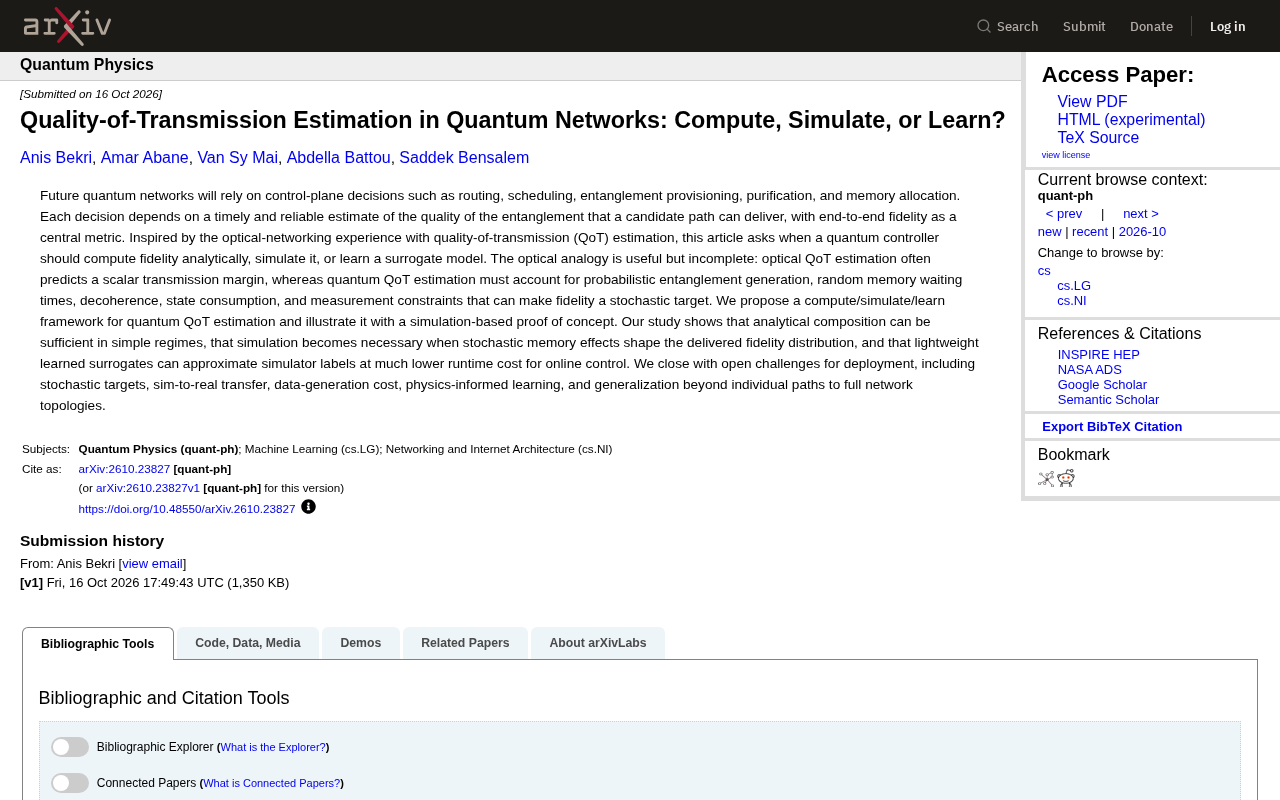
The optical-network analogy is useful but incomplete: optical QoT estimation typically predicts a scalar transmission margin, whereas quantum QoT estimation must account for probabilistic entanglement generation, stochastic memory waiting times, decoherence, state consumption, and measurement constraints—factors that make fidelity a stochastic target.
QoT (quality-of-transmission) estimation originates in classical optical networks, where it refers to predicting the quality metrics (such as signal-to-noise ratio and bit error rate) of a signal after transmission along a candidate path before establishing a connection, thereby avoiding costly trial and error. In quantum networks, this concept is transferred to the entanglement-distribution scenario: the controller must predict the quality of the entangled state that a given path can provide before consuming valuable entanglement resources. The key difference from classical optical networks is that the target of quantum QoT is not a scalar margin but the probability distribution of entanglement fidelity—because entanglement generation, memory waiting, and decoherence are all stochastic. End-to-end fidelity measures how closely the distributed entangled state approaches the ideal maximally entangled state, typically defined via density-matrix overlap, and it is the threshold metric determining whether the state can subsequently be used for tasks such as quantum key distribution and distributed quantum computing.
Decoherence refers to the process by which a quantum state interacts with its environment, causing its coherence (the off-diagonal elements of the density matrix) to decay over time, typically characterized by two timescales: relaxation (T1) and dephasing (T2). In quantum networks, entangled states inevitably undergo decoherence while waiting in memory for routing or purification operations; the longer the waiting time, the lower the fidelity. Entanglement purification, meanwhile, is a protocol that consumes multiple low-quality entangled pairs and, through local operations and classical communication, obtains a smaller number of high-quality entangled pairs; it is itself probabilistic in its success. Quantum memory is used to temporarily store entangled states to address link asynchrony, but its storage time is limited and the waiting is stochastic. Together, these mechanisms mean that quantum QoT estimation must confront a stochastic target: the controller optimizes the distribution or expectation of fidelity rather than a single deterministic value.
Computation, Simulation, and Learning: A Proposed Framework
The authors propose a "compute/simulate/learn" framework and illustrate it through a simulation-based proof of concept. The core of the framework lies in dynamically selecting an estimation strategy according to scenario complexity.
Analytical Computation: An Efficient Choice for Simple Scenarios
In simple scenarios, analytical compositional methods suffice to estimate fidelity. For example, when system parameters are stable and decoherence is negligible, end-to-end fidelity can be computed quickly via analytical formulas. This provides the controller with a low-latency basis for decision-making and is suitable for scenarios with stringent real-time requirements and clear physical models.
However, analytical methods struggle to handle complex factors such as stochastic memory effects. When these effects significantly shape the fidelity distribution, simulation becomes necessary.
Simulation: An Essential Means of Capturing Stochastic Effects
Simulation can characterize stochastic processes such as random memory waiting times and entanglement-generation probabilities, thereby providing a more accurate fidelity distribution. The authors point out that simulation is indispensable when stochastic memory effects shape the delivered fidelity distribution. However, simulation is computationally expensive and may not meet the real-time requirements of online control.
Learned Surrogate Models: A Low-Latency Approach for Online Control
Lightweight learned surrogate models can approximate simulator labels at lower runtime cost, thereby supporting online control. These surrogate models learn the simulator's input–output mapping through offline training and perform fast inference online. This offers a viable path to real-time decision-making, especially in complex network environments.
A surrogate model is a data-driven approximation model used to replace computationally expensive exact simulators or physical simulations. In the framework of this article, the surrogate model is trained offline on large numbers of simulator input–output samples, learning the mapping from network parameters (path length, memory coherence time, entanglement-generation rate, etc.) to the fidelity distribution; online inference then requires only a single forward computation, with latency far lower than running a full stochastic simulation. Physics-informed learning is a class of methods that embed known physical constraints (such as fidelity decreasing monotonically with decoherence and probability normalization) into the model structure or loss function, with the aim of improving extrapolation and generalization when training data are limited. Sim-to-real transfer refers to the performance degradation that occurs when a model trained in a simulator is deployed to a real network due to model mismatch, which needs to be mitigated through calibration with real data or domain adaptation.
Multi-Source Cross-Validation and Consensus
According to analyses from multiple independent sources (including discussions by a Bilibili creator and a YouTube channel), QoT estimation in quantum network control planes does indeed face stochasticity challenges, and learned surrogate models have potential for reducing latency. These sources agree that analytical methods are effective in simple scenarios, but complex scenarios require simulation or learning. The consensus is that no single method applies to all scenarios, and flexible selection based on specific conditions is needed.
However, there is disagreement regarding the generalization ability of learned surrogate models. Some views hold that learned models may struggle to generalize to unseen network topologies; others emphasize that physics-informed learning can improve generalization. The authors of this article also note that generalization to full network topologies is one of the open challenges.
Open Challenges and Future Directions
The paper concludes by identifying open challenges in deployment: stochastic targets, sim-to-real transfer, data-generation costs, physics-informed learning, and generalization from single paths to full network topologies. These challenges require further research to advance the practical deployment of quantum network control planes.
Stochastic targets mean that fidelity is not a deterministic value but a distribution, and the controller must make decisions based on the distribution. Sim-to-real transfer involves the discrepancy between simulators and real environments, which requires calibration. Data-generation cost refers to the large amount of simulation data needed to train learned models, which is expensive. Physics-informed learning can incorporate physical constraints into models to improve generalization. Generalization to full network topologies requires models to handle different network structures.
Conclusion
Quantum QoT estimation is a core problem for the control plane of future quantum networks. The three strategies of computation, simulation, and learning each have their applicable scenarios: simple scenarios can use analytical computation, complex stochastic effects require simulation, and online control can leverage learned surrogate models. Multi-source discussions confirm these views while pointing out open challenges such as generalization. As quantum networks develop, adaptive estimation strategies will become increasingly important.
One-line Summary
Quantum network control planes need to adaptively choose among analytical computation, simulation, and learned surrogate models for QoT estimation depending on the scenario.
Paragraph Summary
This article focuses on the quality-of-transmission (QoT) estimation problem in the control plane of future quantum networks, noting that decisions such as routing, scheduling, entanglement provisioning, and memory allocation all depend on timely and reliable estimation of the end-to-end fidelity of candidate paths. The authors argue that the optical-network QoT estimation analogy is useful but incomplete, because quantum scenarios must handle probabilistic entanglement generation, stochastic memory waiting, decoherence, state consumption, and measurement constraints, making fidelity a stochastic target. They accordingly propose a "compute/simulate/learn" framework: simple, stable scenarios use analytical compositional methods for fast estimation; when stochastic memory effects are significant, simulation is needed to characterize the fidelity distribution; and online control relies on lightweight, offline-trained learned surrogate models to approximate simulator outputs with low latency. The article also summarizes the consensus and disagreements from multi-source discussions and lists open challenges such as stochastic targets, sim-to-real transfer, data-generation costs, physics-informed learning, and generalization to full network topologies.
Related articles

Qwen Image 2.1 Quick Start Guide on Draw Things: The New King of Open-Source Image Models
Qwen Image 2.1 open-source image model lands on Apple's Draw Things, supporting generation, editing, and transparent images. Learn the license, quantization choices, Turbo parameters, prompt tips, and use cases to get started fast.

Indian CA Sets Private Key to 4: HTTPS Trust System Exposes Another Critical Flaw
Indian certificate authority eMudhra set intermediate certificate private keys to simple numbers like 4, allowing easy HTTPS certificate forgery. The flaw went undetected for 18 months; Mozilla took three days to update its trust list, and systems like macOS remain unfixed. This article analyzes the structural flaws and remediation dilemmas of the CA trust system.

iPhone Duo Case Review: A Sliding Kickstand and Awkward Portrait Mode
YouTube reviewer shares iPhone Duo case experience: looks like clearance shoes, sliding design is fun but affects stability, built-in kickstand only supports landscape, awkward in portrait, final score 4/10.