QuotaMint: Handle All Your SaaS Quota and Usage Management with One API

QuotaMint offers a unified API to manage quotas and usage limits, so SaaS and AI teams don't have to rebuild the same system twice.
QuotaMint is a managed service for SaaS, AI, and API product teams that handles the "what can users access and how much can they consume" layer — covering credits, usage limits, plan entitlements, and feature access controls. It's designed to complement Stripe, Paddle, and similar billing systems rather than replace them. Key engineering features include Test/Live environments, idempotent usage tracking, atomic credit deduction, and full usage history — precisely the areas where self-built distributed systems most commonly fail. With AI products increasingly adopting per-token and credit-based billing, there's a clear market rationale for dedicated quota management infrastructure. The product is in its early stages on Product Hunt, and its reliability as a critical-path third-party service will need to be proven over time.
For any team building SaaS, AI, or API products, there's a recurring piece of technical debt that's hard to avoid: managing user credits, usage limits, plan entitlements, and feature access controls. These requirements seem straightforward at first, but in practice they tend to sprawl into a complex system scattered across multiple services that becomes increasingly painful to maintain. QuotaMint, a developer tool that recently launched on Product Hunt, targets exactly this pain point with a simple pitch — "Stop rebuilding quota and rate limiting systems from scratch."
What Problem QuotaMint Is Solving
Beyond billing, products need to answer a whole set of questions about what users can access and how much they can consume: Is this feature available on the user's current plan? Have they exceeded their API call limit for the month? How do we ensure concurrency safety when deducting credits? Developers typically write this logic by hand in their own backends, and as the number of plan tiers and billing dimensions grows, the complexity compounds quickly.
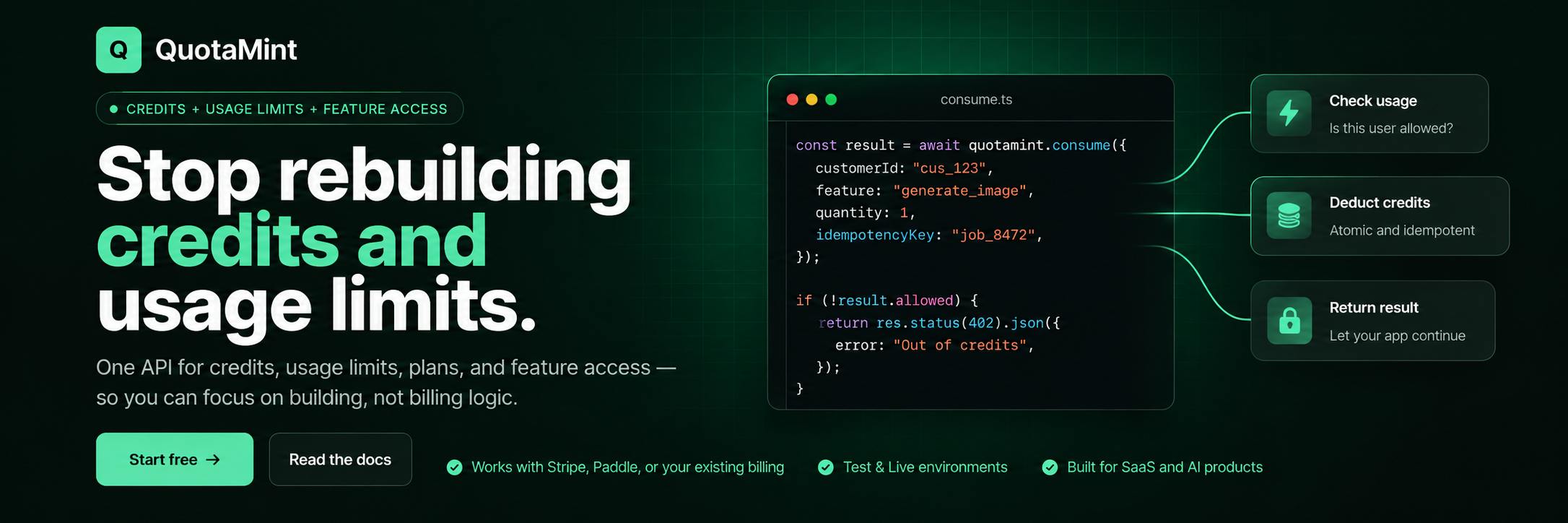
QuotaMint's approach is to extract this layer out of business logic entirely and host credits, usage limits, plans, feature access, and usage tracking behind a single unified API. Rather than building a quota system from scratch for every new product, developers simply call its endpoints to check entitlements and record consumption.
Division of Responsibility with Existing Billing Systems
One of QuotaMint's key design choices is that it doesn't touch payments. It explicitly positions itself as a complement to Stripe, Paddle, Dodo Payments, or whatever billing solution a team already uses — not a replacement. In other words, payment processing, subscriptions, and invoicing remain under the control of the existing billing system; QuotaMint only handles the question of "what can a user access and how much can they consume."
This division lowers the cost of adoption. Teams don't need to overhaul their entire billing stack to add quota management — they just plug QuotaMint in at the entitlement-check and usage-deduction points. For products that already have a mature billing workflow on Stripe, this "layered on top, not swapped out" model is much easier to accept.
Engineering Details Worth Noting
From the official description, QuotaMint has thought through several engineering concerns that are easy to overlook but genuinely important:
- Test and Live environments: Developers can validate quota logic in a test environment before switching to production, avoiding mistakes on real users.
- Idempotent usage tracking: In scenarios involving network retries or duplicate message delivery, reporting the same usage event multiple times won't result in duplicate counts — which is critical for billing accuracy.
- Atomic credit deduction: Under high concurrency, credit deductions are guaranteed to be free of over-deduction or race conditions.
- Clear usage history: Provides traceable records for reconciliation, auditing, and user-facing queries.
These are precisely the areas where self-built systems most commonly run into trouble. Idempotency and atomicity may sound like basic engineering requirements, but reliably implementing them in real distributed environments is far from trivial. Offering them as default capabilities of a managed service is QuotaMint's direct answer to the hidden cost of developer time.
Idempotency is a core concept in distributed systems — it means that performing the same operation once or multiple times produces identical results. In usage tracking, when a network timeout causes a client to retry a request, a service without idempotent handling may count the same API call twice. Idempotency is typically implemented via an "idempotency key": the client generates a unique ID for each operation, and the server checks whether that ID has already been processed before executing — if so, it returns the cached result without re-executing. Atomicity comes from database transaction theory and means a set of operations either all succeed or all roll back, with no intermediate states. In high-concurrency credit deduction, without atomicity guarantees, two requests could simultaneously read a balance of 1, both conclude that deduction is allowed, and both write back — leaving the balance at -1. At the database level this is typically solved with row-level locks or CAS (Compare-And-Swap) operations; in distributed environments it requires Redis atomic commands or distributed locks.
New Demands Driven by AI Products
It's worth noting that QuotaMint explicitly targets AI products as a primary user segment. As a growing number of applications adopt per-token, per-call, or credit-based billing models, "usage" itself has become a core business variable. AI product consumption tends to be highly variable and fine-grained, placing greater demands on the real-time accuracy of usage tracking — demands that traditional monthly subscription models simply can't meet.
In this context, a dedicated middleware layer for quota and usage management becomes more valuable as usage-based billing grows in adoption. QuotaMint is positioning itself precisely around this trend: as more products shift from flat subscriptions toward elastic, consumption-driven billing, there's a clear market for standardized quota management infrastructure.
Usage-Based Billing (UBB) is an alternative to fixed subscriptions where users pay for what they actually consume — classic examples include AWS charging by compute time and OpenAI charging by token count. The rise of UBB is closely tied to the cost structure of AI services: the compute cost of a single large language model inference varies enormously depending on input/output token counts, making it impossible to accurately reflect the cost-to-revenue relationship with a flat monthly fee. For product teams, UBB means that metering infrastructure becomes just as important as the payment system — you need to track every unit of consumption in real time and with accuracy to generate correct invoices. Tools like Stripe Billing, Orb, and Metronome have staked out positions in the UBB billing layer, while QuotaMint's focus on the quota and entitlement layer sits between "business logic" and "billing system" — filling the gap upstream in that chain.
An Honest Assessment
QuotaMint's numbers on Product Hunt are still early-stage (8 upvotes, 1 comment, ranked 9th on launch day), so it's too soon to talk about market validation. Its positioning is clear and its entry point is practical, addressing a genuine and recurring developer pain point.
That said, as a managed service, there are a few real-world factors to weigh. Quota and entitlement checks sit on the critical path of a product, which means adopting a third-party service introduces a dependency on its availability and latency. At the same time, the accuracy of usage data is directly tied to revenue, so teams evaluating this space will scrutinize reliability and consistency guarantees closely. These questions can only be answered through actual use and a longer track record. For teams that don't want to keep reinvesting in quota systems and need to ship quickly, QuotaMint is an option worth evaluating.
Related articles

Felix Rieseberg Personal Homepage
Felix Rieseberg's personal homepage sparks attention on Hacker News. This article covers the Slack engineer's technical background, the rise and fall of nativefier, and the value of a developer homepage as a tech calling card.

@ai-sdk/vue 3.0.306 Patch Release Syncs with [email protected] Update
@ai-sdk/vue 3.0.306 released, synced with [email protected]. A routine patch release for the Vercel AI SDK ecosystem with no public API changes; the Vue adapter layer stays version-aligned with the core package.

Gemini 4 Argon API Launches: The Era of Million-Token Output Begins
Google launches Gemini 4 Argon with sparse MoE architecture, up to 1M output tokens, and a 68.90% Vals Index score, available across API, AI Studio, and the Gemini app.