Qwen 3.6 27B Advanced Playbook: 10 Overlooked Practical Techniques

A Reddit user summarizes ten hands-on Qwen 3.6 27B techniques, from building tools to constructing your own Agent system.
A Reddit user starting from scratch shared a hands-on list for Qwen 3.6 27B based on llama.cpp. The core idea is treating the model as a universal toolsmith: first have it generate personal apps and clone a Chat UI, then build genuinely productive capabilities around ReAct loops, MCP tools, and sub-agents. The author emphasizes that sub-agents can be assigned independent contexts to multiply capacity, and uses llama.cpp's cache-idle-slots so multi-Agent pipelines each hold independent KV cache. He also covers building a pipeline runner, a model launcher with aliases and Jinja templates, temporal awareness metadata injection, session-summary memory, and recommends building your own harness to understand how systems operate. The whole list forms a bottom-up capability-building roadmap: first be able to build tools, then let tools collaborate in loops, and ultimately string model management, awareness, and memory into a working system of your own.
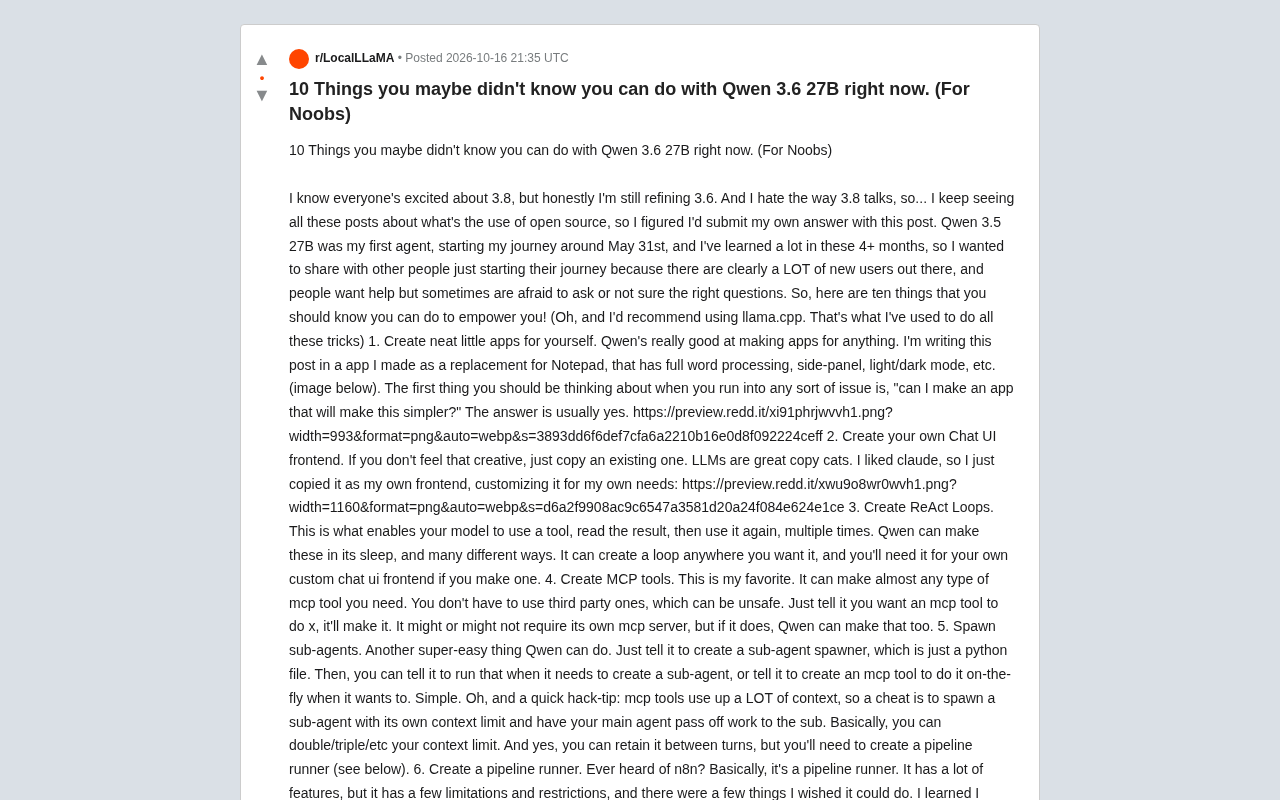
The real value of open-source large models often isn't in benchmarks, but in what you can build with them. A Reddit user who started from scratch (self-described as four-plus months into the hobby, with a first Agent built on Qwen 3.5 27B) shared a hands-on list for beginners on Qwen 3.6 27B, all based on the llama.cpp environment. He admits he's still polishing 3.6 and doesn't like the new version's speaking style, so he organized his hard-won lessons into ten reusable techniques.
Starting with "Reinventing the Wheel": Treating the Model as a Universal Toolsmith
The author's core approach is straightforward: whenever you hit a problem, first ask "can I write an App to simplify this?" and the answer is usually yes. He used Qwen to generate a notepad replacement app with full word processing, a sidebar, and light/dark theme switching—this very post was written in that app. He even copied Claude's interface style directly to customize a Chat UI frontend for himself, because large models are naturally good at imitation.
This "build-your-own-tools" path dramatically lowers the barrier: no need to be a frontend engineer, just describe your requirements clearly.
Making Agents Actually Useful: Loops, Tools, and Sub-agents
The ReAct loop is the foundation of tool-calling capability—the model uses a tool once, reads the result, uses it again, repeating across multiple rounds. The author says Qwen generates these loops almost "with its eyes closed," and the placement and form can be fully customized. On top of that, MCP tools are his favorite part: instead of relying on third-party prebuilt tools that may carry security risks, you can simply tell the model what functionality you want and it generates the corresponding MCP tool—and if needed, writes the accompanying MCP Server too.
Sub-agents are another easily implemented capability: just have Qwen generate a Python sub-agent generator. The author shares a practical tip—MCP tools are extremely context-hungry, so you can assign sub-agents their own separate context, letting the main Agent hand off tasks, effectively doubling or even multiplying your context window. If you want to preserve context across multiple rounds, you'll need a pipeline runner to support that.
ReAct loop (Reasoning + Acting) was first proposed by Google and Princeton University in a 2022 paper. The core idea is to alternate between "reasoning" and "executing actions": the model first outputs a thought (Thought), then decides which tool to call and with what parameters (Action), and after receiving the result (Observation) continues to the next round of reasoning. Unlike the earlier CoT (Chain of Thought) approach where the model generates a complete chain of reasoning in one shot, ReAct allows the model to dynamically adjust its strategy based on real-world feedback, which is why it became the underlying paradigm for virtually all Agent frameworks (LangChain, AutoGPT, Claude Tool Use, etc.).
MCP (Model Context Protocol) is a protocol standard open-sourced by Anthropic in late 2024 to unify how large models communicate with external tools and data sources. Think of it as "AI's USB-C port": as long as a tool implements the Server side according to the MCP spec, any model or client supporting the protocol can call it directly, without writing a separate adapter layer for each tool. It standardizes three capabilities—tool schemas, resources, and prompt templates—which is exactly the precondition for the author being able to "have the model generate MCP tools itself": the generated code only needs to follow the public protocol to be reusable.
Workflow and Model Management: Outsourcing Repetitive Work to the System
Inspired by n8n, the author built his own pipeline runner with Qwen. Compared to n8n, it's freer with fewer restrictions. One key reminder from him: if you chain multiple Agents in a pipeline and want each to have its own independent context, you must enable cache-idle-slots in llama.cpp, so that each round swaps KV cache, evicting the previous cache to CPU memory.
The model launcher is his "signature tool": you can select any model from a directory and set parameters, save it as an alias when satisfied, and next time just pick the alias to launch it with the parameters. The same model can have multiple parameter configurations, each with its own alias. He also recommends incorporating Jinja templates into the launcher, choosing different templates for different model types.
KV cache is a key optimization in Transformer inference: self-attention computation requires the Key and Value vectors of all previous tokens. If you recompute the entire history for every new token generated, the cost grows quadratically with context length. KV cache stores the already-computed K and V for reuse, so each step only needs to compute the new token. The cache-idle-slots setting in llama.cpp is a scheduling switch built around this mechanism: during multi-slot concurrent inference, idle slots' KV cache can be evicted to CPU memory and swapped back when needed, thereby preserving each Agent's independent, non-interfering context while keeping VRAM usage within acceptable bounds.
Jinja templates here refer to chat templates: different models (Qwen, Llama, Mistral, etc.) mark system/user/assistant roles differently, and Jinja2 templates abstract these formats into configurable text rendering rules. llama.cpp reads the template to assemble conversation history into the input string the model expects, so preparing the right template for each model is more reliable than relying on built-in defaults.
Automation and "Meta-capabilities": Installation, Awareness, Memory, and Building Your Own Skeleton
Item 8 demonstrates the boundaries of automation outsourcing: having an Agent download and install llama.cpp, modify the build, and fork a GitHub repo are all within reach. The author gives an example: while busy with a project, he simply had the Agent download and install two TTS apps, Moss and OmniVoice, generate audio clips to verify they work, and everything completed smoothly.
Temporal Awareness is an underrated piece. By injecting metadata—date, time, current context length, max context, hardware/software stack, etc.—at the start of a session and each round, you unlock many more possibilities. The author used this to implement a capability: when the main model approaches its context limit, the Agent can automatically switch to a backup model with larger context, all without restarting the service.
On memory, his Agent writes a session summary at the end of each session; the launcher then concatenates the most recent summary into the context at startup, giving a snapshot of recent events. This can be extended to load reminders, self-reflections, or any document. However, the author specifically notes he no longer recommends loading "self-reflections," because it pollutes the context.
The Bonus item carries the most weight: building your own harness. Faced with existing solutions like pi and hermes, he chose to build his own with Qwen. It's more work but higher reward—you'll truly understand how these systems operate, which spawns unique solutions. For example, after learning about the proxy concept, he developed a series of techniques including context compression, history modification, content cleaning, Jinja template transformation, and hooks.
Harness refers to the entire set of code wrapped around the model that drives its operation—including the conversation loop, tool-call parsing, context assembly, error retry, state persistence, etc. The model itself is just a stateless next-token predictor; what makes it "run like an Agent" is the harness. Open-source solutions like pi and hermes provide out-of-the-box implementations, but they also fix the way things work; building your own harness means you have full control over when to compress context, how to inject metadata, how to fall back on tool errors, and other details—at the cost of handling a lot of edge cases yourself. What the author calls "spawning unique solutions" is essentially because understanding every layer of the harness enables you to insert custom logic like content cleaning, history rewriting, and hooks at the proxy layer.
The Underlying Logic Beginners Should Remember
The entire list really points to one piece of advice: learn from the bottom up, and you'll level up faster; also, get Qwen connected to online tools early, so it can do its own research and solve problems. The author emphasizes these techniques are just a portion of what he's figured out, with more to come. He also states at the end that this post was 100% human-written (he says he's been active in forums/DeviantArt communities for over twenty years and is used to writing bold formatting with Ctrl+B/I/U), and attached "evidence," because structured long-form posts like this are often misjudged as AI-generated.
For users new to open-source models, these ten aren't isolated tips but a bottom-up capability-building roadmap: first be able to build tools, then let tools collaborate in loops, and finally string model management, awareness, and memory into a working system of your own.
(Compiled from a share by Reddit user Grunge)
One-line Summary
A Reddit user summarizes ten hands-on techniques for Qwen 3.6 27B, from building tools to constructing your own Agent system.
Paragraph Summary
A Reddit user starting from scratch shared a hands-on list for Qwen 3.6 27B based on llama.cpp. The core idea is treating the model as a universal toolsmith: first have it generate personal apps and clone a Chat UI, then build genuinely productive capabilities around ReAct loops, MCP tools, and sub-agents. The author emphasizes that sub-agents can be assigned independent contexts to multiply capacity, and uses llama.cpp's cache-idle-slots so multi-Agent pipelines each hold independent KV cache. He also covers building a pipeline runner, a model launcher with aliases and Jinja templates, temporal awareness metadata injection, session-summary memory, and recommends building your own harness to understand how systems operate. The whole list forms a bottom-up capability-building roadmap: first be able to build tools, then let tools collaborate in loops, and ultimately string model management, awareness, and memory into a working system of your own.
Related articles

Chain of Thought Isn't Just for AI: How Humans Can Use CoT to Improve Thinking Quality
Chain of Thought isn't just a prompt trick for large models. Starting from a Hacker News discussion, this article analyzes why CoT works for human thinking too, breaks down actionable ways to transfer it, and highlights the key differences between human CoT and machine CoT.
Cloudflare Teams Up with OpenAI: Closi…
Cloudflare Teams Up with OpenAI: Closing the Loop from Vulnerability Discovery to Defense with AI
Cloudflare uses OpenAI Daybreak to investigate security vulnerabilities and generate reviewable remediation plans, while developers use Codex to boost coding efficiency and quality.

Orca Multi-Agent Orchestration in Practice: A Guide to Parallel Collaboration with Claude and Codex
Orca is Stable AI's free open-source agent workbench supporting 34 agents like Claude Code and Codex in parallel. Learn its Git worktree isolation, multi-model orchestration, and mobile management.