Qwen 3.8 27B Hands-On: Running a Long-Horizon Coding Agent on a Single GPU

Qwen 3.8 27B delivers frontier-level coding agent capabilities on a single consumer GPU for the first time.
Alibaba's newly open-sourced Qwen 3.8 27B model achieves remarkable long-horizon coding agent capabilities on a single 24GB GPU with 4-bit quantization. Benchmarks show it surpassing Claude Opus on SWE-bench Pro despite being a fraction of the size. Deployed via SGLang to avoid vLLM bugs, it achieves 40-50 tokens/s with FP8 precision. While deep thinking mode leads to excessive reasoning time, its ability to autonomously execute multi-step tasks with self-correction marks a breakthrough for personally deployable AI agents.
Running Frontier Agent Capabilities on a Single GPU
On the afternoon of August 14, Alibaba officially open-sourced the Qwen 3.8 27B model weights. The creator completed local deployment and conducted systematic testing that very evening. The reason this release attracted intense attention from the HuggingFace community boils down to one thing: this is the first time a single consumer-grade GPU can run an open-source model with long-horizon coding capabilities.
Architecturally, this generation didn't start from scratch. It's still built on the Qwen 3.5 architecture—a 27.8B dense model supporting multimodal inputs (native image and video), native 262K context length, and fitting into a 24GB GPU with 4-bit quantization. The term "dense model" deserves further explanation: unlike the currently popular MoE (Mixture of Experts) architecture, a dense model means all 27.8B parameters participate in computation during every inference pass. MoE architectures (like DeepSeekAd-V3's 671B parameters) have massive total parameter counts but only activate a subset of expert networks per inference (e.g., 37B), so actual computational cost is far lower than what the total parameter count suggests. Dense models offer simpler inference logic, lower deployment barriers, and no expert routing load-balancing issues. The downside is limited scalability—improving capability requires increasing all parameters, with computational cost growing linearly. Qwen's choice to refine the 27B dense architecture rather than switching to MoE was primarily motivated by deployment friendliness on consumer hardware.
The team explicitly stated that only two things were done this time: Continue Pre-Training and Post-Training (including SFT and RL)—the architecture is identical to 3.5, with model weights carried over directly. Specifically, continue pre-training involves further unsupervised learning on top of the existing pretrained model using new or higher-quality corpora, aiming to supplement knowledge and strengthen specific domain capabilities while avoiding catastrophic forgetting. Post-training includes two phases: SFT (Supervised Fine-Tuning) uses human-annotated instruction-response pairs to teach the model to follow instructions; RL (Reinforcement Learning, typically using algorithms like RLHF or GRPO) further optimizes output quality through reward signals, with particularly notable effects on reasoning chain coherence and tool-calling accuracy. This "same architecture, better training" paradigm demonstrates that as model architectures mature, data recipes and training strategies have become the key levers for capability improvement.
In other words, the Qwen team didn't rely on scaling up parameters—they relied on training strategy optimization to push a 27B-class small model's Agent and long-horizon chain capabilities to unprecedented heights.
Benchmarks: Approaching or Even Surpassing Claude Opus on Multiple Metrics
Compared to the previous generation 3.6 27B, official evaluation data shows scores improving across nearly all benchmarks—not just isolated data points, with comprehensive gains across SWE-Deep, Qwen's own SWE-bench, Terminal-bench, and more.
It's worth explaining what the SWE-bench series of benchmarks measures. SWE-bench (Software Engineering Benchmark) was released by Princeton University in 2023. It extracts issues and corresponding pull requests from real GitHub repositories, requiring models to automatically generate code patches to fix problems given an issue description. This isn't simple code completion—it requires understanding project structure, locating problem files, and generating cross-file modifications—making it one of the most authoritative benchmarks for measuring a model's "software engineering capability." SWE-bench Pro is its advanced version with higher difficulty, involving more complex multi-step reasoning and code modifications.
The most eye-catching result: on SWE-bench Pro, the 27B model's score surpasses Claude Opus. Keep in mind that Claude Opus is estimated to have over 1T parameters, and we're comparing it against a 27B model—this achievement alone is remarkable, meaning that on specific software engineering tasks, clever training strategies can compensate for enormous parameter count gaps.

Of course, we should be rational: the surpassing is only on individual data points, and the gaps aren't astronomical. On GPQA Q&A and collaboration-type evaluations, the 27B is very close to Opus 4.6; Humor scores improved noticeably (rising to 30.8 from previous versions); LiveCode even exceeded 3.7 Plus. But limited by model capacity, some benchmarks still fall short of 3.7.
The real significance isn't about who it surpasses, but that "this tier of capability can run on a single card"—meaning ordinary people now have, for the first time, a local model that can assist with long-horizon programming.
Deployment Testing: VRAM Usage and Inference Framework Pitfalls
The creator shared highly practical deployment experience. 4-bit quantization fits into a 24GB GPU; he personally used FP8 precision deployed on a 48GB GPU, running 4 concurrent requests, with total usage around 46GB including various overheads—essentially approaching the 48GB limit.
The choice of quantization precision is worth understanding in depth: original models are typically stored in FP16 (16-bit floating point) or BF16, with each parameter occupying 2 bytes—a 27.8B model requires approximately 55.6GB of VRAM. 4-bit quantization compresses each parameter to 0.5 bytes, theoretically requiring only ~13.9GB; adding KV Cache and runtime overhead, a 24GB GPU can just barely fit it. FP8 (8-bit floating point) is a natively supported format introduced by NVIDIA in the Hopper architecture (H100) and Ada Lovelace architecture (RTX 4090/5090), with much less precision loss than 4-bit but approximately half the VRAM usage of FP16 (~27.8GB), thus requiring a 48GB-class GPU. Choosing FP8 over 4-bit represents a balance point tilted more toward quality between precision and resources.
For comparison, Kimi's full weights occupy 1.56TB, and even DeepSeek's lower-tier Flash version requires 200-300B parameters—27B's resource footprint is remarkably modest.
Regarding inference framework selection, there's an important pitfall to note. The two most mainstream open-source LLM inference serving frameworks are vLLM and SGLang. vLLM was developed by the UC Berkeley team, with its core innovation being PagedAttention—borrowing the concept of virtual memory paging from operating systems to manage KV Cache, dramatically reducing VRAM fragmentation and waste. SGLang also comes from Berkeley but has different priorities: it introduces RadixAttention for more efficient prefix sharing and cache management, with more aggressive scheduling strategies better optimized for Agent-type workloads (frequent tool calls, long contexts, multi-turn dialogues).
Specifically for this deployment:
- vLLM has a bug: Prefix prefill and MTP (Multi-Token Prediction, set to 3) cannot coexist—enabling both simultaneously creates risks with tool calling. This issue has been open for a long time without full resolution.
- Switching to SGLang: No such conflict exists. With both Prefix Cache and MTP enabled, token generation speed reaches approximately 40-50 tokens/s, Prefix Cache hit ratio around 1.5-2x, performing quite well on a 48GB GPU.
Let me explain these two key optimizations—Prefix Cache and MTP. Prefix Cache means that when multiple requests share the same system prompt or context prefix, the KV Cache computed the first time can be cached and reused, avoiding redundant computation and dramatically reducing time-to-first-token latency. This is especially important in Agent scenarios, where Agents typically carry large amounts of tool descriptions and system instructions as fixed prefixes. Multi-Token Prediction (MTP) is a variant of speculative decoding—the model predicts multiple future tokens at once, then uses a verification step to confirm whether predictions are correct. Correct tokens are directly accepted; incorrect ones trigger fallback and regeneration. MTP set to 3 means attempting to predict 3 tokens per step, potentially boosting generation speed by 2-3x in ideal conditions.
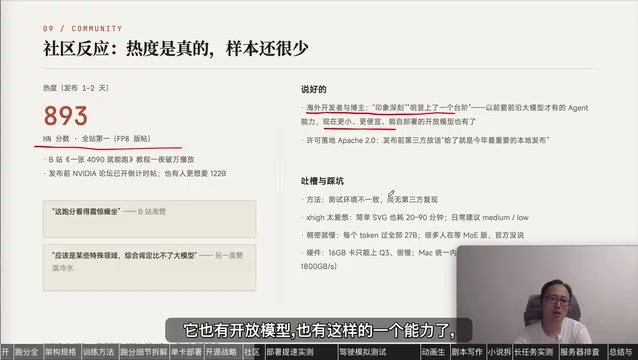
Coding Tests: Capable but Overthinks
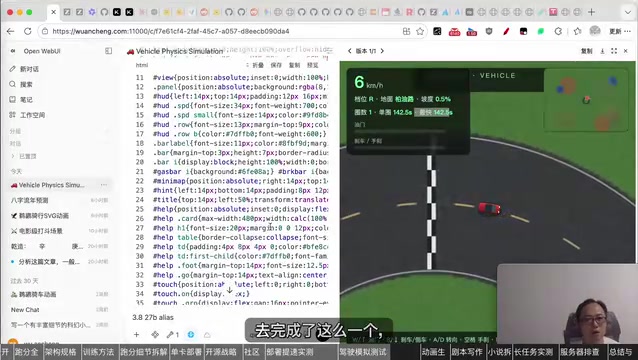
Vehicle Driving Simulator
The first test asked the model to implement a vehicle driving simulator. With deep thinking mode enabled, the model thought for nearly 29 minutes and generated approximately 600+ lines of code.
The "deep thinking mode" here represents an important trend in the current large model landscape—the engineering implementation of Chain-of-Thought Reasoning. Since OpenAI's o1 model, "letting the model perform extended internal reasoning before generating a final answer" has become the standard paradigm for improving performance on complex tasks. The model generates large volumes of intermediate reasoning tokens (thinking process) before outputting an answer—these tokens consume computational resources but aren't directly shown to the user. 29 minutes of thinking time means the model likely generated tens of thousands of reasoning tokens; at the local deployment speed of 40-50 tokens/s, this duration is technically explainable but certainly unacceptable from a user experience perspective. This also exposes the fundamental contradiction of small models doing deep thinking: insufficient parameter count means lower "information density" per reasoning step, requiring more steps to converge on the correct answer.
The final product was quite complete: throttle, brake, turning, acceleration—all interface elements were implemented with realistic logic, and overall performance was acceptable. But the thinking time was simply too long—this is the biggest complaint about this model: it overthinks.
Cycling Animation
The second test was a bicycle riding animation, which took about 12 minutes of thinking. The first version missed the wheels; after a prompt, the model thought for one minute and added them. Leg rotation animation was implemented, but the wheels basically didn't spin, and the riding position was off. Overall: "usable but imperfect."
Script and Novel Analysis
The creator extensively uses models for script analysis and novel generation in daily work. When generating intense fight scenes, the model was more thoughtful, but occasionally produced inexplicable English words (like the English word for "glass" appearing out of nowhere), which was immersion-breaking. Compared to 3.6, script analysis capability improved, but not as dramatically as expected—this correlates strongly with corpus strengths, where coding improvements are notably larger than creative writing improvements.
Long-Horizon Tasks: The Core Breakthrough
The real value lies in task-level long-horizon chain capabilities. This is the core research direction in current AI Agent work: traditional LLM interaction involves single-turn or few-turn dialogue, while the Agent paradigm requires models to autonomously plan multi-step tasks, call external tools (browser, terminal, APIs, etc.), observe execution results, self-correct on failure, and retry—the entire process may involve dozens or even hundreds of "think-act-observe" cycles. This demands far more from models than simple Q&A: they need to maintain goal consistency across ultra-long contexts, accurately parse structured and unstructured information returned by tools, and make reasonable decisions when encountering unexpected situations.

The creator had the model automatically operate a browser to publish promotional content on Xiaohongshu (China's Instagram-like platform). The model ran very actively, continuously refreshing browser operations. Although it hadn't successfully published by the time it was cut off, compared to before, the success rate on this type of web manipulation task has clearly improved—chains are longer, and the model can self-correct and retry after intermediate failures.
Another example is even more illustrative: a Raspberry Pi was sending information to a server, but data wasn't visible on the interface. The creator asked the model to troubleshoot the backend issue. The model ran continuously for nearly an hour—analyzing architecture, checking factory registrations, etc. Although it hadn't fully completed by the time it hit the maximum output token limit, the reasoning coherence and autonomous error-correction capability throughout the entire chain were already quite impressive.
The creator's assessment: this long-chain approach is very similar to Kimi, and the core improvement in this model likely draws from a mechanism similar to Kimi's long-chain approach. Specifically, Moonshot AI employed large-scale reinforcement learning training strategies in Kimi k1.5/k2—letting the model repeatedly attempt tasks in Agent environments, receive environmental feedback, and learn to self-correct, thereby acquiring the ability to maintain reasoning coherence and autonomous error-correction during long tasks. Qwen 3.8's post-training phase very likely adopted similar RL strategies, enabling even a small model to sustain long-horizon tasks.
Alibaba Reclaims the Open-Source Narrative
From an industry perspective, this release's significance extends beyond the model itself. In the first half of the year, Alibaba faced skepticism: when a core training lead departed in March, the stock dropped 5.3% that day, and the prevailing external judgment was that Alibaba's strongest models would no longer be open-sourced.
But this time, Max-level weights were opened for the first time, with 27B simultaneously open-sourced. The official position is to "compress the gap between open weights and closed-source frontier to approximately six months"—meaning they'll release models comparable to six-month-old frontier capabilities (while core secrets like training data recipes remain private, which is normal commercial practice).
It's worth noting that "open weight" and "fully open source" are fundamentally different: the former only releases model parameters while keeping training data, data recipes, and training code confidential. Under this model, Alibaba builds ecosystem barriers through open weights—when large numbers of enterprises worldwide do post-training and application development on the Qwen base, the Qwen architecture becomes a de facto industry standard, and Alibaba's cloud computing services (training and inference infrastructure) naturally become the preferred choice for these enterprises. Meanwhile, widespread community usage feeds back massive amounts of real-world issues and optimization directions, essentially providing free large-scale testing. Meta's Llama series employs a similar strategy.
More importantly, there's ecosystem value. From 3.5 27B to 3.6 27B to 3.8 27B, a large number of overseas companies (Japan, Europe, etc.) have been doing post-training on this base model—effectively meaning Qwen single-handedly nurtured an entire small model ecosystem. In many non-English markets, the Qwen series has become the most important open-source base model choice after Llama. This is a significant gift to the open-source world.
Conclusion: The Best Personally Deployable Local Model Available Today
Objectively speaking, the 27B model capacity means it inevitably has capability ceilings—verbose thinking, limited creative writing improvement, occasional interruptions during long tasks. But as the creator stated: "It is genuinely the best open-source model that an individual can use and deploy at home right now."
For developers who want local Agent capabilities without bearing cloud API costs and privacy concerns, Qwen 3.8 27B makes "local long-horizon programming" a reality for the first time—transitioning it from concept to practice. This is perhaps the real reason this open-source release deserves serious attention.
Related articles

Python 3.15 New Feature: Is the sentinel Type Better Than None?
Python 3.15 adds the sentinel type, using named unique sentinel objects to replace None and bare object(), resolving confusion among missing values, explicit emptiness, and invalid input while avoiding type hint failures.

Deep Learning's Three Architectures and the Universal Approximation Theorem: A Complete Guide to MLPs, CNNs, and Transformers
Explaining the inductive bias differences among MLP, CNN, and Transformer, the existence meaning of the Universal Approximation Theorem (UAT), and the role of Taylor expansion in approximation analysis, while clearing up common misconceptions.

GitLab Emergency Patch Release: Analysis of Critical Security Fixes
GitLab releases critical patch 19.5.1, sparking 355 points of discussion on Hacker News. This article analyzes the background, upgrade steps for self-hosted instances, and verification points to help DevOps teams respond quickly to security updates.