Qwen 3.8 Flash Next Deep Dive: A Hybrid Architecture That Surpasses DeepSeek V4 with Half the Active Parameters
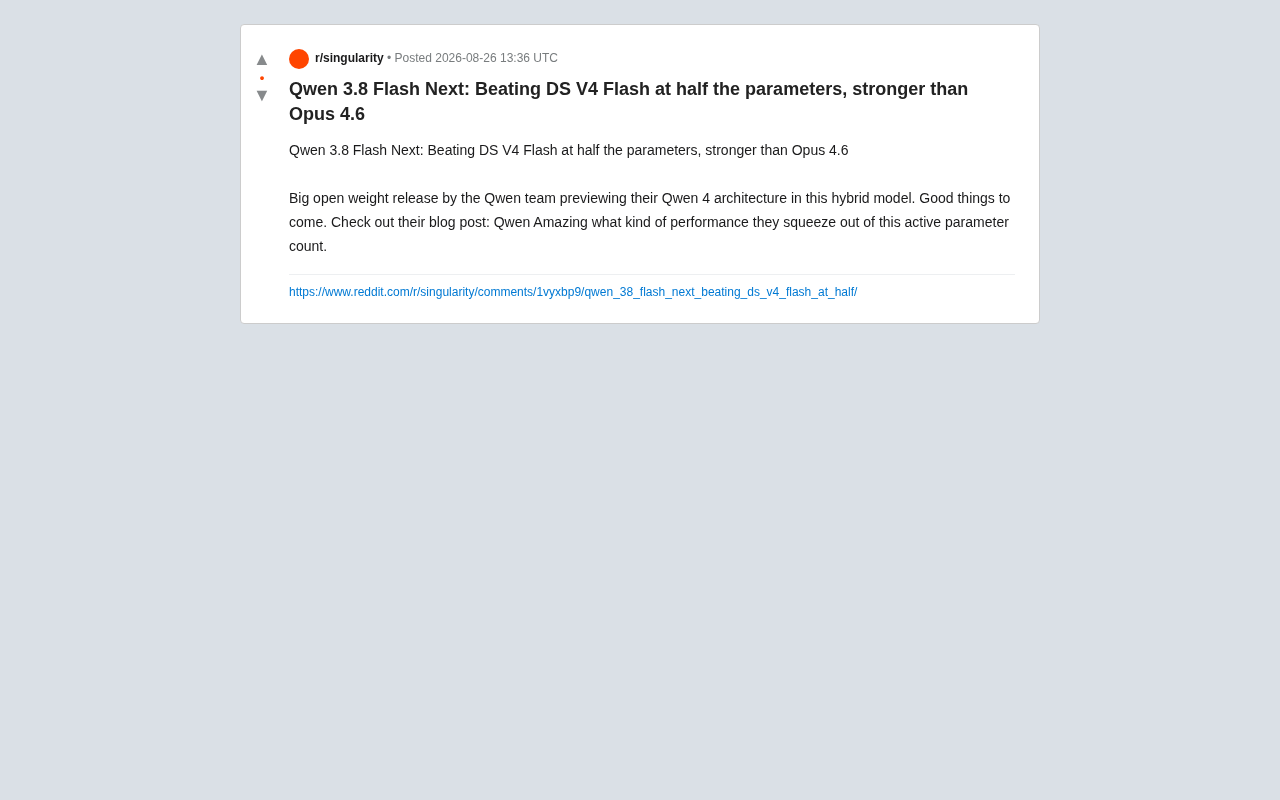
Qwen 3.8 Flash Next uses a hybrid architecture to beat DeepSeek V4 Flash with half the active parameters.
Qwen 3.8 Flash Next is a hybrid architecture model positioned as a preview of Qwen 4. It surpasses DeepSeek V4 Flash across multiple benchmarks with approximately half the active parameters, demonstrating significant advances in MoE efficiency. The article examines what this means technically, the limitations of benchmark comparisons, and why this efficiency-first approach signals the next phase of large model development.
Another Major Update for Open-Source Large Models
Recently, the Qwen team released a heavyweight open-source model on Reddit and other communities — Qwen 3.8 Flash Next. According to the release notes, this hybrid architecture model surpasses DeepSeek V4 Flash across multiple benchmarks with approximately half the active parameters, and even outperforms Opus 4.6 in certain capability dimensions. This performance has attracted significant attention from the open-source community.
Interestingly, this release is not merely a routine iteration — it's officially positioned as a preview of the Qwen 4 architecture. In other words, Qwen 3.8 Flash Next serves as an advance validation of the team's next-generation model design philosophy, making its technical roadmap worth examining in depth.
What "Half-Parameter Superiority" Means Technically for Qwen 3.8 Flash Next
The Trade-off Between Active Parameters and Real Performance
Over the past two years, a clear trend in the large model space has been the shift from "stacking parameters" to "maximizing efficiency." The claim of "surpassing DS V4 Flash with half the parameters" specifically refers to active parameters as the key metric. Under architectures like sparse Mixture of Experts (MoE), a model's total parameter count has been decoupled from the parameters actually activated during each inference — it's the latter that truly determines inference cost and latency.
To understand this, you need to grasp how MoE architecture works. MoE (Mixture of Experts) is one of the mainstream paradigms for scaling large models in recent years. Its core idea is to split the model's feed-forward network layers into multiple "expert" sub-networks, with a gating mechanism activating only a few experts for computation during each inference pass. This allows a model to have hundreds of billions or even trillions of total parameters (representing knowledge capacity), while each token's inference only needs to activate a small fraction (representing computational cost). DeepSeek V2/V3, Mixtral, and multiple models in the Qwen series all employ this type of architecture. The core challenges of MoE lie in load balancing of expert routing, training stability, and knowledge redundancy among experts.
More specifically, in traditional dense models, total parameter count directly determines the computation (FLOPs) for each inference pass. But in sparse architectures like MoE, active parameters refer to the number of parameters actually participating in matrix operations during a single forward pass. For example, a 200B total-parameter MoE model that only activates 2 out of 8 experts each time might have active parameters of only around 50B. Inference latency, memory bandwidth usage, and per-token computation costs are primarily determined by active parameters, not total parameters. Therefore, "surpassing with half the parameters" effectively means achieving equal or better results with roughly half the inference computation — a development with major implications for deployment cost control.
If Qwen 3.8 Flash Next can achieve equivalent or stronger performance with fewer active parameters, it means the team has made substantive breakthroughs in expert routing, attention mechanisms, or training data composition. For developers, this directly translates to lower deployment costs and faster response times — which is precisely what the Flash series naming implies.
The Core Value of Hybrid Architecture
The release specifically emphasizes this as a "hybrid model." Hybrid architecture typically refers to the fusion of multiple mechanisms within a single model — for example, combining linear attention with global attention, or striking a balance between dense and sparse layers. The goal of such designs is to find better trade-offs among long-context processing, inference efficiency, and generation quality.
From a technical lineage perspective, hybrid architectures have multiple implementation forms in the large model space. One common approach alternates standard Softmax global attention (O(n²) complexity) with linear attention or sliding window attention (O(n) complexity) across different layers, preserving global information capture while reducing computational overhead for long sequences. Another hybrid approach combines MoE sparse layers with dense shared layers, allowing some of the model's capabilities to be carried by dense parameters shared across all tokens while other capabilities are handled by specialized sparse parameters. Additionally, the hybridization of Mamba/SSM (State Space Models) with Transformers is a recent hot topic — models like Jamba have already validated the advantages of such architectures for long-context inference efficiency. The specific hybrid approach used by Qwen 3.8 Flash Next has not been fully disclosed, but its positioning as a Qwen 4 preview indicates the team has high confidence in this architectural solution.
As a testbed for the Qwen 4 architecture, the maturity of this hybrid approach will directly influence the direction of subsequent official releases.
How to Interpret the "Surpasses Opus 4.6" Comparison
Maintaining a Cautious Comparative Perspective
"Stronger than Opus 4.6" is a rather aggressive claim. It's worth noting that cross-model comparisons often depend on specific benchmark test sets, and different evaluations vary in domain coverage, difficulty levels, and scoring methods. There can still be gaps between an open-source model achieving impressive results on public leaderboards and its stable performance in real production environments.
Here it's necessary to understand the limitations of benchmarks themselves. Current mainstream LLM evaluation benchmarks include MMLU (multi-domain knowledge), HumanEval/MBPP (code generation), MATH/GSM8K (mathematical reasoning), GPQA (graduate-level Q&A), and others. While these evaluations provide standardized comparison frameworks, they have several known limitations: first, models may have indirectly "seen" test questions through data contamination in training data; second, multiple-choice and short-answer formats cannot comprehensively reflect a model's performance in open-ended generation, multi-turn interactions, tool use, and other real-world scenarios; finally, differences in prompt formatting, sampling strategies (such as temperature settings), and evaluation criteria across different frameworks can lead to dramatically different scores for the same model across different reports. This is why the industry increasingly emphasizes eval-driven development on specific downstream tasks rather than relying solely on public leaderboard rankings.
Therefore, a more rational approach to the "David vs. Goliath" conclusions circulating in the community is: treat them as a signal of architectural efficiency progress, not a definitive verdict on absolute performance. True validation requires developers to test on their own actual tasks, especially in high-frequency scenarios like code generation, long-text comprehension, and multi-turn dialogue.
The Strategic Significance of Open Weights
Regardless of specific scores, the Qwen team's commitment to releasing in "open weight" form is inherently valuable. This means researchers and enterprises can freely download, fine-tune, and build upon the model without being constrained by closed-source APIs.
It's worth noting that strictly speaking, "open weight" differs from fully "open source." Open weights mean the model's parameter files can be freely downloaded and used, but training code, datasets, and complete reproducibility information may not be fully disclosed. By contrast, fully open source requires complete transparency in code, data, and training processes. However, in the current industry context, open weights are already sufficient to support community efforts in fine-tuning, quantized deployment, RAG integration, and customized development based on techniques like LoRA/QLoRA. Model series like Qwen, Llama, and Mistral all adopt open-weight strategies, forming the core infrastructure of today's open-source AI ecosystem — enabling enterprises to avoid dependence on closed-source APIs in local deployments while ensuring data privacy and reducing long-term usage costs.
In the current landscape of intense competition between open-source and closed-source approaches, Qwen's continued release of high-quality open-source models further solidifies its leading position in the open-source AI ecosystem.
Practical Implications for Developers and the Industry
The Era of Efficiency-First
The release of Qwen 3.8 Flash Next once again confirms a key observation: the arms race of purely pursuing parameter scale is cooling down, and "intelligence per unit of compute" has become the new competitive focus. For small-to-medium teams and individual developers, these efficient models mean achieving near-top-tier results with limited hardware resources, significantly lowering the barrier to AI application deployment.
Behind this trend, the entire industry's focus on inference costs is surpassing its focus on training costs. A model is trained once, but must serve continuous inference requests from millions of users. When inference costs are halved, the GPU clusters needed to serve the same user base shrink accordingly — directly impacting the feasibility of commercialization. The Flash series of models is precisely targeting this core pain point.
Watch for Qwen 4's Official Debut
Since this model is positioned as a preview of the Qwen 4 architecture, the capability ceiling of the official release is worth anticipating. The team concluded this release with "Good things to come," hinting that the hybrid architecture will receive more thorough refinement in the official version. Practitioners following AI frontiers are advised to keep track of the Qwen official blog and technical reports to stay updated on architectural details and comprehensive evaluation data.
Conclusion
Qwen 3.8 Flash Next challenges mainstream models with half the active parameters, representing yet another powerful offensive from the open-source camp on the efficiency track. Although the comparison conclusions circulating in the community still need validation in real-world scenarios, the architectural innovation direction it represents — achieving stronger intelligence with fewer active parameters — undoubtedly points to the next phase of large model development. For readers following open-source tools and frontier research, this is both a model worth hands-on testing and an important window into the future direction of Qwen 4.
Related articles

Transitioning to AI Agent Development: A Complete Three-Stage Learning Path for Programmers
Why do programmers keep failing at AI Agent development? This guide breaks down a 3-stage learning path: ReAct & Tool Calling fundamentals, LangChain engineering, and production-grade project delivery.

Getting Started with Agent Skills: A Complete Guide from Prompts to Intelligent Skills
Deep dive into AI Agent Skills' four components (skill.md, references, scripts, assets), explaining how Skills differ from prompts and how to build reusable intelligent skill systems.

Codex Beginner's Guide: Installation, Configuration & Connecting Chinese LLM APIs
Complete guide to installing OpenAI Codex, how it differs from Claude Code, and how to connect Chinese LLMs like DeepSeek via API keys with full setup steps and limitations.