Qwen 3.8 Open Source Incoming, DeepSeek Coding Agent, and the Latest in China's AI Ecosystem

Qwen 3.8 set to open-source, DeepSeek coding agent targets stability, Kimi caps subscriptions over GPU constraints.
China's AI ecosystem is seeing rapid developments: Alibaba's Qwen 3.8 is nearly ready for open-source release, DeepSeek's Resonics agent tackles long-session cache stability for developers, Kimi pauses new consumer subscriptions after Kimi K3 demand overwhelmed compute capacity, and Qiyimole unveiled a domestic GPU direct connect solution independent of NVIDIA NICs at WAIC.
China's domestic large language model and AI tooling ecosystem is entering a period of rapid updates. From Alibaba's next-generation Qwen model open-source announcement to the debut of DeepSeek's native coding agent, and Kimi pausing new user subscriptions due to compute pressure — these developments collectively paint a picture of intensifying competition at both the AI infrastructure and application layers. This article breaks down the key recent developments and their implications.
DeepSeek Resonics: Tackling the Stability Pain Point in Coding Agents
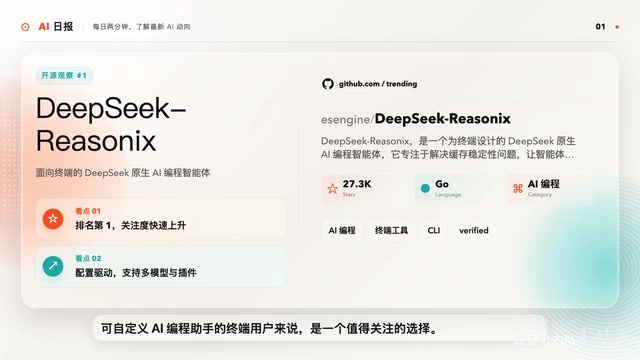
DeepSeekAd Resonics is a native AI coding agent built for terminal environments, powered by DeepSeek. It targets a very specific core problem — cache stability.
Any developer who has used AI coding tools knows the frustration: agents frequently crash or restart mid-session due to unstable caching, severely disrupting workflow. Resonics is designed precisely around this real-world pain point.
Background: KV Cache and Stability Challenges Cache stability is a central engineering challenge for large language models in long-context tasks. When a coding agent handles complex tasks, it must maintain a continuously growing context window containing code history, tool call results, intermediate reasoning steps, and more. The mainstream Transformer architecture uses KV Cache (key-value cache) to avoid recomputing already-processed tokens — but this caching is highly memory-intensive and prone to failure during abnormal process exits or resource scheduling events. For locally deployed open-source models, cache invalidation means complete loss of task state. This is precisely why Anthropic introduced its "Prompt Caching" feature, which allows developers to explicitly cache specific prefixes to reduce cost and latency.
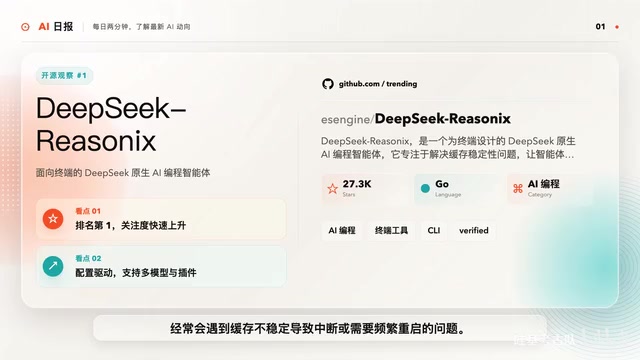
The project adopts a configuration-driven approach with preset modes, providing a configurable and composable CLI framework.
Configuration-driven design is a well-established philosophy in modern DevOps and infrastructure engineering. Its core idea is shifting control over system behavior away from hardcoded logic and into externally modifiable configuration files — think Kubernetes YAML configs or Terraform's declarative infrastructure management. Bringing this philosophy to AI agent development means users can adjust an agent's behavioral strategy, tool-calling order, and fault-tolerance mechanisms simply by modifying config files, without touching source code. Preset modes further lower the barrier to entry — similar to toggling between "debug" and "release" modes in an IDE — letting developers of all experience levels get up and running quickly.
The technical goal: keep agents running stably over long sessions, rather than crashing and restarting every so often.
Why Stability Matters More Than Speed
For agent-class applications, "running longer" is often more important than "running faster." Coding tasks typically involve multi-step reasoning, file operations, and accumulated context. If the process is interrupted midway, cached state may be lost, causing task failure or degraded output quality.
By placing stability as the primary design goal, Resonics reflects a broader shift in AI coding tools — from "functional" to "reliably functional." For developers who need a stable, customizable terminal coding assistant, this is an open-source option worth watching.
Alibaba Qwen 3.8: Launching Soon with Open Source Release
According to 36Kr, Alibaba's latest generation model Qwen 3.8 is set to launch and be open-sourced soon.
The Qwen 3.8 MAX preview has already gone live on Alibaba Cloud's Token program, Qwen Chat, and related work platforms for early access, with the official release and open-source version expected to follow shortly.
A Continued Commitment to Open Source
Since its debut in 2023, the Qwen series has become one of the most active open-source LLM ecosystems globally. According to Hugging Face download statistics, Qwen models consistently rank among the top downloads, with particularly strong traction in the Asia-Pacific developer community. Technically, the Qwen series has evolved across multiple dimensions — multimodal support, code capabilities (CodeQwen), long-context handling (supporting context windows of 128K tokens and beyond), and function calling — forming a fairly comprehensive capability matrix. The Qwen 3 series is especially noteworthy for its "Hybrid Thinking Mode," which blends fast response with deep reasoning, achieving performance competitive with leading commercial closed-source models on multiple benchmarks.
From the original Qwen through Qwen 2 and Qwen 3, Alibaba has consistently followed a dual-track strategy of capability improvements paired with open-source releases, building strong credibility in the developer community. The strategic calculus goes beyond ecosystem positioning — it's about using large-scale community adoption to gather feedback and drive model iteration, creating a positive feedback loop between commercial cloud services and the open-source community.
Qwen 3.8 follows the same playbook: launch a preview on proprietary cloud platforms to collect feedback, then release the official open-source version. This "preview → official → open source" release cadence is becoming the standard template for leading AI companies.
Kimi Pauses Consumer Subscriptions: A Real-World Signal of Compute Pressure
Moonshot AI's Kimi has announced that it is pausing new subscription sign-ups for individual users.

The reason: following the launch of Kimi K3, user request volume surged far beyond projections, pushing the existing cluster toward its capacity ceiling.
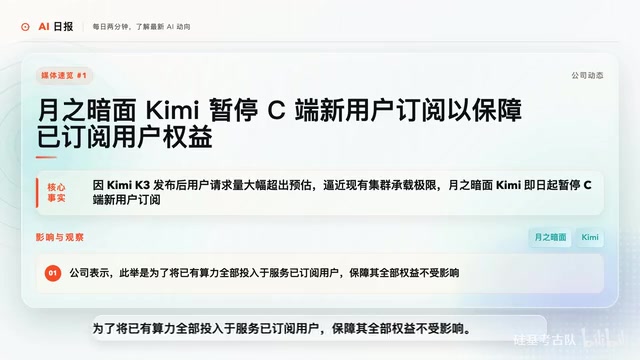
The company stated that this decision is intended to direct all available compute toward serving existing subscribers, ensuring their experience is not impacted.
The Industry Dilemma Behind the Demand Surge
At its core, Kimi's decision is a "good problem to have" — a new model that exceeded popularity expectations, but with compute supply unable to keep pace with demand growth. It also reflects a real constraint that most domestic LLM companies face: high inference compute costs and tight GPU availability.
Background: The Cost Structure of AI Inference Inference compute cost is the central commercial constraint for large language models, and its complexity far exceeds that of the training phase. Training is a one-time offline computation that can fully leverage batching to maximize GPU utilization; inference requires real-time responses with strict requirements for high concurrency and low latency, and computational load grows linearly — or even quadratically — with context length. For GPT-4-class models, inference cost once reached tens of dollars per million tokens. Domestic companies face an additional constraint on GPU procurement: export controls have restricted access to NVIDIA H100/H800 and other high-end chips, making it difficult to scale compute reserves in line with demand growth. This is the deeper structural reason behind Kimi's subscription pause.
Rather than letting both new and existing users suffer degraded service quality, the choice to temporarily halt new sign-ups while prioritizing the paid user experience is a rational trade-off — even if it sacrifices short-term growth. It also serves as an indirect signal that beyond model capability competition, compute infrastructure reserves are becoming a critical variable determining user experience and the ability to scale commercially.
Qiyimole Debuts Domestic GPU Direct Connect Solution
According to Quantum Bit, Qiyimole unveiled its domestic GPU direct connect solution at WAIC for the first time. The solution does not rely on NVIDIA network cards, and internal testing shows improved throughput and reduced latency — offering a new technical path for domestic GPU interconnect performance.
Interconnect: The Other Battlefield Beyond Compute
In large model training and inference, single-card performance matters — but inter-card interconnect bandwidth and latency are often the bottleneck that determines overall system efficiency. NVIDIA has built a deep competitive moat through NVLink and its NIC ecosystem.
Background: The Technical Barriers of NVIDIA's Interconnect Ecosystem NVIDIA has built a vertically integrated high-performance computing interconnect stack through NVLink (chip-to-chip high-speed interconnect with bandwidths exceeding 900 GB/s), NVSwitch (full-mesh switching fabric within a rack), and InfiniBand NICs (high-speed cross-node networking). For domestic GPU vendors, catching up on single-card compute performance is relatively quantifiable — but rebuilding the interconnect ecosystem is far more difficult. It requires not just hardware design, but deep co-optimization with upper-layer communication libraries (like NCCL), distributed training frameworks (like Megatron-LM), and network topology design, creating extremely high system integration barriers.
Qiyimole's approach — focusing on GPU direct connect and interconnect solutions to bypass dependence on NVIDIA NICs, and achieving efficient GPU-to-GPU communication through proprietary interconnect protocols — represents an important attempt to fill the "connection" gap in China's domestic compute ecosystem beyond just the "card" itself. If performance advantages can be validated in real-world deployments and achieved at scale, it will help domestic GPUs build more complete system-level competitiveness, and carry significant strategic value in reducing China's AI infrastructure dependency on US hardware ecosystems.
Summary: The Triple Race Across Capability, Compute, and Ecosystem
Taken together, these recent developments sketch out several key themes shaping the AI industry:
- Application layer: Tools like DeepSeek Resonics are shifting focus from "impressive demos" to "stable and reliable," addressing real developer pain points;
- Model layer: Alibaba's Qwen 3.8 continues the open-source path, steadily reinforcing the open ecosystem advantages of domestic large models;
- Compute layer: Kimi's subscription pause exposes the supply-demand imbalance in compute, while Qiyimole's interconnect solution attempts to fill a critical gap in domestic compute capabilities.
Advances in model capability are just the starting point. What truly determines user experience and commercial sustainability is the combined interplay of compute reserves, system interconnect, and tooling stability. From the engineering optimization of KV Cache, to community operations within open-source ecosystems, to the self-reliant development of GPU interconnect protocols — this race is only now entering its deep waters.
Related articles

Felix Rieseberg Personal Homepage
Felix Rieseberg's personal homepage sparks attention on Hacker News. This article covers the Slack engineer's technical background, the rise and fall of nativefier, and the value of a developer homepage as a tech calling card.

@ai-sdk/vue 3.0.306 Patch Release Syncs with [email protected] Update
@ai-sdk/vue 3.0.306 released, synced with [email protected]. A routine patch release for the Vercel AI SDK ecosystem with no public API changes; the Vue adapter layer stays version-aligned with the core package.

Gemini 4 Argon API Launches: The Era of Million-Token Output Begins
Google launches Gemini 4 Argon with sparse MoE architecture, up to 1M output tokens, and a 68.90% Vals Index score, available across API, AI Studio, and the Gemini app.