Qwen 4 Max Preview Hands-On: Matches Opus on Performance, but Two-Week Lifespan and Subscription Limits

Qwen 4 Max Preview matches Opus 5.5, but subscription limits and a two-week lifespan make it impractical.
A creator ran four hands-on tests on Alibaba's Qwen 4 Max Preview. It supports multimodal input and a 1M-token context, but launched with no benchmarks or model card, only restricted subscription plans, a ban on automation, and a two-week preview lifespan. Qwen tied Claude Opus 5.5 on 12 hidden checks in a real work order and delivered on the haunted-house game and pelican bike animation at far lower cost, but the bug-hunt test could not run due to chat-interface limits and several runs hung. The model delivers; the access does not.
Alibaba's next-generation flagship model in the Qwen family, Qwen 4 Max Preview, is now available for preview. The company describes it as a multimodal flagship built for coding, office work, front-end design, and complex agent tasks. A YouTube creator put it head-to-head with Claude Opus 5.5 across four tests, and the conclusion is interesting: the model itself delivers, but you may not be able to use it at all.
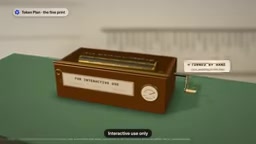
A flagship launch with zero numbers
Alibaba was notably restrained in how it launched Qwen 4. The official docs describe Qwen 4 Max Preview as a next-generation flagship multimodal model supporting text, image, and video input, with a 1M-token context window, thinking mode enabled by default, and three reasoning-effort tiers—low, medium, and extra high. Note that there is no separate "high" tier, which becomes a variable in the later comparisons.
The launch post, however, made only three promises: deeper knowledge, richer world understanding, and stronger coding and agent capabilities. The post racked up over a million views without a single benchmark number, model card, parameter count, or open weights. In other words, local deployment is off the table entirely.
Even rarer is its shelf life. The official docs state that the preview runs until November 25, after which the model is retired—roughly two weeks in total—with no mention of a replacement or a launch date for the full Qwen 4 Max.
Context window refers to the total number of tokens a model can hold in a single inference pass, including the input prompt and generated content. 1M tokens is roughly hundreds of thousands of Chinese characters or over a thousand pages of technical documentation, meaning the model could theoretically read a large codebase or a long video transcript in one go before answering. But window size does not equal effective utilization: a model's retrieval and reasoning accuracy within very long contexts typically decays with distance (the "lost in the middle" phenomenon), and more input tokens significantly raises latency and cost. So 1M tokens is better treated as an upper bound on what you can cram in rather than a default way of working; in practice you still need chunking, retrieval, or summarization for reliability.
Where to buy: no pay-as-you-go, only subscriptions
Multiple testers have described access to Qwen 4 Max Preview as "a mess." Alibaba explicitly says there is no pay-as-you-go API; you can only go through token-plan subscriptions in four tiers—Lite, Essential, Standard, and Pro—with a low-cost Lite trial for new users. During the preview, usage is billed at a rate far below normal.
But the fine print is what matters: the plan is limited to interactive use within tools such as Claude Code, Cursor, and Qwen Code, and is explicitly prohibited for automated scripts or batch tasks, with violations potentially resulting in key bans. Personal plans cannot be canceled once activated, and when your quota runs out you simply wait until next month.
The creator actually bought the $19/month Plus plan for the Qwen app and found that the Qwen Code terminal only offered the previous generation, Qwen 3.8 Max and Flash—which directly determined the testing method: Qwen 4 could only be run in the app's chat interface, with no terminal and no ability to execute and verify the code it wrote.
Pay-as-you-go API vs. token-plan subscription are two different billing paradigms. Pay-as-you-go charges by actual input/output tokens, suited to automated pipelines, batch processing, and elastic workloads, with costs scaling linearly with usage; a subscription plan prepays a fixed quota and then rate-limits or cuts you off, usually tied to an interactive product interface. Plans often carry terms-of-use restrictions (such as no scripted calls) because their pricing assumes low-frequency, human-triggered usage. For developers, this means that even if the model is capable enough, without a pay-as-you-go channel you cannot embed it into CI, scheduled jobs, or multi-user services—it can only serve as a "copilot"-style assistant tool.
Missing from third-party rankings, only the previous generation to go on
On the Artificial Analysis leaderboard, Qwen 4 is nowhere to be found, so there is no independent score. For reference, the previous generation Qwen 3.8 Max scored 34 on the intelligence index, while Opus 5.5 scored 52 at high reasoning effort and 59 at Max. A clear gap.
On price, Qwen 3.8 Max's output tokens cost about one-third of Opus's. But the creator notes that the cost of completing a single benchmark task is nearly the same for both—cheap tokens do not equal cheap tasks. Since Qwen 4 has not published pricing, all costs in the tests were estimated using Qwen 3.8 Max rates as a stand-in, excluding hidden thinking consumption, so the real cost can only be higher.
The Artificial Analysis intelligence index is a third-party evaluator's aggregate benchmark of mainstream models, typically mixing knowledge Q&A, reasoning, coding, math, and other tests into a single score for easy cross-comparison. It is not the same as official benchmarks, nor an absolute capability metric for a specific task; scores are affected by reasoning tier, prompting style, and evaluation version, and the same model can differ by several points across tiers. The index's main value is relative ranking and a rough sense of generational gaps, not predicting whether a given work order will pass. The article's citation of the previous-generation Qwen 3.8 Max at 34 versus Opus at 52/59 only illustrates historical generational gaps and cannot be directly extrapolated to the unranked Qwen 4.
Day-one demos and that pelican fail
Day-one community demos looked lively: a story-writing app, a 3D downhill fox game, a car showroom, a restaurant website. But scroll a bit and you'll notice many posts end with the same sentence pattern, all accompanied by "limited-time discount" promotional language. The creator could not confirm whether these were paid promotions, but noted that some demos were not even this model—before launch, Coder had run early test versions under a codename for several days.

The most widely shared test on X (about 195k views at the time of checking) was a failure case: a 3D pelican riding a bicycle, with wheels spinning wildly like coins. The original author did not disclose the prompt, and did not respond to requests for it in the comments. This became the starting point for the creator's third test.
Four hands-on tests: chat window vs. terminal, how to compare
The methodology here had to compromise. Normally each model runs as a coding agent in its own folder, executing and self-correcting, and that is how Opus 5.5 was run in Claude Code at high reasoning effort. Qwen answered in the app chat interface with thinking mode on and web search enabled (Opus had it off), in a single shot with no execution or verification, so build times are not an apples-to-apples comparison.
Test 1: First-person haunted house horror game
Opus took 36 minutes, with one mid-run framework restart after 15 minutes without a save, and ultimately produced a moonlit corridor, chandelier, flashlight cone, sanity bar, and ghosts, with well-crafted prompts, at an API-equivalent cost of about $4.72.
Qwen took 22 minutes, opened with a title screen, and within seconds showed a ghost at the end of the corridor, a grandfather clock, stairs, and a chandelier, with zero errors. More surprisingly, after writing the entire file it self-checked, claimed to have found structural errors, and then rewrote the complete game within the same response—about 99 KB—and the test used the corrected version. Estimated cost was only in the tens of cents—but this was the second attempt; the first, using the app's web development mode, ran for 27 minutes and returned only "testing finished," with no files.
Test 2: A real freelance work order (with 12 hidden checks)
A messy email thread from a solo design studio: initially every invoice should include tax, but the last email says accounting confirmed design work is tax-exempt and only print line items are taxed; the late-fee percentage is vague, and it's unclear whether payment is monthly or one-time. The model had to build an app and reply to the email, after which 12 unseen hidden tests would verify invoice numbers, due dates, reminders, partial payments, rounding, and tax logic.
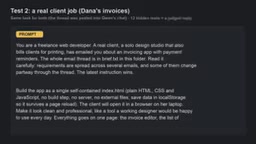
Result: Opus 12/12, Qwen 12/12. Both caught the tax-rule change and both handled the late fee the same smart way—rather than guessing, they replied asking the client to confirm. The replies were scored by two judge models not involved in the head-to-head, using a hidden rubric, and both received full marks. The only differences were clock and cost: Opus about 8 minutes and $2.40; Qwen completed it on the first attempt in about 30 minutes at a cost in the low tens of cents.
This is the most telling test—on real paid work, the preview fully kept up.
Test 3: Pelican riding a bicycle
With a self-written prompt: a sunset coastal highway, a 3D pelican riding a bike, with four camera angles—follow, side, front, and top-down. Qwen's first run took 18 minutes and returned only "request finished"; the second took about 24 minutes and delivered. The final clip had a lighthouse, a sunset over the sea, headlight beams, and a control panel; in the side view the pelican's feet were on the pedals and the bike structure was normal, and the "wheels flipping like coins" from the viral clip did not appear in any frame. Opus took 22 minutes and about $5.40, adding a basket, seagulls, and rocks, with one-click switching between four views.
The creator's judgment: that viral clip was most likely a one-off bad-luck run, or a prompt that will never be made public.
Test 4: Extreme bug hunt—no result
An invoicing backend of about 3,000 lines across 42 files, seeded with 16 real bugs (most only manifesting across files, including concurrent double-charging, tax rounding errors, and a security flaw allowing cross-tenant reads of other customers' invoices), plus 11 decoys disguised as bugs. The model was not told the total number of bugs, hidden tests did the scoring, and breaking functionality incurred penalties.
Opus finished in just over 8 minutes for $2.24, fixing 15/16 with zero regressions, even fixing the cache race condition it had missed in a previous benchmark.
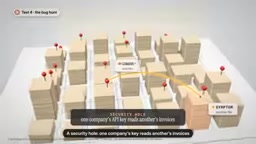
Qwen had no result. The chat app cannot open a project folder, so the entire codebase (about 128k characters) had to be pasted in, and both send attempts stalled at a human-verification slider—the request never started. This is not Qwen losing; it's that the app simply does not accept a complete codebase.
The essential difference between a coding agent and a chat interface lies in the execution loop. An agent can read and write project files, run tests, read errors, and iterate fixes, so it can handle cross-file, verification-heavy tasks (bug hunting, refactoring, concurrency fixes); a chat interface can only receive pasted text and output code in one shot, unable to open directories, run programs, or confirm whether a fix introduced regressions. The reason the bug-hunt test could not be run here is precisely that a project of about 3,000 lines across 42 files exceeds what can feasibly be "pasted into a dialog box," and human verification blocked the oversized input. This shows that model capability and product form are two different things: the same model packaged behind different access methods can differ by an order of magnitude in what tasks it can complete.
Who should use it, and who should wait
Of the four tests, the only one with a standard answer—the work order test—was a tie between Qwen 4 Max Preview and Opus 5.5; the haunted house was scarier, and the pelican didn't crash. But the keyword of the whole story is "access": you can't buy by token, the purchasable plans prohibit automation, the paid plan's Qwen Code doesn't offer this model, you can only run it in a chat app with no terminal, three runs hung for 18 to 45 minutes without responding, and this specific model retires in two weeks.
The creator's conclusion is pragmatic: if you're already inside Coder or a token planAd and want a discounted front-end side model, it's worth trying during the preview—but don't build anything that needs to be "alive next month" on top of it. His own resale business needs scheduled scripts to pull data, which the plan happens to prohibit, so day to day he still uses Opus 5.5 in Claude Code.
What's really worth watching is the full release: if the complete Qwen 4 Max ships with a proper API and clear pricing, and maintains this level, the top vendors will indeed have reason to worry.
Would you build a project on a model with a two-week lifespan, or wait for the full release?
Related articles
How the Grok Team Hits 11,000 PRs a Month: Replacing Manual Review with Deterministic Constraints
Inside the Grok team's formula for 11,000 monthly PRs at a 0.5% rollback rate: Lint rules, type systems, and formal verification as deterministic constraints.

Is Spacetime Made of Something? Six Possible Answers from Quantum Gravity
Is spacetime made of something? This article surveys the main candidate answers from quantum gravity: spacetime may be fundamental, geometry quantized, causal relations prior to distance, spacetime an emergent state of matter, geometry derived from string theory, or no spacetime atoms needed at all.
After GTA 6, Where Does the Game Industry Go?
The Vergecast talks with Game File's Stephen Totilo about GTA 6's impact on gaming: billion-dollar budgets, console market struggles, cloud gaming tests, and the future of microtransactions—and whether it marks the end of an era.