Qwen 4 Surprise Release: Alibaba Quietly Teases Next-Generation Model

Alibaba's Qwen official account stealth-announces Qwen 4 with a cryptic tweet, sparking speculation but revealing no key details.
Alibaba's Qwen team posted a vague tweet on social media that the community interpreted as a "stealth announcement" of Qwen 4. The tweet included no model card, benchmarks, or technical details—only confirmation that the model exists. Reddit discussion is essentially secondary传播 of the official tweet, lacking independent cross-verification. Model parameter scale, open-source status, training data composition, benchmark performance, and release timing all remain unknown. The article suggests this low-key approach may stem from an unfinalized model, ongoing internal evaluations, or deliberate suspense marketing, and reminds developers not to over-infer model capabilities from a single tweet before official technical materials appear. The current Qwen version remains the practical basis for model selection.
Alibaba's Qwen team posted a cryptic message on social media that the community has interpreted as a "stealth announcement" of Qwen 4. No launch event, no technical blog—just a vague tweet. This unusually low-key approach has actually sparked even more discussion among developers.

Speculation Sparked by a Single Tweet
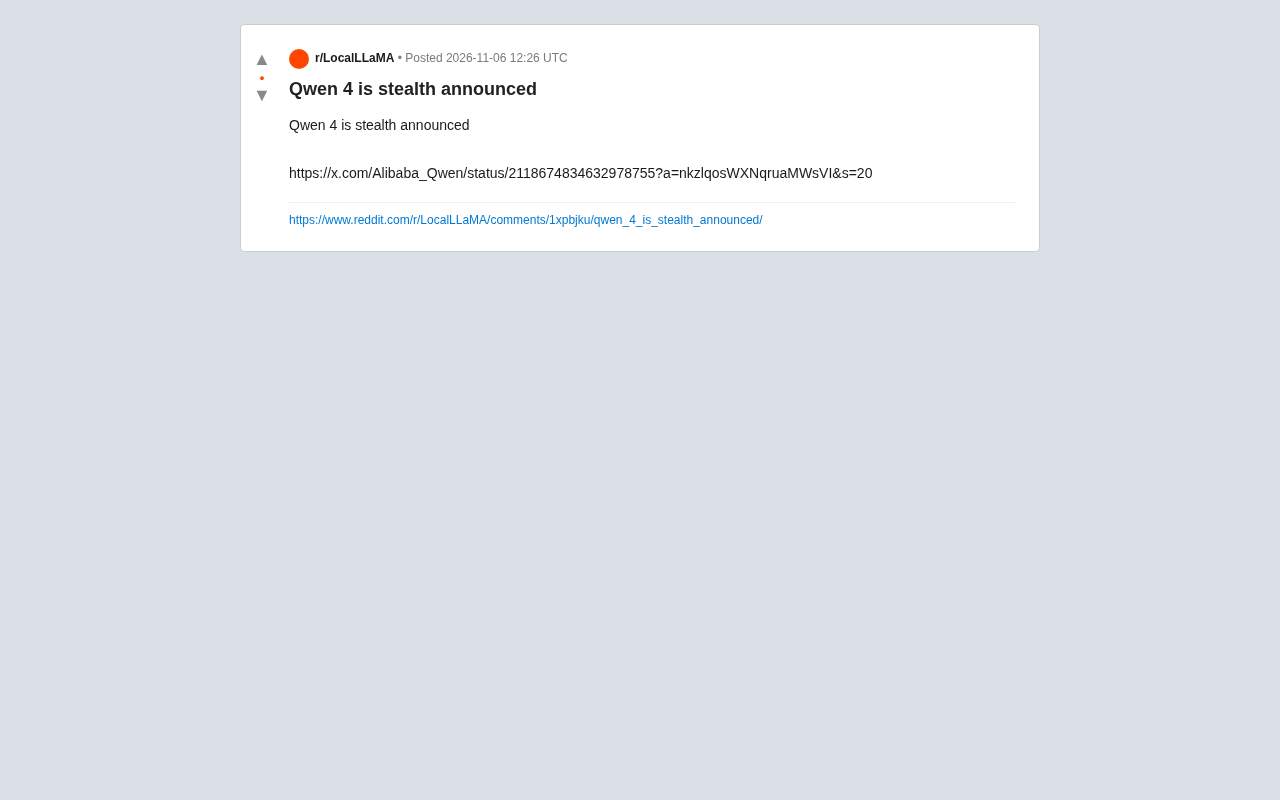
According to discussions in the Reddit community, the official Qwen account posted a message pointing to a next-generation model. The content was brief, with no model card, benchmarks, or technical details attached. The original link points to the official account's activity on X, but the information was so restrained that it barely conveyed anything beyond "confirming existence."
This "stealth announce" approach is uncommon in AI model releases. Typically, vendors wait until technical reports, benchmark leaderboards, and blog posts are all ready before going public, but the Qwen team offered only a signal this time. The community's first reactions centered on two interpretations: either this is a pre-launch teaser before the official release, or the model is already in limited internal testing and the official account is confirming it in a vague way ahead of time.
For China's large-model arena, which is used to splashy launches, this restraint is itself a noteworthy signal.
"Stealth announce" is a low-key strategy in tech product launches: vendors skip press events, technical blogs, or complete documentation, and instead release a minimal signal through informal channels like social media to confirm the product exists. This approach typically appears when a product isn't fully finalized or when the team wants to gauge community reaction first. Compared to the traditional "technical report + benchmark leaderboard + blog" full-package release, a stealth announce carries very little information and easily triggers community speculation and over-interpretation—but it can also be a marketing tactic to stretch out the teaser period and sustain discussion. In the AI model space, since model cards and evaluation data are key references for developers evaluating and selecting models, release signals lacking these materials can only serve as clues that "it exists," not actionable decision information.
Why "Low-Key" Is Actually More Noteworthy
The Qwen series has maintained a relatively steady iteration cadence over the past few generations, advancing open-source weights and closed-source APIs in parallel, and has built up a large user base in the developer community. Following this pattern, Qwen 4's release should logically come with a complete model card and evaluation data.
The tweet contains so little information that it may mean several things: the model isn't fully finalized and the official account just wants to claim the "Qwen 4" name first; internal evaluations are still underway and the signal is meant to gauge community reaction; or it's a deliberate suspense marketing move to stretch out the release cadence and sustain discussion.
Whatever the case, what developers truly need to be wary of is over-inferring model capabilities from a single tweet before official technical details emerge.
Source and Information Credibility
Currently, there is only one source of information about Qwen 4: the original tweet from the official Qwen X account, along with the Reddit community's relay and discussion of that tweet. There is no independent cross-verification between the two—the Reddit post is essentially secondary传播 of the official tweet, not independent intelligence.
This means the following remain unknown: model parameter scale, whether it will be open-source, training data composition, benchmark performance, and the specific release window. All discussion about "how good Qwen 4 performs" can only be speculation until official technical materials appear.
There are also rational voices in the community discussion pointing out that a "stealth announce" is more likely a market teaser than a full technical release. For developers following the series, the reasonable approach is to record this tweet as "known to exist" rather than "known details."
In the AI field, a "model card" is a standard document accompanying model releases, typically containing information such as model architecture, parameter scale, training data sources and composition, intended use, performance benchmark results, known limitations, and ethical considerations. It helps developers judge whether a model is suitable for specific tasks and is an important safeguard for model transparency and reproducibility. For open-source models, model cards are often released alongside weight files; for closed-source API models, vendors also provide similar documentation. The absence of a model card means outsiders cannot systematically assess a model's capability boundaries and must rely on unofficial testing or community feedback, which increases uncertainty in model selection.
What It Means for Developers
In the short term, the vague Qwen 4 teaser won't change existing model selection decisions. The current Qwen version remains an available option with documentation and community support, and the shadow of a new model isn't enough to justify migration.
What's worth watching is the release format itself. If Qwen 4 continues the open-source path, the community will quickly provide independent hands-on feedback once weights are released, which is more valuable as a reference than any official benchmark. If it shifts to a more closed release approach, it will affect downstream projects that rely on open-source weights.
Until official information is complete, staying informed and not betting on it yet is the safest posture when facing this kind of "stealth announce."
"Open-source weights" refer to the parameter files made public after model training is complete, which developers can download, deploy, fine-tune, and even use commercially (depending on the license). The Qwen series has previously adopted a strategy of parallel open-source weights and closed-source APIs, which has helped it accumulate a large number of downstream projects in the developer community. If Qwen 4 continues the open-source path, the community will quickly conduct independent testing after weights are released, forming feedback that is closer to real-world scenarios than official benchmarks; if it shifts to a more closed release approach, downstream projects relying on open-source weights will face migration costs or be forced to switch to other open-source models. Therefore, the actual impact of the release format (open-source or closed-source) on developers is often more worth watching than the model's benchmark scores themselves.
One-line Summary
Alibaba's Qwen official account "stealth-announced" Qwen 4 with a minimalist tweet, sparking community speculation but offering no key information.
Related articles

AI Coding Enters the Team Collaboration Era: Interpreting Three Major Moves from Meta, GitHub, and Mistral
Meta acquires Conductor, GitHub Copilot Fusion becomes available, Mistral opens Large 4 weights—three moves show AI coding shifting from code generation to organizing development workflows. This article explains task orchestration, model collaboration, and cost control for developers.

Building a RAG Assistant with Dify: A Practical Guide to Knowledge Bases, Workflows, and Agent Nodes
How should knowledge bases, workflows, and Agent nodes connect in a Dify RAG assistant? We break down the division of labor and wiring logic for a shippable app.
 Tech Frontiers
The AI Industry Doesn't Lack Marketing—It Lacks Good Products
AI faces market selloffs and public skepticism—is marketing really the problem? This analysis of market signals and product experience argues the core困境 is incomplete products and a gap between promises and experience; the only way to change perceptions is to ship better products.