Qwen Code: An Open-Source AI Coding Agent in Your Terminal
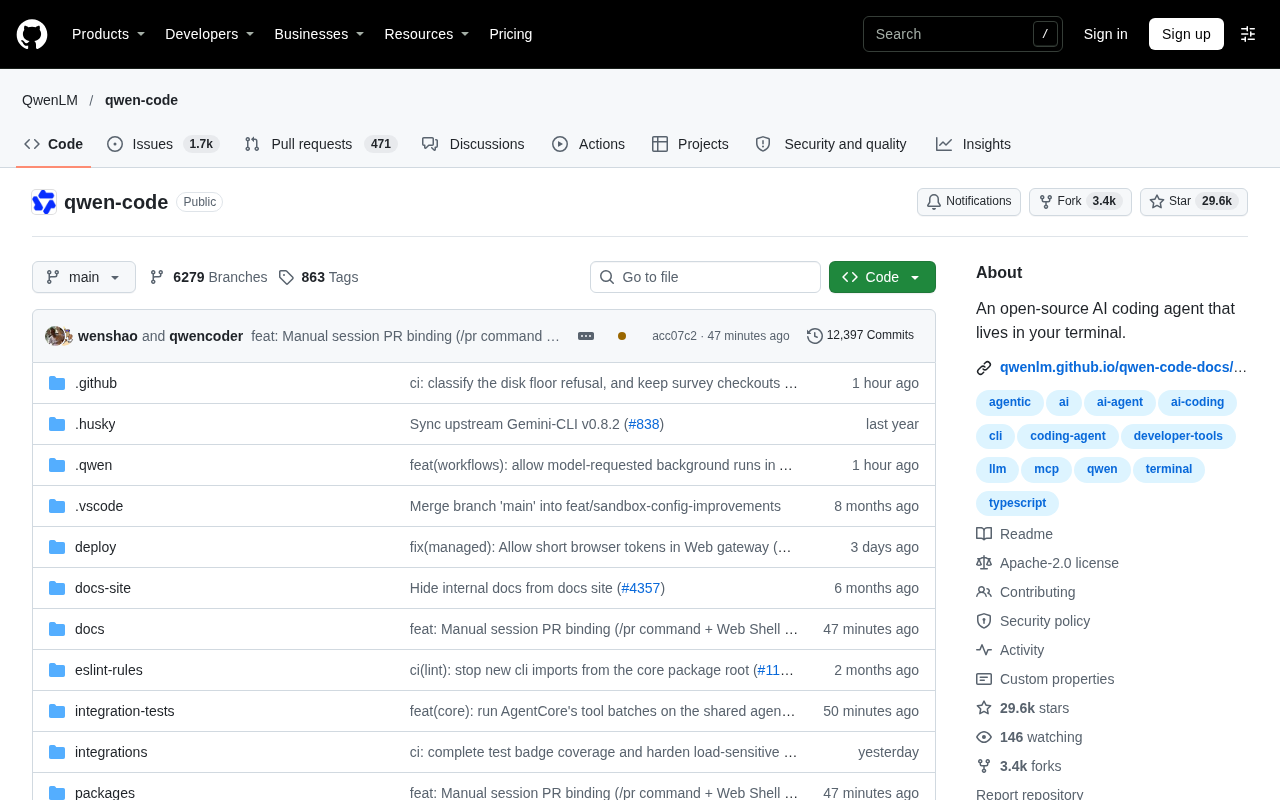
QwenLM's open-source terminal AI coding agent Qwen Code has surpassed 29,000 GitHub stars.
Qwen Code is an open-source AI coding agent from QwenLM that runs in the terminal, written in TypeScript, with over 29,000 GitHub stars and 3,300+ forks. It places its interaction entry point in the terminal itself, letting developers have AI read projects, understand context, and generate or modify code without leaving their workflow. The article highlights its terminal-native form factor and open-source nature as lowering the barrier to use, but also cautions that effectiveness depends on the underlying model and tool-calling design, and that AI directly manipulating files involves permission boundaries.
An AI Coding Companion in the Terminal: What Is Qwen Code
If you're used to writing code, running tests, and managing Git repositories from the command line, the open-source qwen-code from the QwenLM team is worth a look. Its positioning is straightforward—an AI coding agent that runs in the terminal, written in TypeScript, and it has already surpassed 29,000 stars on GitHub, still growing by over a hundred stars per day.
Unlike many AI coding tools that require opening a separate IDE or web interface, qwen-code places its interaction entry point in the terminal itself. This means developers can let the AI read project files, understand context, and generate or modify code without leaving their workflow. For engineers accustomed to vim, tmux, or SSH-based remote development, this form factor offers noticeably less friction.
Core Capabilities and Design Orientation
Terminal as the Native Environment
The official description of qwen-code emphasizes that it "lives in your terminal"—this isn't merely a UI choice but a deliberate trade-off about usage scenarios. The terminal is where builds, tests, and version control actually happen, and embedding an AI agent directly here more naturally connects the loop of "read code—modify code—run commands—check results."
AI coding agents differ fundamentally from ordinary code completion tools. Completion tools typically respond passively to cursor position within an editor, while agents possess autonomous planning and multi-step execution capabilities: they can break down tasks based on natural language goals, proactively invoke tools (reading/writing files, executing shell commands, searching codebases), and adjust their next actions based on command return results, forming a "perceive—decide—execute—observe" loop. This model places higher demands on the underlying model's function calling capabilities and long-context understanding, and also means an agent's actual performance depends heavily on prompt design and toolset boundaries. The terminal environment naturally provides full filesystem and command-line permissions, so an agent's capability ceiling is higher here—but the impact of mistakes is also greater.
TypeScript Tech Stack
The project is implemented in TypeScript, which is friendly to developers in the frontend and Node.js ecosystems and facilitates community contributions and secondary development. The open-source nature combined with a relatively mainstream language choice lowers the barrier to participation.
Node.js ecosystem and CLI tool development: TypeScript compiles to run on the Node.js runtime, which is one of the mainstream choices for building command-line tools today. Thanks to the npm ecosystem, developers can quickly distribute and try CLI programs via npx or global installation without complex build processes; meanwhile, TypeScript's static type system significantly reduces runtime errors when interfacing with model APIs and defining tool schemas. For projects like qwen-code that frequently interact with external services (model inference interfaces) and local systems (files, processes), type definitions can also serve as "contracts" for tool-calling parameters, reducing the probability of model output parsing failures. This is also why many open-source AI agent projects tend to choose TypeScript or Python.
Community Traction and Signals
Nearly 30,000 stars, over 3,300 forks, and a growth rate of over a hundred stars per day indicate that this project is attracting a considerable number of developers to try it. Such data typically reflects attention rather than maturity, but combined with the background of the Qwen model family, it's clear the open-source community is interested in the combination of "domestic models + terminal agents."
The limits of interpreting GitHub Stars: Star counts measure the breadth of a project being "bookmarked/followed" and are often influenced by release timing, social media spread, and the popularity of the associated model brand—they don't directly equate to code quality or production readiness. Fork counts more reflect the willingness to do secondary development and integration. To assess whether an AI coding agent is mature, you typically also need to observe commit frequency, issue response speed, release cadence, documentation completeness, and whether real users report stability in complex projects. So nearly 30,000 stars is a strong signal that the project has entered the center of developers' attention, but whether it's "safe to use in daily production" still requires comprehensive judgment based on the above metrics.
Who It's For and What to Watch Out For
Suitable scenarios: Developers who frequently need to complete multi-file modifications, script writing, and code explanation in CLI environments; teams looking to replace closed-source subscription tools with open-source solutions and willing to deploy and tune them themselves.
Things to note: A terminal agent's capabilities depend heavily on the underlying model and tool-calling design, and actual results may vary across different project structures. Additionally, having AI directly manipulate project files and execute commands naturally involves permission boundary issues—before use, you should clarify its accessible scope and rollback mechanisms.
From its positioning, qwen-code is a sample of open-source AI coding tools evolving toward "deep workflow embedding." Whether it can move from high attention to stable productivity depends on the pace of subsequent iterations and the accumulation of its community ecosystem.
One-line Summary
QwenLM's open-source terminal AI coding agent Qwen Code has surpassed 29,000 GitHub stars.
Paragraph Summary
Qwen Code is an open-source AI coding agent from the QwenLM team that runs in the terminal, written in TypeScript, with over 29,000 GitHub stars and 3,300+ forks, gaining over a hundred stars daily. Unlike tools that rely on separate IDEs or web interfaces, it places its interaction entry point in the terminal itself, letting developers have AI read projects, understand context, and generate or modify code without leaving their workflow—especially friendly for engineers using vim, tmux, or SSH remote development. The article notes its advantages lie in the terminal-native form factor and open-source nature lowering the barrier to use, but also cautions that a terminal agent's effectiveness depends heavily on the underlying model and tool-calling design, and that AI directly manipulating files and executing commands involves permission boundaries—before use, you should clarify access scope and rollback mechanisms.
Related articles

Gemini 4 Neon Released: A Balance Between Frontier Intelligence and Efficient Task Execution
Google DeepMind releases Gemini 4 Neon, focused on frontier intelligence and fast end-to-end task execution. This article breaks down its benchmark performance in coding, enterprise analysis, scientific reasoning, and cybersecurity, its four thinking levels, pricing, and safety alignment data.

Is AI the Culprit Behind Global Outages? The Trust Crisis Behind the NSA and FAA Failures
Fourth major failure in five days hits NSA classified network. Microsoft blames a software bug, FAA denies its new AI system, NSA says routine maintenance. Senator Warner suggests AI accelerates vulnerability discovery, leading to rushed fixes — while 39% of Americans already view AI negatively, exposing a deepening trust crisis.

Robot Developer Builds Custom B-rep Kernel with 3,487 Tests
A robot developer builds a custom B-rep geometry kernel with 3,487 tests, exploring why robotics needs dedicated CAD tools and the barriers to building one.