Qwen Image 2.1 Early Access: A New Benchmark for Open-Source Image Generation?
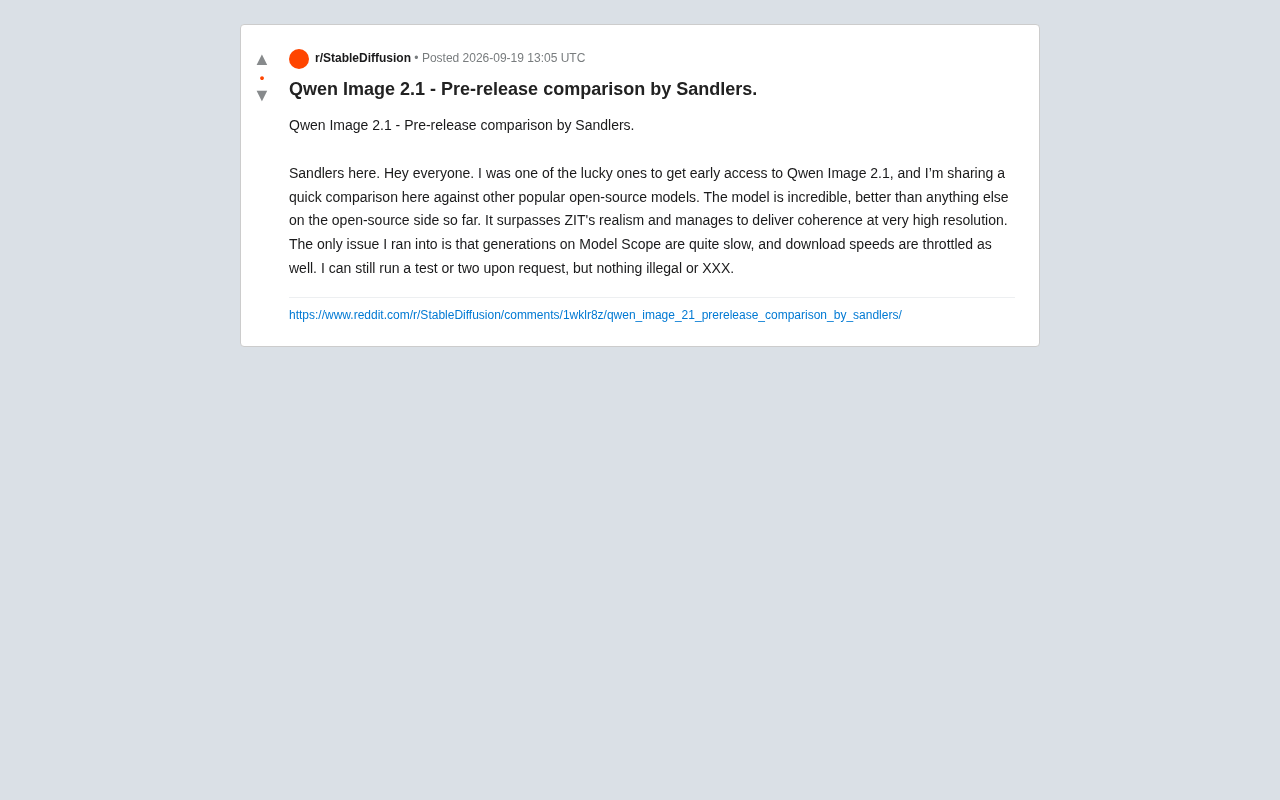
Early tester claims Qwen Image 2.1 outperforms open-source rivals in realism and high-resolution coherence, though platform speed remains a bottleneck.
Reddit user Sandlers, one of a handful of early access testers, shared pre-release impressions of Qwen Image 2.1, finding it superior to all current open-source competitors in two key areas: realism (explicitly surpassing ZIT) and coherence at very high resolutions. The latter is a critical marker separating production-ready models from experimental ones. However, slow generation speeds and download throttling on ModelScope are notable engineering-side shortcomings at this stage. Importantly, this evaluation reflects a single user's subjective judgment without systematic benchmark support — the claim of "surpassing all open-source models" will require broader independent validation after the official release.
Qwen Image 2.1 Early Access Overview
A Reddit user named Sandlers shared his early hands-on experience with Qwen Image 2.1. As one of the few users granted early access, he benchmarked this yet-to-be-officially-released model against other mainstream open-source image generation models — and came away with notably positive impressions.
According to his account, Qwen Image 2.1 "outperforms anything currently available in the open-source space." While this verdict comes from a single user's subjective experience, it signals that the model is already showing strong competitive potential in its pre-release stage.
Core Strengths: Realism and High-Resolution Coherence
Based on Sandlers' feedback, Qwen Image 2.1 has two standout technical highlights.
Realism Surpassing ZIT
He explicitly noted that the model surpasses the ZIT model in terms of realism. Realism is one of the key metrics for evaluating image generation models — especially when generating portraits, scenes, and other content where lifelike quality is critical. A model's ability to render lighting, materials, and fine details directly determines output quality.
ZIT (Zero-shot Image Transfer) is a class of open-source image generation architecture based on diffusion models or generative adversarial networks, well regarded in the community for its high-quality realistic rendering, and often used as a realism benchmark in the open-source space. Evaluating realism typically covers dimensions such as skin texture, light scattering, depth-of-field blur, and material reflectivity. Some researchers also use quantitative metrics like FID (Fréchet Inception Distance) to measure how closely generated images match the distribution of real photographs. If Qwen Image 2.1 already surpasses ZIT on subjective evaluation, it marks a meaningful step forward in perceptual realism — though systematic blind tests or user studies are still needed to confirm whether this advantage holds broadly.
Coherence at Very High Resolutions
Another noteworthy point is that the model "maintains coherence at very high resolutions." Many image generation models suffer from structural distortion, detail collapse, or element repetition when resolution is increased. Maintaining coherence at high resolutions is often the dividing line between production-ready models and experimental ones. If Qwen Image 2.1 truly delivers stable performance in this area, its usability in real production environments would be significantly elevated.
Coherence issues in high-resolution generation typically stem from the resolution constraints used during training. Mainstream diffusion models like Stable Diffusion are natively trained at 512×512 or 1024×1024; when inferring at higher resolutions, the denoising network's receptive field cannot cover the global structure, causing local regions to "hallucinate" independently — resulting in multiple heads, limb distortions, or tiling artifacts. Common solutions include multi-stage super-resolution (e.g., HiDiffusion, MultiDiffusion), region-guided sampling, or fine-tuning on higher-resolution data. If Qwen Image 2.1 natively supports global coherence at high resolutions, it likely reflects targeted improvements in training data scale, attention mechanism design, or post-processing pipelines — which would have real value for film-grade asset production and print output use cases.
Bottlenecks in Practice
The experience wasn't without drawbacks. Sandlers noted that running generation tasks on the ModelScope platform is currently slow, and download speeds are throttled.
These kinds of issues are fairly common during pre-release stages, typically related to platform resource allocation, server load, and unoptimized inference pipelines. For users who need to iterate and test quickly, slow generation and download throttling directly impact workflow efficiency. That said, these are engineering and operations-level issues — not reflections of the model's core capabilities — and are likely to be addressed as infrastructure matures ahead of and following the official release.
ModelScope is the model-as-a-service (MaaS) platform launched by Alibaba DAMO Academy, similar to Hugging Face, offering model hosting, online inference, and dataset management — and is one of the primary distribution channels for the Qwen model family. Download throttling during the pre-release phase is typically due to bandwidth or request-rate quotas applied to beta users, designed to manage server load and prevent large-scale distribution of model weights before the official launch. Slow inference speeds are often tied to shared GPU resource queuing; beta environments generally lack production-grade elastic scaling, so this is not an accurate indicator of throughput performance in local deployment or dedicated inference cluster scenarios.
How to Interpret This Early Review
It's worth being clear-eyed here: this comparison comes from a single user's early access experience — a personal, subjective assessment without the support of systematic benchmark data. Sandlers mentioned he's willing to run one or two additional tests on request (excluding prohibited or adult content), which itself indicates the amount of publicly available information remains limited.
For those following the open-source image generation space, this feedback can serve as a forward-looking signal: the Qwen series continues to push forward in image generation, and version 2.1 could become a noteworthy option in the open-source ecosystem. But until the official release arrives and more independent evaluations emerge, conclusions like "surpasses all open-source models" should be treated with appropriate caution.
Closing Thoughts
Qwen Image 2.1's pre-release experience demonstrates promising potential in realism and high-resolution coherence, while also exposing platform-side issues around speed and throttling. For the open-source community, a more capable image generation model is undeniably welcome news. Just how capable it truly is will only become clear once it faces broader real-world testing after the official release.
Related articles

Does AI Need Antitrust Immunity to 'Avoid Destroying Humanity'? A Warning from the Former DOJ Antitrust Chief
Former DOJ Antitrust Chief Jonathan Kanter warns on the Decoder podcast: should AI companies get antitrust immunity for 'safety'? A deep dive into the risks.
DraftKings Uses AI to Target the Most Likely Losers: The Ethics Debate Behind the Algorithm
DraftKings reportedly uses AI to identify and target the most loss-prone gamblers. A technology that could protect addicts is being weaponized for precision marketing — raising urgent AI ethics questions.
Claude Code Adds Mods and AGENTS.md Support: A Deep Dive
Anthropic adds Mods plugin system and AGENTS.md support to Claude Code, alongside Projects redesign, background computer use, Diff panel, and Skills evaluation tools.