Qwen-Image-2.1 Lands on HF Spaces: A Single Model for Both Image Generation and Editing
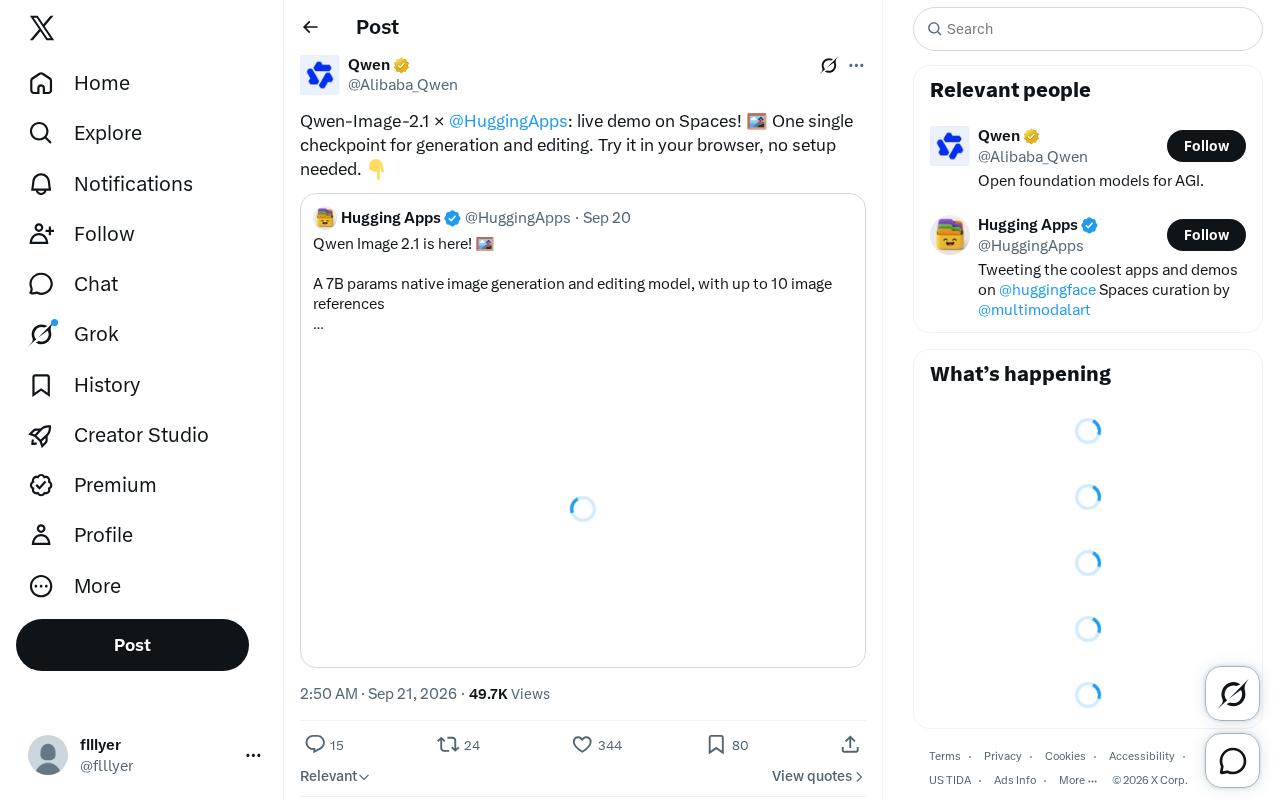
Alibaba's Qwen-Image-2.1 unifies image generation and editing in one model, now available as a browser demo on Hugging Face Spaces.
Alibaba's Qwen-Image-2.1 stands out for using a single set of model weights to support both text-to-image generation and image editing — breaking the convention of relying on separate models for each task. This unified architecture lowers deployment costs for developers and delivers a more seamless user experience. The new version is now live as an online demo on Hugging Face Spaces, requiring no local installation or GPU setup. However, since public information is currently limited to the demo release itself, the model's actual performance on image quality, editing precision, and inference speed remains to be verified through further testing and technical documentation.
Alibaba's Qwen team has launched an online demo of their image model Qwen-Image-2.1 on Hugging Face Spaces, letting users experience image generation and editing directly in the browser — no local setup required. The most notable aspect of this release is that it uses a single checkpoint (model weights) to cover both generation and editing tasks.
One Model for Both Generation and Editing
In traditional image AI workflows, text-to-image generation and image editing typically require separate models or specialized adapter components. Generation models handle creating images from scratch, while editing models deal with localized modifications, style transfer, object replacement, and similar tasks — the two are usually trained independently and deployed separately.
Qwen-Image-2.1 takes a different approach by consolidating both capabilities into a single set of weights. For developers, this means lower deployment overhead — no need to maintain multiple model files or switch between loading different models for generation versus editing. For end users, it translates to a more seamless experience: you can generate an image and then edit it directly within the same interface, without exporting and re-importing into a separate tool.
This "unified checkpoint" philosophy has become increasingly common in the multimodal model space. It reduces system complexity and enables the model to share underlying visual understanding capabilities across both generation and editing tasks.
From a technical standpoint, there are a few common approaches to unifying generation and editing into a single set of weights. One is a conditional generation framework built on diffusion models, where a reference image is introduced as an additional conditioning signal at inference time — allowing the same model to generate images unconditionally from noise or perform local/global edits constrained by an original image. Another approach draws from the instruction tuning paradigm, framing editing tasks as natural language instructions so the model learns to "understand and execute modification intent" rather than simply "generate a new image." The core challenge with both approaches is that generation tasks encourage creative freedom, while editing tasks demand high fidelity to the original content — a tension that exists in their training objectives. Whether a unified checkpoint can match the performance of dedicated models on both task types is the central question when evaluating this kind of architecture.
Zero-Configuration, Browser-Ready Demo
The demo is hosted on Hugging Face Spaces in collaboration with @HuggingApps. Spaces is Hugging Face's model hosting and demo service, allowing anyone to access a running model directly through a browser — no dependency installation, weight downloads, or GPU setup required.
For developers, designers, or content creators who want to quickly evaluate a model's capabilities, this "live demo" format lowers the barrier to entry as much as possible. You simply open the page, enter a prompt or upload an image, and immediately see Qwen-Image-2.1's output. This is now the standard playbook for the open-source model community when launching new versions — get people hands-on first, and let them decide whether to integrate it deeper into their workflow.
Hugging Face Spaces typically runs on interactive web frameworks like Gradio or Streamlit, with model inference handled on cloud GPUs while the user's browser handles only input and output rendering. It's worth noting that free, publicly shared Spaces demos often run on limited shared compute resources, which can result in queuing or slower response times during peak usage. Paid ZeroGPU or private deployments offer a more stable experience. For developers looking to integrate the model into their own products, a Spaces demo serves more as a rapid prototyping tool — production environments will typically still require self-hosting or calling an official API.
What This Means for the Open-Source Image Model Ecosystem
The Qwen series represents one of Alibaba's major investments in open-source large models, and continued iteration on image models further extends its multimodal capabilities. Putting a new version on Hugging Face Spaces right away leverages the world's largest open-source AI community for distribution while also making it easy for community developers to provide quick feedback and build on top of it.
It's worth paying attention to whether a "single checkpoint covering both generation and editing" can match dedicated models in practice. If it can, this would significantly shift how image AI applications are architected — developers could build products with a leaner tech stack, and model vendors could iterate and maintain capabilities in a more unified way.
That said, since the publicly available information is currently focused on the demo release itself, the actual performance of Qwen-Image-2.1 on specific metrics — image quality, editing precision, inference speed — still needs to be validated through hands-on testing and subsequent technical documentation. Interested users can visit the demo page on Hugging Face Spaces to try it out themselves.
Summary
Qwen-Image-2.1 unifies image generation and editing under a single model, and opens it up for browser-based, zero-configuration testing — reflecting the continued evolution of open-source image models toward greater usability and architectural simplicity. For practitioners in the AI image generation space, this is a new option worth trying out firsthand to assess its real-world capabilities.
Related articles

Chain of Thought Isn't Just for AI: How Humans Can Use CoT to Improve Thinking Quality
Chain of Thought isn't just a prompt trick for large models. Starting from a Hacker News discussion, this article analyzes why CoT works for human thinking too, breaks down actionable ways to transfer it, and highlights the key differences between human CoT and machine CoT.
Cloudflare Teams Up with OpenAI: Closi…
Cloudflare Teams Up with OpenAI: Closing the Loop from Vulnerability Discovery to Defense with AI
Cloudflare uses OpenAI Daybreak to investigate security vulnerabilities and generate reviewable remediation plans, while developers use Codex to boost coding efficiency and quality.

Orca Multi-Agent Orchestration in Practice: A Guide to Parallel Collaboration with Claude and Codex
Orca is Stable AI's free open-source agent workbench supporting 34 agents like Claude Code and Codex in parallel. Learn its Git worktree isolation, multi-model orchestration, and mobile management.