Qwen-Image-2.1 Open Source Release: A 7B Lightweight Model Taking on Closed-Source Image Generation

Alibaba open-sources Qwen-Image-2.1, a 7B unified image generation and editing model with native RGBA transparency support.
Alibaba's Qwen team has released Qwen-Image-2.1, a lightweight 7B open-weights model that unifies image generation and editing. Key highlights include native RGBA transparent layer output (eliminating manual background removal), support for up to 10 reference images with local control and strict fidelity for e-commerce and portrait use cases, and coverage of challenging scenarios like panoramas, infographics, and virtual try-on. The model also continues Qwen's strength in text rendering and Chinese typography. It is available on GitHub, Hugging Face, and ModelScope.
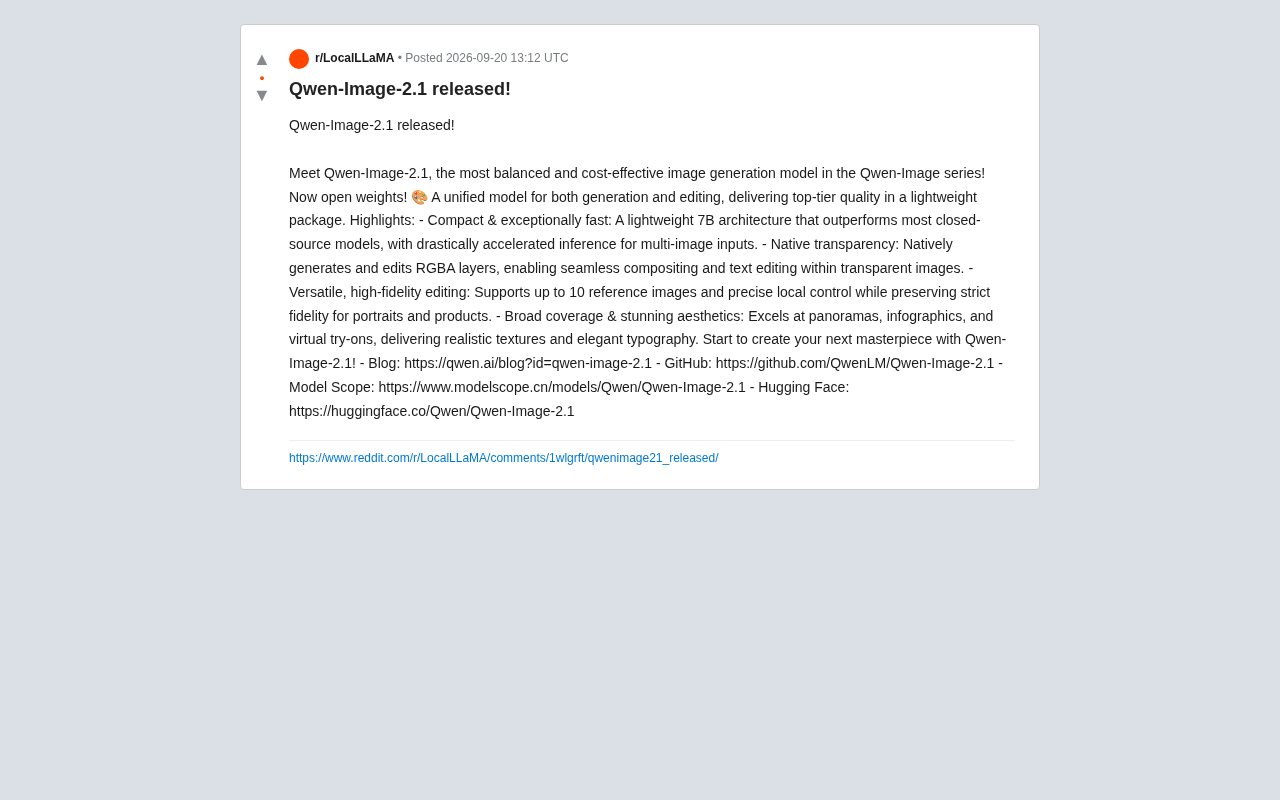
Alibaba's Qwen team has officially released Qwen-Image-2.1, the most balanced and cost-effective model in the Qwen-Image series. This release adopts an open weights strategy, unifying generation and editing capabilities into a single model — aiming to challenge the dominant closed-source solutions with a lightweight architecture.
The Efficiency of a 7B Architecture
One of the most notable aspects of Qwen-Image-2.1 is its size — a lightweight 7B parameter architecture that, according to official claims, outperforms most closed-source models. This "small but powerful" approach reflects a clear trend in the image generation space: compressing model scale while maintaining output quality, thereby reducing deployment and inference costs.
For multi-image input scenarios, the team specifically highlights significant inference speed improvements. This matters a great deal in production environments, where synthesizing multiple reference images is often a performance bottleneck. The smaller parameter count also means lower VRAM requirements, making it accessible for more developers to run locally on consumer-grade hardware.
Native Transparency: Why RGBA Matters
A key technical highlight of this release is native support for generating and editing RGBA image layers. This means the model can directly output images with transparency channels, rather than requiring a separate background removal step after generation.
For design workflows, this capability is significant. Native transparency makes image compositing much smoother and also enables text editing within transparent images. These needs are extremely common in e-commerce assets, UI design, and poster creation — tasks that previously required additional post-processing steps but can now be handled end-to-end at generation time.
RGBA is an image color model that adds an Alpha channel (A) to the standard RGB (red, green, blue) channels, representing the transparency of each pixel (0 = fully transparent, 255 = fully opaque). Traditional image generation models typically output RGB format; producing assets with transparent backgrounds requires additional semantic segmentation or matting algorithms, which are time-consuming and prone to edge artifacts like jagged lines or residual pixels. Native RGBA generation means the model has learned, during training, to understand the semantic boundary between foreground objects and transparent background regions — allowing it to output clean transparency layers directly at inference time. This eliminates post-processing pipelines and significantly reduces engineering complexity for automated, large-scale asset production.
Editing Capabilities and Fidelity
Qwen-Image-2.1 is positioned as a unified generation-and-editing model, with editing as a core focus. The team claims support for up to 10 reference images and precise local control.
For detail-sensitive scenarios such as portraits and product photography, the model emphasizes "strict fidelity" — meaning it preserves the original subject's characteristics as closely as possible during editing. This is a critical metric for commercial applications: distortions in e-commerce product images or human likenesses during editing directly impact usability. The combination of multi-reference image support and local control provides greater flexibility for complex, customized editing tasks.
"Strict fidelity" in image editing refers to a model's ability to maximally preserve the visual characteristics of unmodified regions during localized edits — including a person's facial features, skin tone, and hairstyle, or a product's brand markings, material texture, and shape. This is typically achieved through precise feature extraction and conditional injection from reference images via attention mechanisms, enabling "surgical" precision in edits. For e-commerce use cases, fidelity is directly tied to compliance: many platforms require product images to closely match the physical item. If a model inadvertently changes a product's color or details while adjusting the background or lighting, the resulting assets become unusable or may even create compliance risks.
Scene Coverage and Aesthetic Performance
In terms of application breadth, the team highlights support for panoramas, infographics, and virtual try-on — areas where general-purpose text-to-image models often struggle. Panoramas test spatial consistency, infographics test layout and text rendering, and virtual try-on tests the model's understanding of human bodies and clothing.
The model's performance in texture realism and typographic aesthetics is also emphasized. Text rendering has long been a weak point for image generation models; the Qwen-Image series has previously earned a solid reputation for Chinese text and layout quality, and version 2.1 continues in that direction.
Open Source Ecosystem and Access
This release continues Qwen's established open strategy, with the model available through multiple channels including GitHub, ModelScope, and Hugging Face. Open weights mean developers can freely deploy, fine-tune, and even build commercial applications on top of the model.
- Blog: https://qwen.ai/blog?id=qwen-image-2.1
- GitHub: https://github.com/QwenLM/Qwen-Image-2.1
- ModelScope: https://www.modelscope.cn/models/Qwen/Qwen-Image-2.1
- Hugging Face: https://huggingface.co/Qwen/Qwen-Image-2.1
For developers and creators following AI image generation, Qwen-Image-2.1 is worth testing to verify its claimed performance. The combination of lightweight architecture, open weights, and unified generation-and-editing capabilities gives it a clear differentiated position in today's competitive open-source image model landscape.
Related articles

Chain of Thought Isn't Just for AI: How Humans Can Use CoT to Improve Thinking Quality
Chain of Thought isn't just a prompt trick for large models. Starting from a Hacker News discussion, this article analyzes why CoT works for human thinking too, breaks down actionable ways to transfer it, and highlights the key differences between human CoT and machine CoT.
Cloudflare Teams Up with OpenAI: Closi…
Cloudflare Teams Up with OpenAI: Closing the Loop from Vulnerability Discovery to Defense with AI
Cloudflare uses OpenAI Daybreak to investigate security vulnerabilities and generate reviewable remediation plans, while developers use Codex to boost coding efficiency and quality.

Orca Multi-Agent Orchestration in Practice: A Guide to Parallel Collaboration with Claude and Codex
Orca is Stable AI's free open-source agent workbench supporting 34 agents like Claude Code and Codex in parallel. Learn its Git worktree isolation, multi-model orchestration, and mobile management.