Qwen-Image-2.1 Open-Sourced: A New Benchmark in Image Generation from a 7B Lightweight Model

Alibaba open-sources Qwen-Image-2.1: a 7B model unifying image generation and editing with native RGBA transparency and multi-reference control.
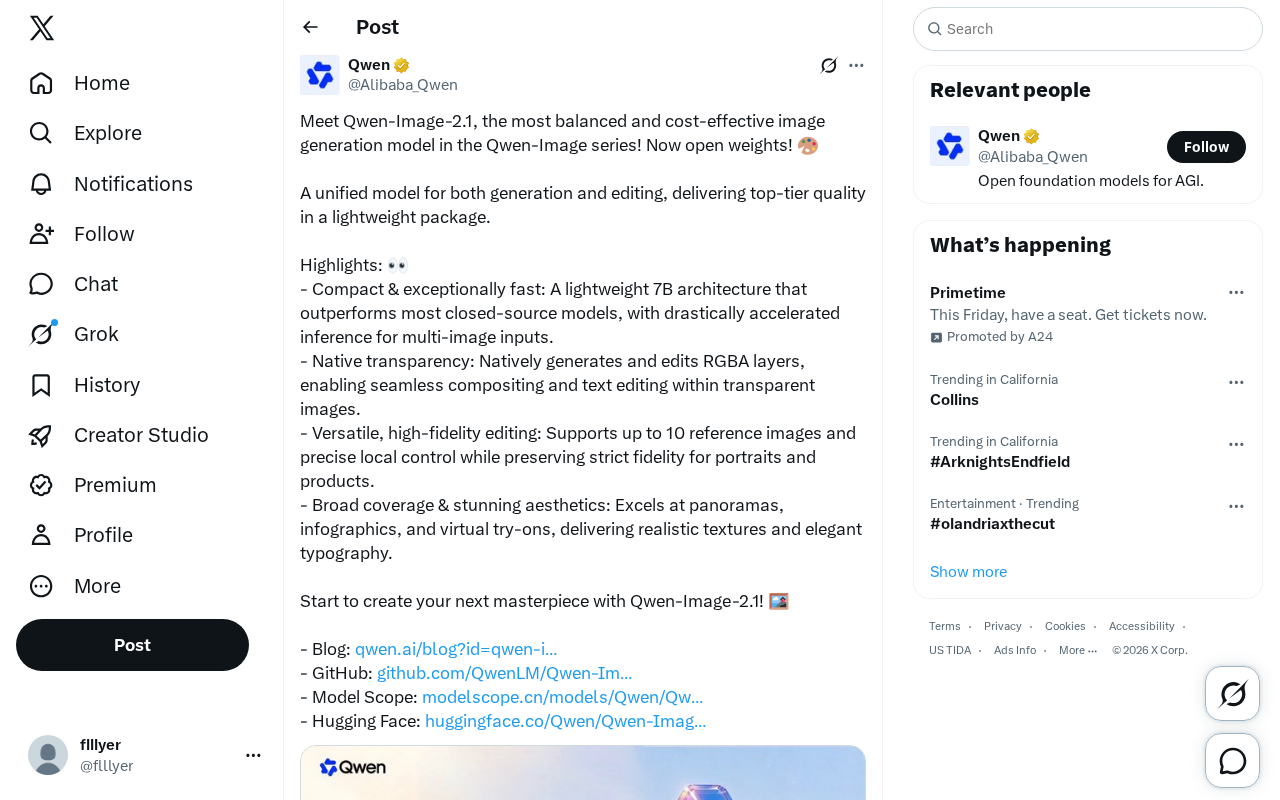
Alibaba's Qwen team has released Qwen-Image-2.1, an open-source image generation and editing model built on a lightweight 7B architecture that unifies both tasks under a single set of weights. Key differentiating features include native RGBA transparent layer generation and editing (with in-layer text editing support), up to 10 reference images with precise local control, and high-fidelity portrait and product editing. The team also claims significantly improved inference speed, especially for multi-image inputs, and support for diverse scenarios including panoramas, infographics, and virtual try-on. Weights are available on GitHub, Hugging Face, and ModelScope.
The Alibaba Qwen team has released the latest addition to the Qwen-Image series — Qwen-Image-2.1 — as open-source weights. The model is positioned around the themes of "balance" and "cost-effectiveness," aiming to achieve breakthroughs in both image generation and editing using a lightweight 7B parameter architecture.
One Model for Both Generation and Editing
The core positioning of Qwen-Image-2.1 is the unification of image generation and editing within a single model. In the past, these two tasks often required separate models or pipelines. A unified architecture means developers can cover a broader range of use cases with a single set of weights, reducing the cost and friction of deployment and task-switching.
The team claims it achieves "top-tier quality" while remaining lightweight. At 7B parameters, it sits on the smaller end of the spectrum compared to today's diffusion models, which often range into the tens or hundreds of billions of parameters. Yet the Qwen team asserts it outperforms most closed-source models — a "punching above its weight" approach that is one of the most closely watched trends in the open-source model community.
Lightweight and Fast: Performance Trade-offs of the 7B Architecture
For image generation models, inference speed and VRAM usage directly determine how widely they can be deployed. Qwen-Image-2.1 uses a compact 7B architecture, and the team emphasizes that inference speed has been "significantly accelerated," particularly when handling multi-image inputs.
This is highly relevant for real-world production environments. Multi-reference image inputs typically slow down inference considerably, so targeted optimization makes batch creation and multi-asset compositing much more feasible. For individual creators and small-to-medium teams, a high-quality model that can run on consumer-grade hardware is often more valuable than a larger model that's difficult to deploy in practice.
Current mainstream open-source image generation models (such as Stable Diffusion XL and FLUX.1) typically range from several billion to tens of billions of parameters, with VRAM requirements often exceeding 12GB — some flagship versions requiring professional-grade GPUs with 24GB or more. A 7B diffusion model can generally keep VRAM usage in the 8–12GB range, meaning consumer machines with RTX 3080 or 4070-class GPUs have the basic conditions to run it. It's worth noting that parameter count is not the only factor in generation quality — training data quality, distillation techniques, and inference step optimization can all significantly improve outputs without increasing parameter count. The claim that "7B outperforms larger closed-source models" is therefore rooted in improved training efficiency, not simply more parameters.
Native Transparent Layers: Direct RGBA Support
One feature of Qwen-Image-2.1 that deserves special mention is its native support for RGBA transparency. The model can directly generate and edit images with an alpha channel, which is extremely practical in real design workflows.
Native transparency means generated assets can be seamlessly composited without requiring an additional background-removal step. Going further, the model also supports text editing within transparent images — a clear efficiency boost for layered use cases such as posters, stickers, and UI assets. Most image generation models output RGB bitmaps without a transparency channel, making this capability a meaningful differentiator among open-source models.
The "A" in RGBA stands for the Alpha channel, which describes the transparency of each pixel on a scale from 0 (fully transparent) to 255 (fully opaque). Traditional RGB images lack this channel, so when transparent backgrounds are needed, assets typically require post-processing with semantic segmentation or AI-powered background removal tools (e.g., Remove.bg, Segment Anything), which can introduce jagged edges or lost detail. Having a diffusion model directly model the Alpha channel requires it to simultaneously learn both "what to draw" and "where to draw it" — a technically more demanding task. This capability has real engineering value for sticker generation, UI icons, product image cutouts, and similar workflows, as it reduces the number of post-processing steps in the pipeline.
High-Fidelity Editing and Multi-Reference Image Control
On the editing side, Qwen-Image-2.1 supports up to 10 reference images and provides precise local control. The team specifically highlights its ability to maintain strict fidelity when editing portraits and product images — two categories where the bar for detail preservation is extremely high, as any facial distortion or product inaccuracy immediately renders the output unusable.
The combination of multi-reference inputs and precise local control makes the model significantly more practical for professional use cases like virtual try-on, product image editing, and consistent character portrayal. These capabilities previously required dedicated custom solutions; they are now integrated into a single general-purpose model.
Multi-reference image control is an advanced editing capability whose core challenge lies in accurately identifying and transferring specific attributes from each of multiple reference images — which may differ in style, lighting, and angle — without mixing up features. Common implementation approaches include IP-Adapter (identity feature adapters), ControlNet (structural control networks), and multi-image cross-attention mechanisms. Supporting up to 10 reference images implies more complex context fusion, placing high demands on the model's attention mechanisms and training data diversity. Portrait editing is particularly demanding in terms of fidelity, as the human eye is extremely sensitive to facial details — subtle distortions in proportion or slight shifts in skin tone are immediately noticeable. This is why high-fidelity portrait editing is often used as a key benchmark for evaluating the overall capability of editing models.
A Wide Range of Supported Use Cases
Beyond standard image generation, Qwen-Image-2.1 also claims strength in diverse tasks including panoramas, infographics, and virtual try-on, delivering realistic material textures and refined typography.
Infographics and text-heavy layouts have long been a pain point for image generation models — accurate text rendering and visually appealing composition test a model's understanding of structured content. If Qwen-Image-2.1 genuinely excels here, it would significantly expand its applicability in commercial scenarios such as marketing materials and e-commerce product displays.
Open Access Across Multiple Platforms
Qwen-Image-2.1 weights are now available across multiple platforms:
- GitHub: Source code and usage documentation
- Hugging Face: Model hosting and online demos
- ModelScope: Alibaba's official model community
- Official Blog: Technical details and release notes
Releasing open weights continues the Qwen series' established tradition of openness. For teams looking to deploy, fine-tune, or build on top of image generation capabilities in their own environments, freely accessible models like this significantly lower the barrier to entry.
Summary
Qwen-Image-2.1 showcases the "small but complete" philosophy of open-source image models — combining a lightweight 7B architecture, unified generation and editing, native transparent layer support, and high-fidelity multi-reference editing. Of course, claims like "outperforms most closed-source models" will still need to be validated through real-world community use. For developers and creators following image generation technology, its open-source nature and balanced positioning make it well worth trying.
Related articles

DeepCell: One-Click AI Generation of Documents, Spreadsheets, and Slides
DeepCell tops Product Hunt with one-click generation of documents, spreadsheets, and slides, using the .deepcell format for linked updates, designed for System 2 tasks like modeling and sales reviews.

Doneas: 15-Minute Daily Accountability Calls That Keep Indie Developers From Procrastinating
Doneas is a daily accountability tool for indie developers: plan tasks on Monday, join a 15-minute call with five builders each day, and log deliveries on a public progress page. This article analyzes its core mechanics, effectiveness, and potential issues around retention and matching.

Fastlane 2.0: Fully Automated AI Ad Campaigns, From Creative to Optimization
Fastlane 2.0 is an AI ad automation tool: enter your website and it learns your brand, generates video and image ads, and runs and optimizes them on Meta, TikTok, Instagram, and YouTube.