Qwen-Image-2.1 Tops Arena Leaderboard: A New Benchmark for Open-Source Image Models

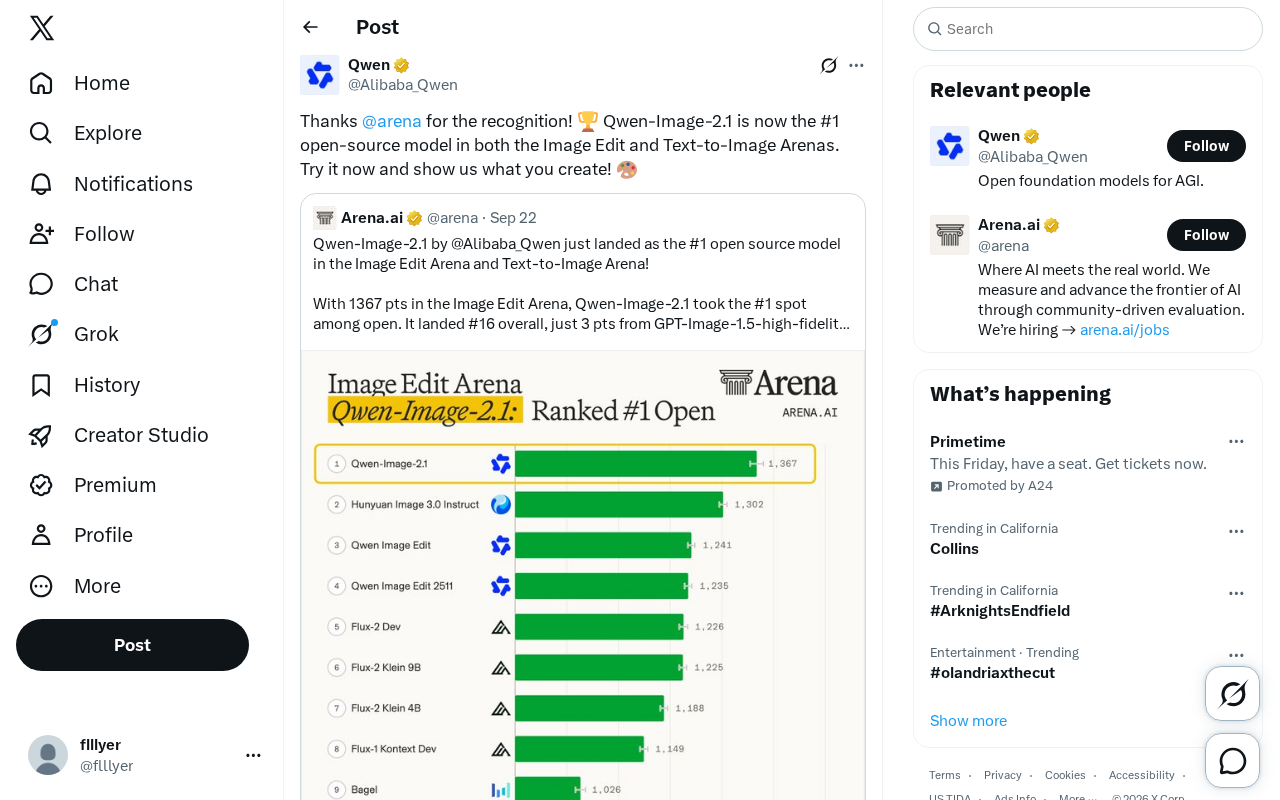
Qwen-Image-2.1 claims #1 open-source rankings on Arena's Image Edit and Text-to-Image leaderboards.
Alibaba's Qwen-Image-2.1 has simultaneously topped both the Image Edit and Text-to-Image tracks on Arena, a leading blind-test evaluation platform, making it the top-ranked open-source model in both categories. Arena's real-user pairwise voting combined with Elo scoring makes results difficult to game, lending credibility to the achievement. Leading in both generation from scratch and precision editing of existing images demonstrates well-rounded capabilities. As an open-source model, it enables private deployment, fine-tuning, and low-cost access to near-top-tier image tools for developers, researchers, and creators alike.
Qwen-Image-2.1 Claims the Top Spot on Both Leaderboards
Alibaba's Qwen team recently announced that its image generation and editing model, Qwen-Image-2.1, has simultaneously topped two major leaderboards on the Arena evaluation platform — the Image Edit and Text-to-Image tracks — making it the #1 open-source model in both categories.
In the official announcement, the team expressed gratitude for Arena's recognition and invited users to try the model and share their creations. This achievement signals that Qwen-Image-2.1 excels not only in generating images from text descriptions, but also in the more demanding task of image editing, which requires deeper semantic understanding and pixel-level precision.
Why the Arena Leaderboard Matters
Arena is a widely recognized blind-testing platform in the AI community. Its core mechanism invites real users to anonymously compare outputs from two different models side by side and vote for the better result. Rankings are then determined using an Elo rating system. Compared to traditional static benchmarks, this "user vote" approach more closely reflects real-world usage and is far harder to game through targeted optimization.
That's why simultaneously claiming the open-source top spot on both the Text-to-Image and Image Edit tracks carries significant weight. It reflects broad user recognition of Qwen-Image-2.1 across multiple dimensions — image aesthetics, prompt following, and editing consistency.
The Dual Challenge of Text-to-Image and Image Editing
Text-to-image generation tests a model's ability to construct a scene from scratch based on a text description, encompassing composition, lighting, detail, and semantic accuracy. Image editing is even more complex — the model must accurately execute localized modification instructions while preserving the original content, placing higher demands on spatial understanding and consistency.
Leading in both directions simultaneously suggests that Qwen-Image-2.1 has a well-rounded underlying capability, rather than being specialized for only one type of task.
The Elo rating system was originally designed by Hungarian-American physicist Arpad Elo for chess tournaments. Its core idea is to dynamically adjust a player's score based on the relative strength of their opponents — defeating a strong opponent earns more points, while losing to a weaker one costs more. In the context of AI model evaluation, each pairwise user comparison is essentially a "match." After accumulating a large number of real-user votes, Elo scores can robustly reflect a model's overall performance ranking. This mechanism has a natural resistance to leaderboard manipulation: if a model only excels at specific styles or instructions, it will quickly be exposed across the diverse range of real user requests and struggle to maintain a top position over time.
The Significance of Open-Source Competition
The "open-source #1" distinction is worth highlighting. Currently, the most capable image generation tools are largely concentrated in closed-source commercial products. An open-source model reaching the top of the leaderboard means developers and researchers can access near-top-tier image generation and editing capabilities without relying on commercial APIs.
This has real practical implications for the broader ecosystem: companies can use the open weights for private deployment and fine-tuning; researchers can examine model internals for interpretability studies; and individual creators can access high-quality tools at a much lower cost. The Qwen series' consistent open-source strategy is now extending into the image domain the influence it has built up in language models.
The key difference between open-source and closed-source models goes beyond price — it comes down to access to model weights. Closed-source commercial products (such as Midjourney, DALL·E 3, and Ideogram) are only available via API; users cannot view or modify the model's internal parameters, and data must be processed through third-party servers. Open-source models allow users to download the full weights and deploy them locally or on a private cloud, satisfying data privacy and compliance requirements. Open weights also enable customization techniques like fine-tuning and LoRA training, allowing vertical industries (such as gaming, advertising, and medical imaging) to train models with domain-specific styles or capabilities on top of a general-purpose base — without bearing the cost of training hundreds of millions of parameters from scratch.
How to Try It
The official announcement explicitly invited users to "try it now" and share their creative results. Those who want to get hands-on can access the model through the Qwen platform or open-source channels. Whether you're generating a brand-new illustration or making localized edits to an existing image, both are direct ways to evaluate its capabilities.
It's worth noting that since the original information came from a brief official social media post, this article has limited detail on specific technical parameters, model architecture, and detailed benchmark data. Interested readers are encouraged to follow the team's official technical reports and model cards for more comprehensive performance details.
Summary
Qwen-Image-2.1's claim to the open-source #1 position on both the Arena Image Edit and Text-to-Image leaderboards marks an important breakthrough for the open-source image model community. It reflects Alibaba's Qwen team's sustained investment in multimodal AI, and provides the open-source community with a high-quality, freely usable foundation for image creation. For practitioners interested in AI-generated art and image editing, this is a new option well worth exploring.
Related articles

Workbuddy for Absolute Beginners: How a Desktop AI Agent Fits Into Real Workflows
A beginner's guide to the Workbuddy desktop AI agent: installation, claiming credits, file management, and building automated workflows—compared with CodeX for fit and cost, helping professionals shift from AI question-askers to AI managers.

OpenAI's New Agent Stack: Computer Use, Decisions API, and Ultra-Fast Workflows
OpenAI Dev Day unveiled a new agent stack: Computer Use outperforms humans, Decisions API delivers ultra-low-latency classification via Luna, Agents API opens the same Computer Use capabilities, and GPT-6.1 Sol costs only one-seventh of Astra. Core updates, benchmark data, and developer insights.

Liang Wenfeng Open-Sources DeepInfo Inference Framework, Takes On U.S. Ban
DeepSeek open-sources its DeepInfo inference framework after its models, featuring GPU/CPU cross-pipelining, small-model prediction with large-model verification, and full Huawei Ascend and NVIDIA chip support—facing the U.S. federal ban head-on. This article analyzes its significance for AI deployment and open-source strategy.