Qwen Meets Cerebras: How Practical AI Is Solving Real-World Problems Faster Than Ever

Qwen open-source models paired with Cerebras inference hardware showcase a faster, more practical path to real-world AI deployment.
A community tweet highlighted a real-world AI application built on Alibaba's open-source Qwen model and Cerebras's wafer-scale inference chip, praised as a standout example of practical AI solving real problems. The article uses this as a lens to examine a key trend: model capability is no longer the main bottleneck — inference speed and deployment cost are what determine whether AI can truly enter everyday workflows. Qwen offers open weights and multilingual support; Cerebras's WSE slashes response latency; together, they upgrade 'runs fine' to 'runs fast.' The article argues that the 'model + hardware + use case' model will become the defining path for scaling AI applications.
The Signal Behind a Tweet
A community tweet recently caught attention: a developer showcased a real-world application built on the Qwen model with Cerebras hardware acceleration, calling it "a great example of practical AI solving real problems" — and noting it runs "faster than ever."
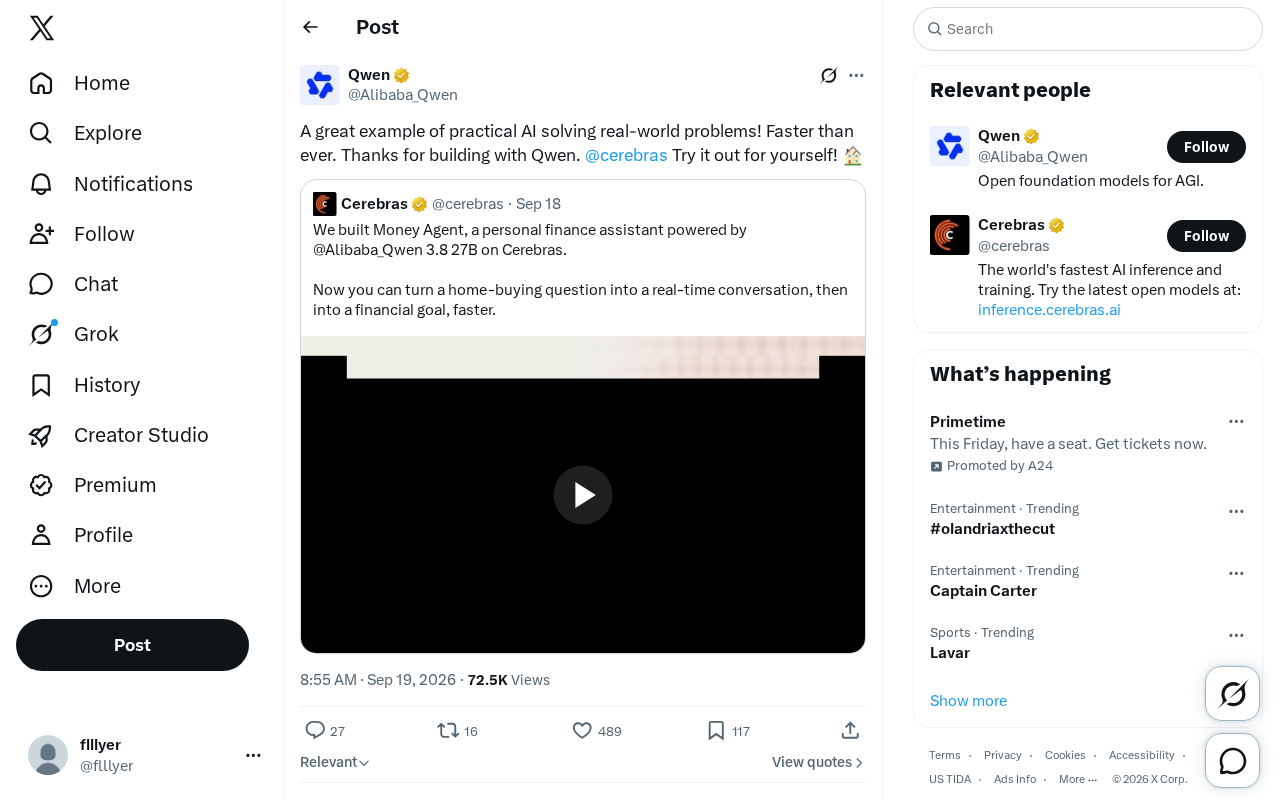
Brief as it was, the post reflects an important trend in AI deployment: combining model capabilities with purpose-built inference hardware is turning "runs fine" into "runs fast" — and that difference is what allows AI to genuinely embed itself into everyday workflows. Worth noting: this article is based solely on that single tweet, and the original post didn't go into detail about the specific application.
Qwen's Open Ecosystem
Qwen (the Tongyi Qianwen series) is Alibaba's family of open-source large language models, and it has built a substantial following in the developer community in recent years. Its open weights, coverage across multiple parameter scales, and support for multilingual and coding tasks have made it a popular foundation for building real applications.
The tweet's phrasing — "Thanks for building with Qwen" — captures exactly what makes open-source models valuable: developers can freely build products on top of them without being locked into a closed API. That openness lowers the barrier to innovation and allows "solve a real problem" applications to emerge quickly.
The Qwen series, developed by Alibaba DAMO Academy, spans model sizes from 0.5B to 72B parameters, with specialized variants including Qwen-Coder for programming tasks, Qwen-Math for mathematical reasoning, and Qwen-VL for multimodal understanding. Model weights are released under Apache 2.0 or similar licenses on Hugging Face and ModelScope, with commercial use permitted — a licensing strategy that has driven rapid adoption across the open-source community. Compared to the Llama series, Qwen holds a clear edge in Chinese language comprehension and generation, while remaining highly competitive across multilingual benchmarks, giving it a solid user base among developers worldwide.
The Speed Advantage Cerebras Brings
The tweet specifically tagged @cerebras and emphasized "Faster than ever." Cerebras is well known for its Wafer-Scale Engine (WSE), which has been a consistent talking point in discussions about large model inference speed.
Deploying open-source models like Qwen on Cerebras's inference platform can theoretically cut response latency dramatically. For user-facing real-time applications, speed isn't just a user experience concern — it directly determines whether AI can actually be put to use. An assistant that takes several seconds to respond and one that replies almost instantly are worlds apart in terms of real-world viability.
The Wafer-Scale Engine (WSE) is Cerebras's core technical differentiator. Conventional GPU chips are typically limited to around 800mm² due to lithography yield constraints, requiring multiple chips to be connected via PCIe or NVLink — inter-chip communication latency and bandwidth bottlenecks become especially pronounced in large model inference scenarios. Cerebras instead fabricates an entire 300mm wafer as a single processor: its second-generation WSE-2 packs 2.6 trillion transistors and approximately 40GB of on-chip SRAM, with memory bandwidth far exceeding what multi-GPU cluster solutions can offer. The bottleneck in large model inference is rarely raw compute — it's the bandwidth required to move model weights from memory to compute units. The WSE's massive on-chip memory eliminates exactly that bottleneck, enabling token generation speeds that can be several times to tens of times faster than GPU-based solutions.
Why "Practical" Matters More Than "Powerful"
The tweet used the phrase "practical AI" rather than "powerful AI" — a distinction worth sitting with. Today's large models are already highly capable, but what actually limits the value they deliver is whether they can serve specific use cases reliably, quickly, and cost-effectively.
The full picture of AI deployment is the combination of model capability, inference hardware, and application context. Qwen provides an open, capable model foundation. Cerebras delivers extreme inference speed. And developers are responsible for pointing both at a real need. This "model + hardware + use case" collaborative model may well be the defining path for scaling AI applications in the years ahead.
Takeaway
Given the limited source material, we can't know exactly what problem this application solves or who it serves. But the direction it points is clear: open-source models are deeply integrating with purpose-built inference hardware, pushing the practical usability of AI to new heights. For developers, it's a signal worth acting on — and trying out yourself.
Related articles

Felix Rieseberg Personal Homepage
Felix Rieseberg's personal homepage sparks attention on Hacker News. This article covers the Slack engineer's technical background, the rise and fall of nativefier, and the value of a developer homepage as a tech calling card.

@ai-sdk/vue 3.0.306 Patch Release Syncs with [email protected] Update
@ai-sdk/vue 3.0.306 released, synced with [email protected]. A routine patch release for the Vercel AI SDK ecosystem with no public API changes; the Vue adapter layer stays version-aligned with the core package.

Gemini 4 Argon API Launches: The Era of Million-Token Output Begins
Google launches Gemini 4 Argon with sparse MoE architecture, up to 1M output tokens, and a 68.90% Vals Index score, available across API, AI Studio, and the Gemini app.