Qwen Model Fabricates Alibaba Cloud Signed URLs Out of Thin Air: Hallucination or Data Exfiltration Risk?
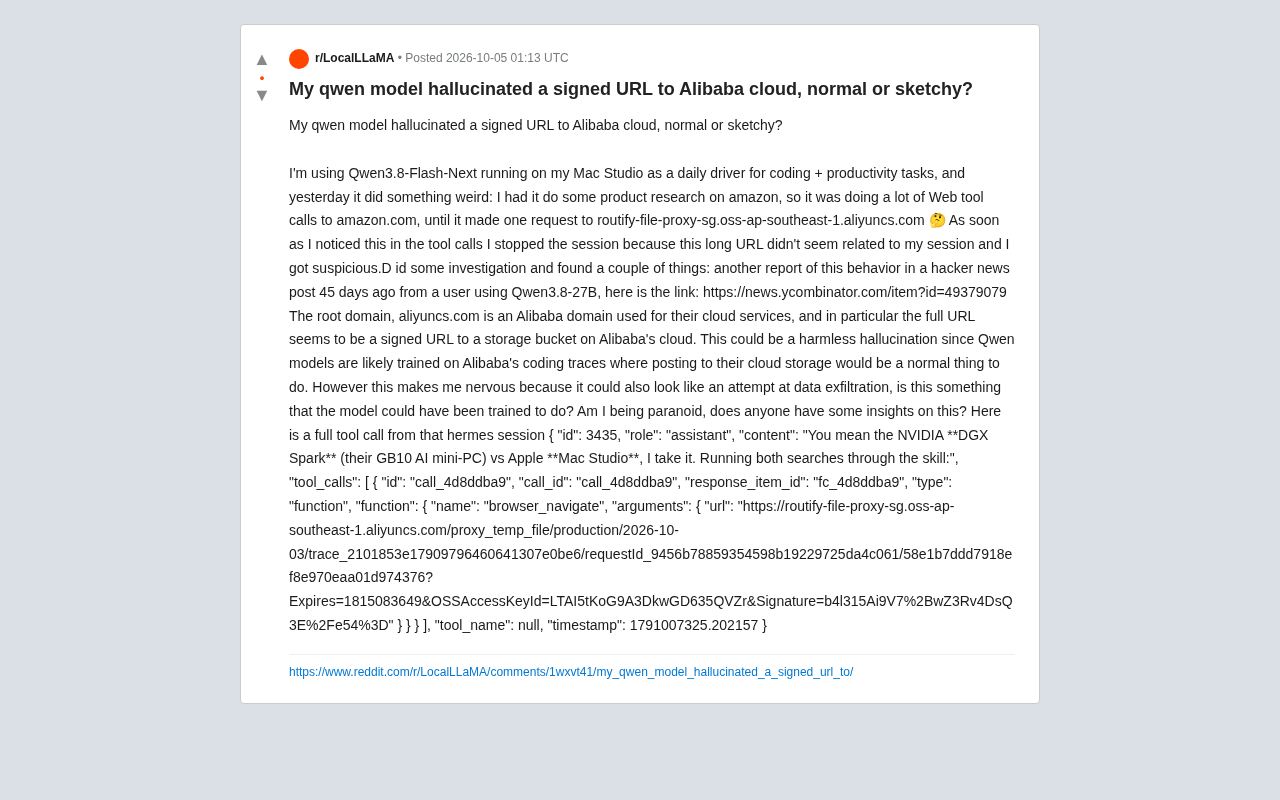
Qwen model fabricated an Alibaba Cloud OSS signed URL mid-task, raising hallucination and security concerns.
A Reddit user found their locally-running Qwen model generating and attempting to access a signed Alibaba Cloud OSS URL during an unrelated Amazon research task. An independent Hacker News report of similar behavior 45 days earlier makes random coincidence unlikely. Analysis suggests the most probable cause is a "structured hallucination" from Qwen's training data, where the model learned OSS URL patterns from Alibaba ecosystem coding traces. While evidence doesn't support deliberate data exfiltration, the incident highlights a critical security concern: with tool-calling capabilities, model hallucinations can trigger real network requests, making domain allowlists and session permission isolation essential Agent safety practices.
A Reddit user recently reported a disturbing incident: while running the Qwen model locally on a Mac Studio as a daily coding and productivity assistant, the model suddenly accessed a signed URL pointing to Alibaba Cloud Object Storage (OSS) during a web tool call. The URL had nothing to do with the current task, immediately raising concerns about data exfiltration. Is this a harmless model hallucination, or a potential security risk?

What Happened: A Suspicious Tool Call
The user had asked the model to conduct product research on Amazon, which prompted a series of web tool calls to amazon.com. But at some point, the model generated and attempted to access a completely unrelated address:
routify-file-proxy-sg.oss-ap-southeast-1.aliyuncs.com
The full tool call log shows a standard browser_navigate operation, with a target URL containing typical Alibaba Cloud OSS signature parameters — Expires, OSSAccessKeyId, and Signature. The URL path also included fields like proxy_temp_file, trace, and requestId, suggesting it resembled a temporary file link generated by some kind of proxy service or call tracing system.
The user terminated the session immediately upon noticing the anomaly. His concern was not unfounded: aliyuncs.com is the root domain used by Alibaba Cloud services, and the full URL pointed to a signed access link for an Alibaba Cloud storage bucket. For a task that was supposed to be browsing Amazon, this redirect was strikingly out of place.
Not an Isolated Case: A Second Independent Report
Notably, this was not a one-off incident. While investigating, the user discovered that another user on Hacker News had reported similar behavior — also involving a Qwen-series model (a different Qwen variant was mentioned), and also featuring a suspicious URL request pointing to Alibaba Cloud storage. The two incidents occurred roughly 45 days apart, involved different users and different model configurations, yet pointed to the same type of domain.
This cross-source recurrence makes "pure random hallucination" an insufficient explanation. When multiple independent cases point to the same underlying infrastructure (Alibaba Cloud OSS), there is likely a systemic cause at play, rather than mere noise.
Two Possible Explanations
Possibility One: Hallucination from Training Data
The most benign explanation is that this is a harmless hallucination. Qwen is developed by Alibaba, and its training corpus likely contains a large volume of coding traces from within Alibaba's internal systems and ecosystem. In such data, reading from or writing to Alibaba Cloud storage buckets is completely routine.
When generating tool calls, the model may have "memorized" the structural patterns of such URLs and, when it needed to construct a file proxy address, drawn on learned distributions from training data to piece together a plausible-looking Alibaba Cloud signed URL. The signature parameters (Signature, Expires) may themselves be fabricated values mimicking the correct format, not corresponding to any real, valid credentials.
The presence of fields like trace and requestId in the URL suggests this looks more like the "ghost" of a server-side proxy file link the model encountered during training — something it later reproduced as if it were an accessible resource.
What are "coding traces"? Coding traces are a specialized type of training data derived from real software development workflows: commit histories, CI/CD logs, API debugging records, server-side request trace files, and so on. Unlike ordinary code snippets, these artifacts often include rich contextual information — real cloud storage URLs, temporary signed credentials, request IDs, and more. When Alibaba trained Qwen, its training data very likely included large volumes of such logs from internal and open-source ecosystem sources — for example, signed links generated when Alibaba's internal systems call OSS. The model learned the syntactic structure of these URLs (domain format, query parameter naming and ordering) across massive numbers of samples, to the point where, when asked to "construct a file access URL," it can reproduce a structurally complete, externally valid-looking Alibaba Cloud OSS link with high confidence. This phenomenon is sometimes called "memorization hallucination" by researchers: rather than fabricating randomly, the model projects high-frequency patterns from training onto inappropriate output contexts.
Possibility Two: Data Exfiltration Concerns
A more alarming hypothesis is whether the model was trained to send data to external servers under certain conditions. From the user's perspective, a locally running model proactively attempting to make a signed request to an overseas cloud storage service naturally triggers associations with data exfiltration.
However, this needs to be assessed objectively: the available evidence is insufficient to support a conclusion of "deliberate exfiltration." The tool call shows a browser_navigate operation, not an active POST upload; the signature in the URL is very likely an invalid fabricated value; and open-source models running locally are hard to use as vehicles for hidden backdoor behavior — widespread community scrutiny makes it very difficult for genuine malicious implants to persist undetected over time.
What is "data exfiltration"? In cybersecurity, data exfiltration refers to the covert transfer of sensitive data from a controlled environment to an external, unauthorized destination. In AI Agent contexts, this threat has a unique dimension: a model with tool-calling capabilities can proactively initiate network requests. If a model is implanted with specific behaviors, it could theoretically silently transmit user data from the context — such as code, document contents, or environment variables — to an attacker-controlled server via GET request URL parameters or POST request bodies. Key evidence points for distinguishing "malicious exfiltration" from "hallucinatory misdirection" include: whether the request is an upload (POST/PUT) rather than navigation (GET/Navigate); whether the signature parameters in the URL are real and valid, verifiable by the server; and whether the behavior is conditionally triggered (only appearing when sensitive keywords are detected). In this incident, the recorded operation was a
browser_navigateaction, and the signature was very likely an invalid fabricated value — both factors reduce the likelihood of malicious exfiltration, though they do not rule it out entirely.
How to Rationally Assess This Type of Incident
Taking both independent reports together, the more reasonable judgment leans toward "structured hallucination induced by training data" rather than malicious design. But that doesn't mean it can be entirely dismissed. For users employing model tool calling in production or sensitive environments, here are a few practical recommendations:
- Restrict tool calls to a network allowlist: Set up domain allowlists for network-capable tools like
browser_navigate, blocking all unexpected external requests. - Manually review high-risk calls: In automated Agent workflows, add human confirmation steps or audit logging for calls involving file read/write operations or external URL access.
- Maintain session isolation: Avoid giving the same Agent session both access to sensitive data and open network access permissions.
- Monitor community feedback: When multiple users report similar anomalies, promptly follow up on official statements from vendors or open-source communities.
At its core, this incident reveals a broader problem: as large models are granted increasingly powerful tool-calling and autonomous execution capabilities, the content a model "hallucinates" is no longer just a text error — it can directly translate into real network operations. Regardless of how this specific case is ultimately classified, establishing strict permission boundaries for Agents is an indispensable security practice today.
What is tool calling (function calling)? Tool calling is the core mechanism by which mainstream LLM frameworks give models "action capability": rather than only outputting text during inference, models can also generate structured function call instructions that are actually executed by an external runtime — for example, searching the web, reading/writing files, or calling APIs. This capability extends the risk of model hallucination from the text layer to the behavioral layer: in the past, if a model hallucinated a nonexistent URL, the worst outcome was a dead link appearing in a response. In an Agent framework, the same hallucination directly triggers a real network request. This is the deeper reason why this incident attracted such widespread attention. Measures such as domain allowlists, call audit logging, and the principle of least privilege (tools can only access the narrowest scope required by the current task) are essentially transplanting the "defense in depth" philosophy from traditional software security into the AI Agent runtime environment. As model autonomy continues to grow, these kinds of boundary controls will become standard requirements for production deployments.
Related articles

Workbuddy for Absolute Beginners: How a Desktop AI Agent Fits Into Real Workflows
A beginner's guide to the Workbuddy desktop AI agent: installation, claiming credits, file management, and building automated workflows—compared with CodeX for fit and cost, helping professionals shift from AI question-askers to AI managers.

OpenAI's New Agent Stack: Computer Use, Decisions API, and Ultra-Fast Workflows
OpenAI Dev Day unveiled a new agent stack: Computer Use outperforms humans, Decisions API delivers ultra-low-latency classification via Luna, Agents API opens the same Computer Use capabilities, and GPT-6.1 Sol costs only one-seventh of Astra. Core updates, benchmark data, and developer insights.

Liang Wenfeng Open-Sources DeepInfo Inference Framework, Takes On U.S. Ban
DeepSeek open-sources its DeepInfo inference framework after its models, featuring GPU/CPU cross-pipelining, small-model prediction with large-model verification, and full Huawei Ascend and NVIDIA chip support—facing the U.S. federal ban head-on. This article analyzes its significance for AI deployment and open-source strategy.