Qwen Opensources Investigation Traces: How Open-Weight Models Prove Their Innocence

Qwen open-sources investigation traces and reproduction scripts of model anomalies, revealing prefilling as the key trigger.
The article centers on the Qwen team's public release of investigation traces regarding anomalous model behavior. The incident originated when a developer running Qwen3.8 locally discovered "strange links." The behavior is rare under normal prompts but can be reliably reproduced with prefilling. The team not only published conclusions but also open-sourced raw token sequences and minimal reproduction scripts, enabling external researchers to independently verify and compare behavioral differences under different inference configurations. The article notes that this demonstrates the auditability advantage of open-weight models: when similar anomalies occur in closed-source models, outsiders can only observe inputs and outputs, whereas open weights make controlled experiments possible. The team reaffirmed support for the open approach and the Apache 2.0 license, and emphasized that safety evaluation must cover guidance methods like prefilling. For developers, these materials can be used to troubleshoot behavioral consistency in their own environments and gradually accumulate into a community-maintained behavior archive.
An Anomaly Discovered by the Community
According to discussions in the Reddit community, the Qwen team has released investigation traces regarding anomalous model behavior, along with open-sourced raw tokens and a minimal reproduction script. The incident began when a developer running Qwen3.8 locally discovered "strange links." This phenomenon does not appear consistently during normal inference—the team stated that the behavior is rare without prefilling, but can be reproduced with specific prompts combined with prefilling.
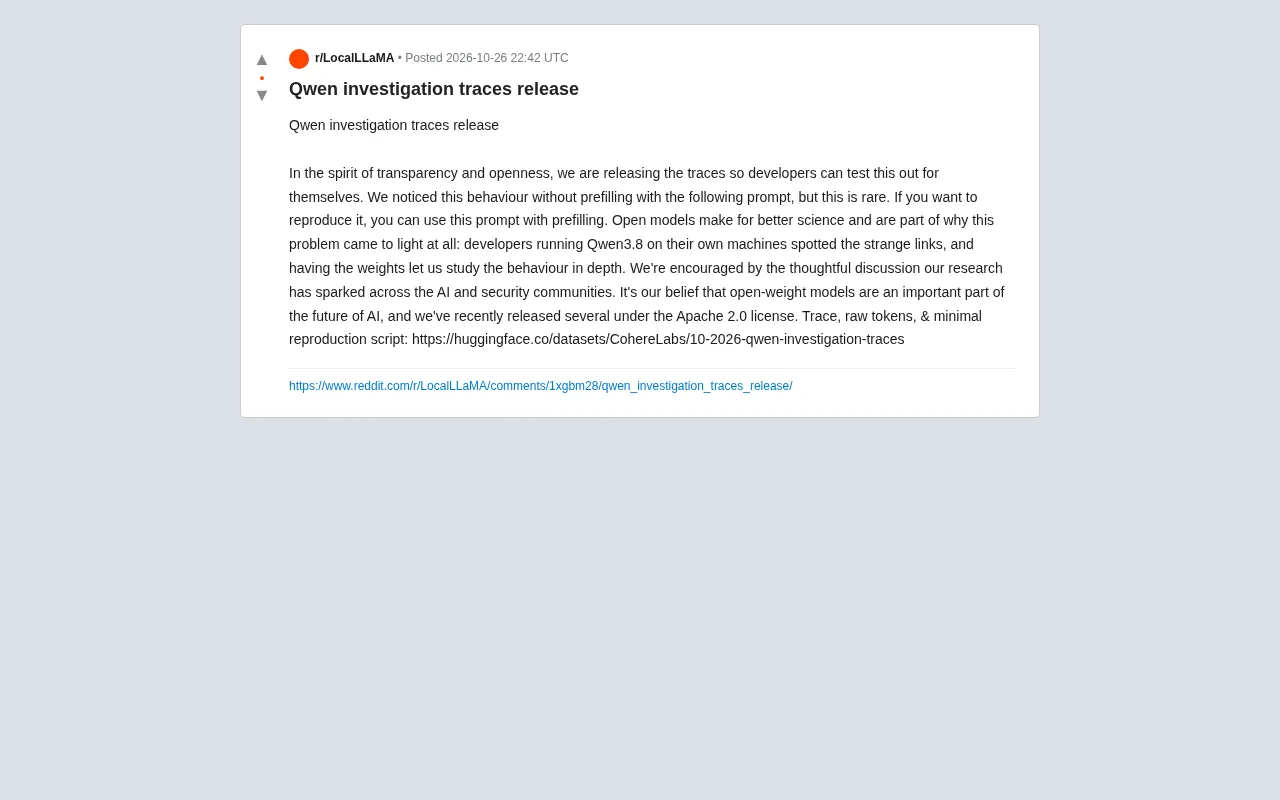
The unusual aspect of this incident is that the problem was not initially discovered by the vendor's internal red team, but by a developer running the model on their own machine. Open weights expose anomalies to broader scrutiny and make subsequent in-depth research possible.
Why Publish "Traces" Rather Than Just Conclusions
Releasing investigation traces means handing over to the community the raw token sequences at the time the anomaly was triggered, along with reproduction scripts. This is more valuable than simply issuing a "we've fixed it" statement: other researchers can independently verify, compare behavioral differences under different inference configurations, and even test whether similar models exhibit similar patterns.
The team emphasized in their statement that open models "make for better science," and stated directly that it was precisely open weights that brought this issue to the surface. They mentioned that they have recently released multiple open-weight models under the Apache 2.0 license, viewing openness as an important part of AI's future.
From an engineering perspective, publishing raw tokens rather than just summaries lowers the barrier for external reproduction. Security research has long been plagued by the inability to reproduce phenomena described by vendors, and the release of traces partially addresses this pain point in form.
"Investigation traces" borrows the concept of trace from software engineering, typically referring to a replayable execution record: the complete input token sequence, the tokens actually generated by the model, sampling parameters (temperature, top_p, seed, etc.), and the minimal code needed for reproduction. What distinguishes it from a model card or incident report is executability—readers don't have to trust textual descriptions but can directly rerun the script and compare outputs. In mechanistic interpretability research, similar artifacts include attention maps, activation probe results, and sparse autoencoder features; trace releases align these internal evidence with external behavior, allowing questions like "does the anomaly really exist" and "is it bound to specific configurations" to be independently adjudicated by third parties.
Prefilling: The Key Variable Triggering the Anomaly
The most technically substantive detail in this disclosure is the role of prefilling in reproduction. Prefilling refers to pre-filling the beginning of an assistant reply in a conversation, guiding the model to continue in a specific direction. The team stated that the behavior is rare under normal prompts but can be reliably reproduced with prefilling.
This points to a more general issue: many anomalies reported as "spontaneously generated by the model" may depend on specific inference configurations. When evaluating model safety, failing to cover guidance methods like prefilling could miss an entire class of behaviors. Conversely, this also shows that sampling tests under default settings alone cannot fully characterize a model's behavioral boundaries.
In engineering implementation, prefilling corresponds to assistant message prefix injection in inference APIs: the caller submits an incomplete assistant reply as part of the conversation history, and the model continues generating from after that prefix without regenerating the prefix itself. The Messages/Chat Completions interfaces from vendors like Anthropic and OpenAI all support this parameter, and local inference frameworks (vLLM, llama.cpp, Transformers) can also implement it by directly concatenating token sequences. It was originally used to enforce output formats (such as requiring JSON returns), skip lengthy role setup, or compress first-token latency. But from a security perspective, prefilling effectively hands part of the generation control to the caller, pushing the model into regions of state space that default sampling can hardly reach—which is why more and more red team work in recent years lists it as an independent attack surface.
Open Weights and Auditability
This incident can be seen as an empirical demonstration of the auditability of open-weight models. When similar anomalies occur in closed-source models, external researchers can typically only observe inputs and outputs, cannot inspect weights, cannot conduct controlled experiments, and find it difficult to determine whether the anomaly is inherent to the model or caused by server-side configuration.
Open weights change this landscape: developers can reproduce locally, researchers can analyze in depth, and community discussions can proceed based on shared technical facts. The team's response to community discussion was that they were "encouraged"—this statement itself reflects that transparent disclosure is becoming a routine part of the model release process rather than an exceptional option for crisis PR.
Of course, publishing traces also brings new considerations—reproduction scripts could be misused. How to balance transparency and security remains a question that the open-weight approach must continuously answer.
Open weights means model parameters can be downloaded and run locally, but training data, training code, and data processing pipelines are not necessarily public, so the gap between it and fully open source is often discussed. For auditing purposes, the key capability that weight accessibility brings is controlled experimentation: researchers can fix random seeds, swap tokenizers, change quantization precision, and inject system prompts, thereby attributing behavioral differences to specific variables rather than only observing black-box API inputs and outputs. This is also the methodological value of open-weight models repeatedly cited in security research—it transforms "the vendor says it's fixed" into "the community can verify whether it's fixed."
Practical Significance for Developers
For developers deploying models locally, this release provides directly usable troubleshooting materials: reproduction scripts can verify whether behavior is consistent in one's own environment, and raw tokens can be used to compare differences across quantization versions or inference frameworks. If prefilling-type features are enabled in one's own applications, it's worth conducting a dedicated test for similar patterns.
In the longer term, if such trace datasets can accumulate continuously, they will form a community-maintained "behavior archive" that helps developers anticipate model performance under edge configurations. The public resource is available at the CohereLabs dataset on Hugging Face (10-2026-qwen-investigation-traces), containing traces, raw tokens, and minimal reproduction scripts.
Related articles

Domestic AI Coding Plans Compared: How to Choose Between Zhipu, Kimi, and MiniMax
Compare Zhipu GLM Coding Plan, Kimi Code, and MiniMax M-Plan on pricing, points/quota rules, and model changes, plus scenario-based selection advice.

JetBrains Open-Sources AI IDE ThinkRail: Multi-Workspace Parallelism and Spec-Driven Development
ThinkRail is an open-source agentic IDE from the JetBrains Innovation Hub built on Pi, featuring multi-workspace parallelism, Git worktree isolation, spec-driven development, and diff review. Completely free under Apache 2.0.

Higgsfield: How AI Video Is Moving from the 1-Minute to the 10-Minute Era
Higgsfield shares AI video breakthroughs from 1 minute to over 10 minutes, covering Astra's text rendering, external tool use for 3D modeling, voice-to-movie, and productivity gains for small creative teams.