Qwen3 27B Local Deployment Test: Frontier-Level Agent Capabilities on a Single RTX 3090

Qwen3 27B delivers frontier-level Agent performance on a single RTX 3090 at a fraction of the cost.
Qwen3 27B, a 27-billion parameter open-source model, achieves near-frontier performance across Agent capabilities, multimodal vision, and financial tool calling while running on a single consumer-grade RTX 3090. Benchmarked by Artificial Analysis, it matches DeepSeek V-Flash in intelligence while offering 100-120 tokens/sec inference speed at a hardware cost of just $100-200, compared to $8,000+ for competing solutions.
A "Frontier-Level" Model You Can Run at Home
The authoritative third-party evaluation organization Artificial Analysis has included Qwen3 27B in its benchmark rankings and completed a series of standardized tests. Artificial Analysis is an independent AI model evaluation organization focused on standardized performance benchmarking of large language models. Unlike single-dimension academic benchmarks such as MMLU or HumanEval, the organization employs a comprehensive scoring system covering reasoning ability, code generation, multilingual understanding, Agent tool calling, and more, while simultaneously measuring inference speed and cost efficiency. It has become an important industry reference for comparing the cost-effectiveness of different models.
This open-source model quickly sparked community discussion—its overall performance rivals top closed-source models, yet its hardware requirements are surprisingly low.
According to hands-on testing by a blogger specializing in local deployment and Agent workflows, Qwen3 27B sits in the same tier as the DeepSeekAd V-Flash series on the overall intelligence leaderboard (52-53 point range), with its biggest killer feature being cost-effectiveness and inference speed. In his own words: "If you have a spare RTX 3090 lying around, you're already in the game."
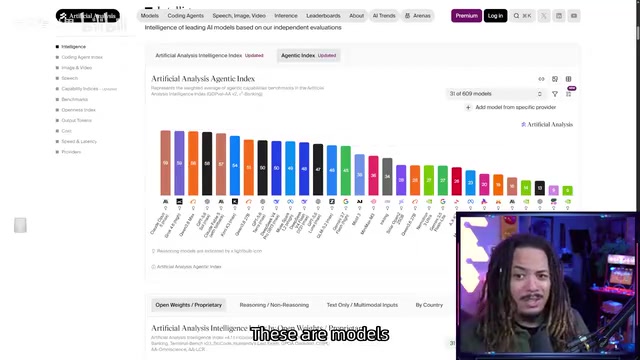
Behind this statement is a very real hardware cost comparison: DeepSeek V-Flash requires two DGX Sparks (approximately $8,000) or nearly six 3090s to run smoothly; GLM, DeepSeek Pro, and other large models require RTX 6000 or 5090-level multi-GPU workstations. Meanwhile, the 27B-parameter Qwen3 can run on just one or two 3090s.
It's important to understand the technical significance of the 27B parameter scale: parameter count (27B meaning 27 billion parameters) is the core metric for measuring LLM scale. For reference, GPT-4 is speculated to have over 1 trillion parameters, and DeepSeek V3 has approximately 670B parameters. 27B falls into the "medium-scale" category, with its advantage being the ability to perform inference within the VRAM (24GB) of a single consumer-grade GPU, while approaching larger models' capabilities through more efficient training methods—such as better data ratios, improved attention mechanisms, and knowledge distillation. This represents a "punching above its weight" technical approach, using algorithmic advances to bridge the parameter gap.
Inference Speed: The Core Competitive Advantage of Local Deployment
Throughout this round of testing, the blogger repeatedly emphasized one core conclusion: At equivalent intelligence levels, Qwen3 27B's inference speed delivers a crushing advantage.
Specific data:
| Model | Inference Speed (tokens/sec) |
|---|---|
| Qwen3 27B (single 3090) | 100-120 |
| DeepSeek series | ~80 |
| GLM series | 30-40 |
When running on a DGX Spark, Qwen3 27B can also maintain a stable 20-30 tokens/sec. For Agent workflow scenarios, speed directly determines experience—Agents require multiple rounds of tool calling and continuous reasoning, and halving the speed means halving the efficiency of the entire task chain.
Some background on hardware choices: The NVIDIA RTX 3090 is a consumer flagship GPU released in 2020, equipped with 24GB GDDR6X VRAM. In LLM inference, VRAM capacity is the most critical bottleneck—model parameters need to be fully loaded into GPU VRAM for efficient operation. A 27B parameter model at FP16 precision occupies approximately 54GB of VRAM, but through 4-bit quantization (GPTQ/AWQ and similar techniques) can be compressed to approximately 14-16GB, just fitting within a single 3090. By comparison, the NVIDIA DGX Spark is a professional AI workstation priced at approximately $3,999 per unit with 128GB unified memory, targeting enterprise deployment. Used 3090s currently sell for approximately 800-1500 RMB (roughly $110-210), representing a hardware cost difference of tens of times.
Running DeepSeek V-Flash requires two Sparks, while GLM-level models need four. From the perspective of "how much intelligence can each dollar buy," Qwen3 27B is currently one of the most cost-effective local deployment options.
Agent Capabilities: Breaking into the Top Tier
If Qwen3 27B only ranks "mid-table" on the overall intelligence leaderboard, its performance on the Agentic capability leaderboard is nothing short of impressive.
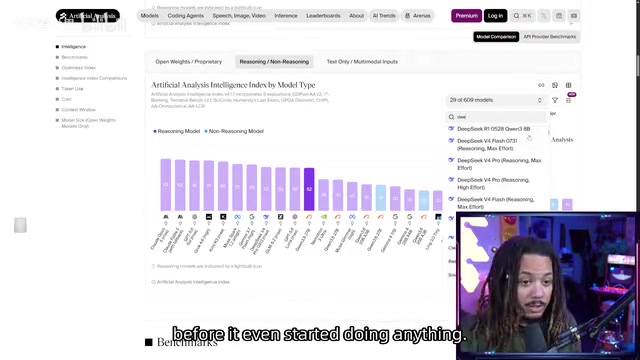
According to Artificial Analysis data, Qwen3 27B surpasses DeepSeek V-Pro, DeepSeek V-Flash, and multiple closed-source models on the Agent capability leaderboard, tying with Kimi K3 and trailing the top spot by only about 6 points. This raises a thought-provoking question: What qualifies as a "Frontier" model?
From a pure data perspective, an open-source model that can run on a single GPU while ranking among the top in Agent capabilities is enough to challenge the established notion that "frontier must mean closed-source large models."
Which Agent Scenarios Is Qwen3 27B Best Suited For?
For users whose primary workflow involves Agents, the blogger listed practical use cases:
- Marketing ads and tweet writing
- Information gathering and brainstorming
- Shopify order processing and customer service
- Content creation planning
- Video transcription and script writing
To understand why these scenarios are suitable for Agent models, it helps to understand the technical nature of Agent workflows: An Agent workflow means the LLM no longer serves merely as a single-turn Q&A tool, but acts as an autonomous "agent" executing multi-step tasks. A typical Agent workflow involves: understanding user intent → decomposing tasks → selecting and calling external tools (such as search engines, databases, APIs) → obtaining results → reasoning about next steps → final aggregated output. This requires the model to have strong instruction-following ability, tool-calling formatting capability (such as Function Calling), and context retention throughout long chains. Speed is crucial in Agent scenarios because a single complete task may involve 5-20 consecutive inference calls, with each inference delay accumulating and amplifying.
These tasks are precisely the battleground for Agent-type models, and Qwen3 27B is fully capable of handling them.
Multimodal Vision and Financial-Grade Tool Calling Capabilities
Beyond speed and Agent capabilities, Qwen3 27B is also a natively multimodal model supporting visual input, filling the gap left by DeepSeek V-Flash's inability to process images.
A multimodal model refers to an AI model capable of simultaneously processing multiple input modalities such as text, images, and audio. Traditional text-only LLMs cannot understand image content and require a separate vision encoder. Natively multimodal models integrate visual capabilities at the architecture design stage, typically using a Vision Transformer (ViT) as the image encoder to convert images into token sequences that are then fed into the Transformer alongside text tokens for joint reasoning. This means the model can directly perform tasks like "analyzing data from charts," "recognizing text in screenshots," and "understanding UI layouts" without relying on external OCR or image recognition services.
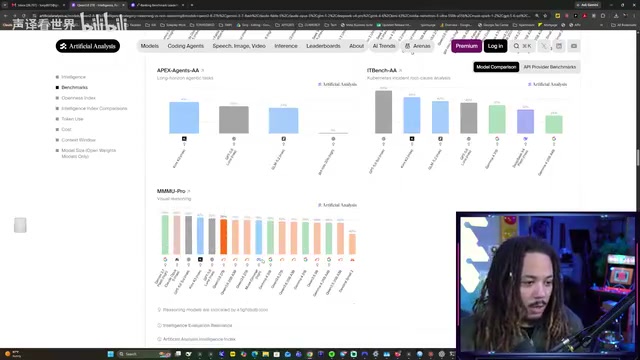
On the visual reasoning leaderboard, Qwen3 27B scored 76 points, trailing just behind several top vision models. Previously, sending images to DeepSeek required calling an auxiliary model for image recognition, whereas Qwen3 27B can directly process image inputs natively.
Even more noteworthy is the model's performance on the "Banking/Fintech" benchmark—it achieved second place in the Agent tool-calling dimension. This benchmark evaluates whether an Agent can navigate vast unstructured knowledge bases and execute multi-step tool calls to solve real financial business processes:
- Credit card recommendations and dispute resolution
- Cashback program matching
- Business account selection
- Invoice processing and bookkeeping
Additionally, Qwen3 27B's non-hallucination rate reaches approximately 70 points, significantly outperforming Opus 5 and the DeepSeek series—a critical metric for business applications requiring accuracy. Hallucination is one of the core pain points of LLMs, referring to the model generating content that appears plausible but is actually incorrect or fabricated. In business applications, hallucinations can lead to erroneous financial advice, fake legal citations, or nonexistent product information. A 70-point non-hallucination rate means that in standardized tests, approximately 70% of the model's outputs can be verified as factually correct—while not yet reaching 100% reliability, it already has practical value for business processes with human review steps, and significantly outperforms many models at the same level.
The context window supports 256K tokens, which is sufficient for most practical scenarios. For reference, 256K tokens is roughly equivalent to a 400,000-500,000 character Chinese book or hundreds of pages of PDF documents, meaning the model can process large amounts of contextual information in a single conversation without segmentation.
Deep Reasoning: The Trade-off Between Higher Accuracy and Longer Wait Times
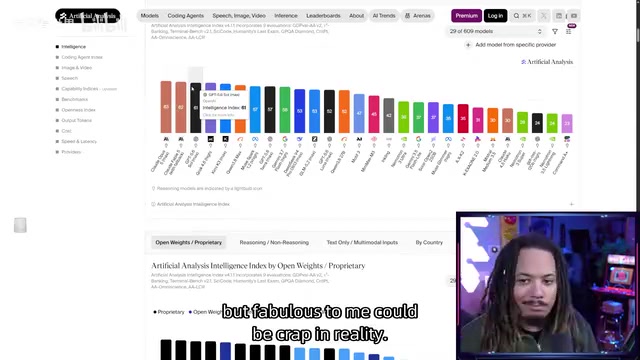
In reasoning capability, Qwen3 27B leads DeepSeek V-Flash by approximately 10 points (the two tie in maximum effort mode). However, it should be noted that this is a "heavy reasoning" model—during testing, the model reasoned for nearly 30 minutes before producing output.
This involves the core mechanism of modern reasoning models: Chain-of-Thought (CoT) technology. Modern reasoning models (such as o1, QwQ, DeepSeek-R1) perform extensive internal reasoning steps before outputting the final answer. These reasoning processes consume additional token generation time—the model may "think" through thousands or even tens of thousands of tokens before providing an answer. The "thinking mode" toggle essentially controls the token budget allocated to internal reasoning: when off, the model outputs answers directly (fast but potentially less accurate); when on, the model spends more time on self-verification and multi-angle analysis (accurate but slow). A 30-minute reasoning time indicates the model may have generated extremely long chains of thought on complex math or logic problems.
Therefore, for everyday use, it's recommended to set "thinking mode" to lightweight or turn it off entirely in exchange for faster responses. This reveals a universal trade-off in reasoning models: Deeper thinking brings higher accuracy, but also means longer waiting. For Agent scenarios that prioritize speed, turning off deep thinking and relying on the model's base capabilities is often more practical.
Conclusion: Open-Source Models Are Rapidly Approaching the Closed-Source Frontier
Overall, Qwen3 27B stands as one of the most significant open-source model releases to date. It matches DeepSeek V-Flash in capability, but the most fundamental difference between them lies in accessibility:
- DeepSeek V-Flash: Entry threshold approximately $8,000+
- Qwen3 27B: Runs on a single used 3090 (around $100-200 level), dual cards can achieve stable 80-100 tokens/sec
Core conclusion: Open-source models are rapidly approaching the capability boundaries of closed-source frontier models at much lower hardware thresholds. For developers and entrepreneurs who prioritize local deployment, privacy, and cost control, high-performance models like Qwen3 27B that "can run at home" represent an extremely attractive option.
Behind this trend is the convergence of multiple technological advances: more efficient model architecture designs (such as Grouped-Query Attention/GQA and lightweight variants of Mixture of Experts/MoE), higher-quality training data strategies, maturation of post-training alignment techniques (RLHF/DPO), and the proliferation of quantized inference technology. Together, these advances enable medium-scale models to achieve capability levels that only top closed-source models possessed a year or two ago, at one-tenth the hardware cost. As this trend continues, "AI democratization" will no longer be a slogan but a reality unfolding before our eyes.
Note: Some naming conventions in the video differ from current publicly available information. The core data in this article comes from Artificial Analysis evaluations and the blogger's hands-on testing, and is provided for reference only.
Related articles

Chain of Thought Isn't Just for AI: How Humans Can Use CoT to Improve Thinking Quality
Chain of Thought isn't just a prompt trick for large models. Starting from a Hacker News discussion, this article analyzes why CoT works for human thinking too, breaks down actionable ways to transfer it, and highlights the key differences between human CoT and machine CoT.
Cloudflare Teams Up with OpenAI: Closi…
Cloudflare Teams Up with OpenAI: Closing the Loop from Vulnerability Discovery to Defense with AI
Cloudflare uses OpenAI Daybreak to investigate security vulnerabilities and generate reviewable remediation plans, while developers use Codex to boost coding efficiency and quality.

Orca Multi-Agent Orchestration in Practice: A Guide to Parallel Collaboration with Claude and Codex
Orca is Stable AI's free open-source agent workbench supporting 34 agents like Claude Code and Codex in parallel. Learn its Git worktree isolation, multi-model orchestration, and mobile management.