Qwen3 27B Local Testing: How Does It Actually Perform with 16GB VRAM?
Real-world Qwen3 27B testing on 16GB VRAM: impressive results hampered by slow inference speed.
This article presents hands-on testing of Qwen3 27B running locally on an RTX 5060 Ti with 16GB VRAM. While the model delivers impressive results in web page generation, 3D game creation, and video understanding — with benchmark scores surpassing some closed-source models — the 16GB VRAM limitation forces memory offloading that drops inference to under 7 tokens/second. It's a powerful model worth watching, but needs stronger hardware or further optimization to serve as a true daily driver.
Qwen3 27B: An Open-Source Model Positioned as Your Local Daily Driver
Qwen3 27B (the 27B parameter version of the Tongyi Qianwen 3 series) was released by Alibaba, positioning itself as a "locally runnable daily driver model" with native multimodal capabilities. In theory, it can run on consumer-grade hardware — but how does it actually perform?
This article is based on hands-on testing by Bilibili content creator Kinto, covering real-world usage experience, architecture analysis, and benchmark results to provide a comprehensive breakdown of this model's true performance in a 16GB VRAM environment.
Test Environment and Hardware Configuration
All tests were conducted using llama.cpp, with the GGUF quantized version of Qwen3 27B — specifically UD-Q4_K_XL. GGUF (GPT-Generated Unified Format) is a model file format proposed by Georgi Gerganov, the maintainer of the llama.cpp project, optimized specifically for local inference. It packages model weights, tokenizer configuration, and metadata into a unified format for easy cross-platform loading. Quantization is a technique that compresses model weights from their original 16-bit or 32-bit floating-point representation to lower bit-widths, trading some precision for smaller VRAM footprint and faster inference speed. Q4_K_XL is a variant of 4-bit quantization — "K" indicates the k-quant method, which assigns different quantization precision to different layers based on their importance, while "XL" means more critical layers retain higher precision. The tester specifically emphasized not using quantization below Q4, because lower levels (such as Q3 or Q2) cause excessive weight information loss in coding tasks, potentially resulting in syntax errors, broken logic, or even nonsensical output — a dramatic drop in quality.
The hardware configuration was: RTX 5060 Ti with 16GB VRAM + 64GB system RAM. The critical limitation is that a 27B model cannot fit entirely into 16GB of VRAM and must offload to system memory, which directly causes a significant drop in inference speed. Offloading refers to when the model's parameter count exceeds GPU VRAM capacity, and the inference framework "unloads" some of the model's layers to run in system memory. GPU VRAM bandwidth is typically in the 500–1000 GB/s range, while DDR5 system memory bandwidth is only about 50–80 GB/s — a gap of over 10x. Since the core bottleneck of model inference is memory bandwidth — every generated token requires reading the entire model weights once (the so-called "memory-bound" characteristic) — when a large number of layers are forced to run in system memory, speed plummets from dozens of tokens per second to single digits.
Web Page Generation Test: Impressive Results but Painfully Slow
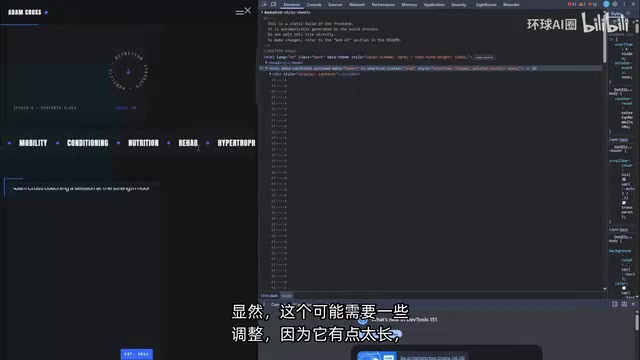
The first test asked the model to build a modern, responsive "Personal Trainer" single-page portfolio website using inline CSS and vanilla JS, all within a single HTML file. The results were quite impressive:
- Beautiful layout, essentially usable as-is (just swap out images and icons)
- Correct copy, though with typical AI-style writing
- Successfully implemented responsive layout
The tester called this one of the most impressive websites he'd ever seen generated by a "mid-size model." But the cost was speed — the entire generation process took 1 hour and 10 minutes, averaging only 6.42 tokens per second.
3D Game Generation: Impressive Capabilities but Questionable Practicality
The second test was far more challenging: building a playable 3D racing game using Three.js in a single file. Three.js is currently the most popular JavaScript 3D graphics library. It wraps the low-level WebGL (Web Graphics Library) API, allowing developers to create 3D scenes, lighting, materials, and animations in the browser with relatively concise code. WebGL is a browser-built-in graphics rendering interface based on the OpenGL ES standard, capable of directly leveraging GPU hardware-accelerated rendering. For AI models, generating a runnable 3D game in a single HTML file is an extremely difficult comprehensive task: it requires correct 3D math (vectors, matrix transformations), physics engine logic (collision detection, velocity decay), and coordination of render loops, user input handling, and game state management. Interactive 3D WebGL physics engines are typically the "breaking point" for small models.
The game was called "Apex" and featured a three-lap track, four cars, and nine checkpoints. The graphics were impressive, and it even implemented track boundary collision detection. The tester noted this was a massive improvement over the previous generation.

But there were notable issues:
- Other AI-controlled cars wouldn't drive
- Ranking logic was incorrect
- Steering controls were abnormally sensitive with direction mapping problems
Speed was even more discouraging: with context set to 65,000, this test took a whopping 2 hours and 15 minutes, averaging only 4.78 tokens per second. The tester bluntly stated that using this hardware setup as a daily tool for 3D tasks "isn't really viable."
Multimodal Video Understanding: The Biggest Surprise
The most surprising aspect of this test was the model's native multimodal capability, especially video understanding. Previously, this was nearly impossible to achieve in llama.cpp, but now it can run locally.
The tester fed the model a 10-second silent video (a skateboarding scene) and asked for a structured analysis. The results were stunning:
- Accurately identified the person's clothing and action details
- Described action milestones with precise timestamps
- Even inferred environmental context information
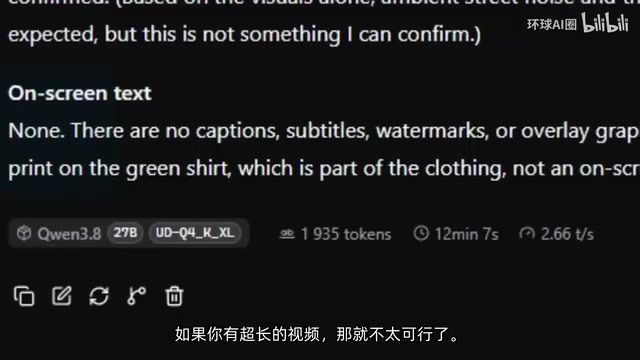
Efficiency was also satisfactory — analyzing this 10-second video took only 12 minutes. This means that even with underpowered hardware, the model can handle video analysis tasks, making "locally adding subtitles to videos" a reality.
Mixed Results on Logic Reasoning
On pure logic tests, the model showed mixed results. On the classic "counting fingers" test, it failed even with thinking mode enabled. However, it successfully passed the "car wash test" (whether to walk or drive to a car wash 50 meters away), correctly reasoning that one should drive there.
Architecture Analysis: Hybrid Attention Mechanism and Multi-Token Prediction
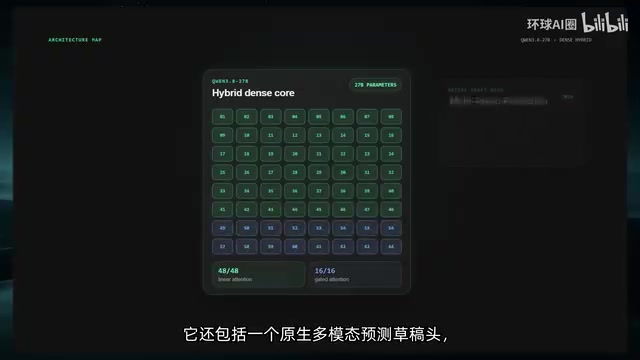
At the architecture level, Qwen3 27B remains a dense model rather than taking the MoE (Mixture of Experts) route. A dense model means all 27B parameters participate in computation during every inference pass. In contrast, the MoE architecture splits the model into multiple "expert sub-networks," activating only a subset during each inference (for example, DeepSeekAd-V3 has 671B total parameters but activates only 37B per pass). MoE's advantage lies in achieving a larger model's knowledge capacity at lower computational cost, but its large total parameter count still means high VRAM usage, and the routing mechanism adds engineering complexity. Qwen3 27B's choice of dense architecture means its 27B parameters are "what you see is what you get" — model size equals actual computation, making it better suited for resource estimation and optimization in local deployment scenarios.
It uses Linear Attention in 48 of its 64 layers, with the remaining layers using standard gated attention. Standard Transformer self-attention has O(n²) computational complexity, where n is the sequence length, meaning computation grows quadratically when processing long sequences. Linear attention reduces complexity to O(n) through techniques like kernel function decomposition, dramatically lowering the computational overhead for long sequences — crucial for supporting 262K or even million-level context windows. This 48+16 hybrid design achieves an elegant balance between efficiency and expressiveness — linear attention handles large volumes of contextual information efficiently, while standard attention layers maintain precise capture of subtle semantic relationships at key positions.
Key features include:
- Native MTP (Multi-Token Prediction) Head: Traditional autoregressive language models predict only one token at a time, while multi-token prediction trains the model to simultaneously predict multiple future tokens. Combined with Speculative Decoding, the MTP head quickly "drafts" multiple candidate tokens, which the main model then verifies in a single pass. If prediction accuracy is high enough, this effectively generates multiple tokens in one forward pass, boosting inference throughput by 1.5–2x or more. vLLM and SGLang are currently the mainstream high-performance inference frameworks that provide native support for such optimizations. It's worth noting that MTP acceleration is most significant in GPU-fully-loaded scenarios; in memory offload scenarios, the bandwidth bottleneck limits the acceleration gains.
- Massive Context Window: Native 262K, expandable to 1 million tokens
- Native Multimodal Input: Works out of the box with code, charts, UI screenshots, and long videos
- Flexible Thinking Control: Toggle thinking mode on/off and adjust reasoning effort level
Benchmark Results: Generational Leaps Across Multiple Metrics
On authoritative benchmarks, Qwen3 27B delivered impressive scores:
| Benchmark | Previous Gen | Qwen3 27B | Notes |
|---|---|---|---|
| Terminal Bench 2.1 | 63.4 | 73 | Major improvement |
| LiveCodeBench V6 | 83.9 | 90.3 | Slightly exceeds Opus 4.6 Max (88.8) |
| DeepSeek Benchmark | 13.3 | 42.2 | Generational leap |
| OSWorld Verified | — | 84.3 | Exceeds Opus 4.6 Max (72.7) |
Each of these benchmarks has a different focus: Terminal Bench 2.1 primarily evaluates a model's ability to complete complex software engineering tasks in terminal/command-line environments, including code writing, debugging, and system operations; LiveCodeBench V6 is a continuously updated programming ability evaluation that uses competitive programming problems to avoid data leakage, testing algorithmic reasoning and code implementation; OSWorld Verified evaluates a model's ability as a Computer Use Agent to complete tasks in real operating system environments, such as operating GUIs, managing files, and using applications.
The biggest jump appeared on the DeepSeek-class benchmark, soaring from 13.3 to 42.2. On OSWorld Verified, the score of 84.3 even surpassed top-tier closed-source models — meaning a locally runnable open-source 27B model has caught up with or even exceeded top closed-source models on the cutting-edge capability of "operating a computer." This would have been almost unimaginable just six months ago.
Conclusion: Worth Watching but Needs Optimization
If you want an open-source model that can serve as a local daily driver, Qwen3 27B is one of the strongest options available. Its performance across web generation, 3D graphics, video understanding, and benchmarks is all commendable.
Strengths:
- Excellent multimodal capabilities with strong practical video understanding
- Outstanding benchmark scores, surpassing closed-source models in multiple areas
- Supports local execution with controllable privacy and costs
Weaknesses:
- Notably slow: Inference is very slow in 16GB VRAM offload scenarios
- High token consumption: Reasoning traces are very long in thinking mode
For users with more powerful hardware (capable of fitting the entire model in VRAM), this model's practical value increases dramatically. With the RTX 5090's 32GB VRAM, for example, the Q4-quantized 27B model could potentially fit entirely in VRAM, with inference speed improvements of 5–8x — truly achieving the "daily driver" positioning. Furthermore, as MTP speculative decoding continues to mature in llama.cpp and community quantization teams continue optimizing the model, speed issues are expected to gradually improve. This is definitely one to keep an eye on.
Related articles

Python 3.15 New Feature: Is the sentinel Type Better Than None?
Python 3.15 adds the sentinel type, using named unique sentinel objects to replace None and bare object(), resolving confusion among missing values, explicit emptiness, and invalid input while avoiding type hint failures.

Deep Learning's Three Architectures and the Universal Approximation Theorem: A Complete Guide to MLPs, CNNs, and Transformers
Explaining the inductive bias differences among MLP, CNN, and Transformer, the existence meaning of the Universal Approximation Theorem (UAT), and the role of Taylor expansion in approximation analysis, while clearing up common misconceptions.

GitLab Emergency Patch Release: Analysis of Critical Security Fixes
GitLab releases critical patch 19.5.1, sparking 355 points of discussion on Hacker News. This article analyzes the background, upgrade steps for self-hosted instances, and verification points to help DevOps teams respond quickly to security updates.