Qwen3 27B Open-Source Breakdown: Native Multimodal Dense Architecture and Agent Capability Benchmarks

Qwen3 27B packs native multimodal and Agent capabilities into a deployable 27B dense model under Apache 2.0.
Alibaba's Qwen3 27B is a 27B-parameter dense vision-language model with a hybrid attention architecture (3:1 linear-to-full attention cycle), native 260K token context, and Apache 2.0 licensing. Official benchmarks show major Agent capability gains across SWE Bench, OS World, Web Arena, and Cowork Bench. BF16 weights total ~55.6GB, with FP8 quantization available for reduced memory footprint.
Qwen3 27B: A Model Easily Misunderstood by Its Name
Alibaba's Qwen team has officially released their latest 27B-class model on Hugging Face. First, let's clear up a common point of confusion: it's neither the rumored 8B small model nor a trillion-parameter MoE (Mixture of Experts) architecture. Instead, it's a 27B-parameter dense, natively multimodal vision-language model.
"Dense" means the model activates all parameters during inference, rather than selectively routing through a subset of expert networks as MoE does. This design typically delivers more stable performance and simpler deployment, at the cost of relatively higher inference overhead. From a deeper technical perspective, dense and MoE architectures represent the two main design philosophies in today's large model landscape. MoE introduces multiple "expert" sub-networks into the Transformer's feed-forward network (FFN) layers, using a gating mechanism to dynamically select a small number of experts for each token—for example, Qwen's own Qwen3-235B-A22B is an MoE architecture with 235 billion total parameters but only 22 billion activated per inference pass. While MoE can achieve the expressive power of larger models at lower inference cost, it suffers from difficulties in expert load balancing, high communication overhead, and deployment complexity. Qwen3 27B's choice of the dense approach is fundamentally a pursuit of deployment simplicity and inference stability.
From a licensing perspective, the model uses the permissive Apache 2.0 license, supports both image and video inputs, and offers truly native multimodal capabilities. Apache 2.0 is one of the most permissive licenses in the open-source world, allowing users to freely use, modify, and distribute software (including for commercial purposes), with the only core requirement being the preservation of the original copyright notice. Unlike the GPL family of licenses, Apache 2.0 does not require derivative works to also be open-sourced (no "copyleft" requirement), which is crucial for enterprise users. Compared to Meta's Llama series, which uses a custom community license (with restrictions for companies exceeding 700 million monthly active users), Qwen3 27B's Apache 2.0 license means virtually no barriers to commercial use, directly facilitating enterprise-grade private deployments and ecosystem development.
The configuration file reveals 64 layers, a hidden dimension of 5120, and a native context length of 262,144 tokens (approximately 260K), with the official model card also providing an extension path to 1 million tokens. In Chinese text, 262,144 tokens roughly corresponds to 130,000–200,000 characters, or the content of several hundred pages of PDF documents. Early GPT-3 had a context window of only 2,048 tokens, GPT-4 extended it to 128K, and Qwen3 27B's native 260K-token context already surpasses most models in its class. The technical challenges of achieving ultra-long context lie in two main areas: first, the computation and memory overhead of standard attention mechanisms grows quadratically with sequence length (O(n²)), and processing 260K tokens requires astronomical computational resources; second, positional encodings need to generalize to sequences longer than those seen during training, with common solutions including frequency extrapolation of Rotary Position Embedding (RoPE) and position interpolation techniques like YaRN. These specifications give it a natural advantage in long-document comprehension and multimodal long-sequence tasks.
Hybrid Attention Architecture: A Cyclical Design of Linear and Full Attention
What truly deserves attention is Qwen3 27B's architectural choice. The model combines three layers of Linear Attention with one layer of Full Attention in a cyclical structure, balancing long-context processing efficiency with global modeling capability.
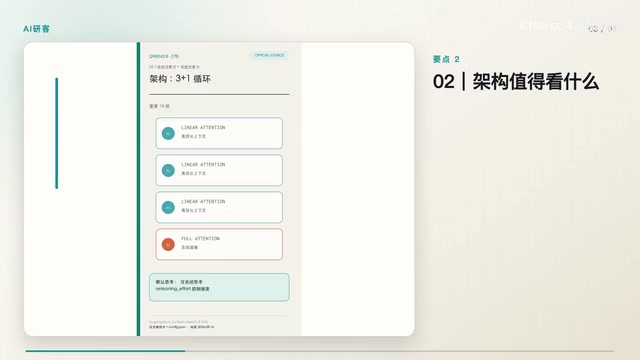
This design has a clear engineering motivation in the industry: Full Attention (i.e., the standard Softmax self-attention mechanism) captures global dependencies by computing dot products between Queries and all Keys followed by Softmax normalization, but its computational complexity grows quadratically with sequence length. When sequences reach 260K or even 1 million tokens, computing full attention directly becomes practically infeasible. The core idea behind Linear Attention is to replace the Softmax operation with kernel functions, decomposing the attention computation into a form that can be linearly accumulated along the sequence dimension, thereby reducing complexity to O(n). Representative works include Linear Transformer, RWKV, RetNet, and Mamba. The tradeoff of Linear Attention is reduced expressiveness, particularly on tasks requiring precise "retrieval" of information at specific positions compared to full attention. The 3:1 alternating cycle essentially lets Linear Attention layers handle most of the "pipeline-style" information passing, while inserting a Full Attention layer every three layers for global information calibration and precise retrieval—striking a balance between "precision" and "long-context efficiency."
Additionally, the model has Thinking Mode enabled by default, with the option to disable it, and uses a Reasoning Effort parameter to control inference intensity. The core concept of thinking mode originates from the Chain-of-Thought (CoT) reasoning paradigm popularized by OpenAI's o1 series—rather than directly outputting an answer, the model first generates an explicit reasoning process internally, analyzing the problem step by step, decomposing sub-tasks, and then producing the final answer. This approach significantly improves accuracy on complex tasks such as mathematical reasoning and code generation, but at the cost of dramatically increased token generation, higher inference latency, and greater computational costs. The Reasoning Effort parameter is an engineering solution to this problem, essentially giving the model a "budget for how long to think." This means developers can flexibly adjust based on task complexity—disabling deep reasoning for simple tasks to speed things up, while enabling full chain-of-thought for complex ones. This controllable reasoning is becoming a standard feature of next-generation models.
Official Benchmark Analysis: Comprehensive Agent Capability Improvements
An important caveat: the following data comes entirely from the official model card's self-reported results and is not yet equivalent to independent third-party reproduction. Readers should maintain a healthy skepticism.
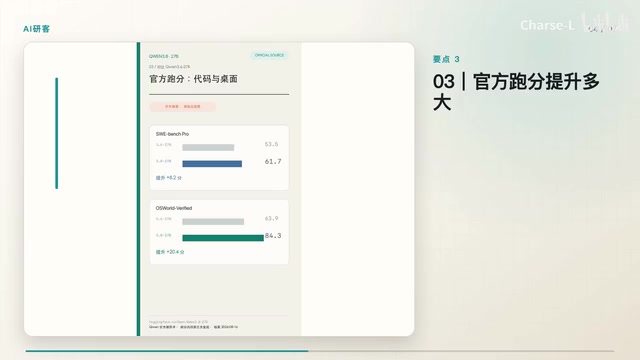
Compared to the previous generation, key benchmark improvements include:
- SWE Bench Pro (software engineering): from 53.5 to 61.7
- OS World Verified (desktop agent): a major leap from 63.9 to 84.3
- Web Arena Verified (web operations): from 48.8 to 64.8
- Cowork Bench (collaborative tasks): from 61.0 to 70.7
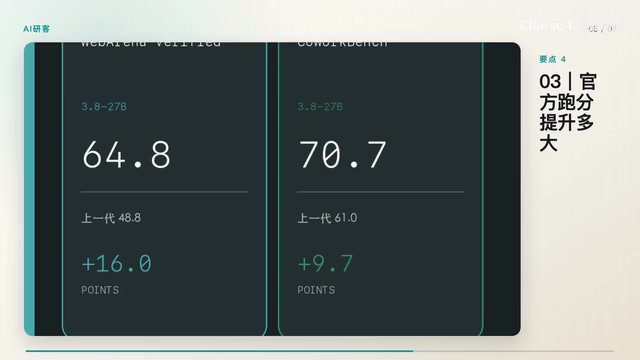
These benchmarks represent a significant trend in AI evaluation, shifting from "answering questions" to "completing tasks." SWE Bench, proposed by Princeton University, requires models to automatically modify relevant files in a code repository to fix bugs or implement features based on real GitHub Issue descriptions—essentially testing a model's end-to-end engineering capability as an "AI programmer." OS World, developed by Carnegie Mellon University and other institutions, requires models to complete real operational tasks in actual OS virtual machines, understanding screen content via screenshots and generating mouse click and keyboard operation commands. Web Arena tests a model's ability to browse and operate within real website environments. Together, these benchmarks form the core metrics for evaluating an AI Agent's ability to "autonomously complete complex tasks in real-world environments"—fundamentally different from traditional knowledge and code generation benchmarks like MMLU and HumanEval. They test not what a model "knows," but what a model "can do."
The most valuable aspect of these results isn't any single benchmark-topping score, but rather the simultaneous improvement across code, desktop, web, and collaborative tasks. This clearly indicates that the model's optimization target is decidedly oriented toward the Agent direction—an intelligent agent that can "see" (visual understanding), "reason," and "operate tools." The leap in OS World Verified from 63.9 to 84.3 is particularly noteworthy, reflecting a substantial breakthrough in automated operation capabilities within real desktop environments.
Real Hardware Costs for Local Deployment of Qwen3 27B
For developers looking to deploy locally, hardware requirements deserve serious evaluation. The model's BF16 weights consist of 18 shards, with the index recording a total size of approximately 55.6GB. This is just the weight size alone—real-world deployment also requires additional overhead for runtime and KV Cache, making it far from easy to run on consumer-grade GPUs.
BF16 (Brain Floating Point 16) is a 16-bit floating-point format proposed by the Google Brain team. It retains FP32's 8-bit exponent (providing the same numerical range) while compressing the mantissa from 23 bits to 7 bits. Compared to FP16, BF16 can represent a larger numerical range and is less prone to numerical overflow during training, making it the mainstream precision format for large model training and inference. A single BF16 parameter occupies 2 bytes, so a 27B-parameter model requires approximately 54GB of weight storage, closely matching the 55.6GB mentioned above. It's worth noting that KV Cache (Key-Value Cache) is another significant source of memory consumption during inference—the model needs to cache the Key and Value vectors of previously processed tokens to avoid redundant computation, and at a 260K-token context length, KV Cache alone can consume tens of gigabytes of memory.
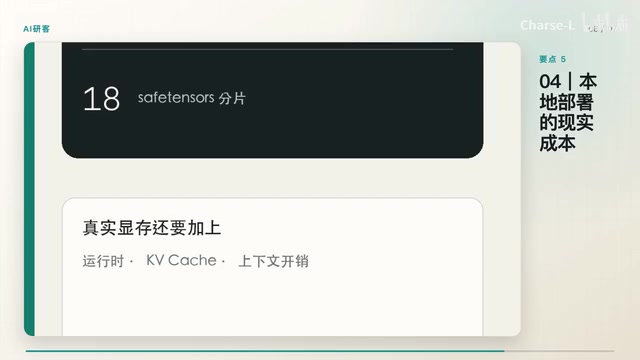
The team also provides an FP8 quantized version to reduce memory requirements. FP8 is a more aggressive quantization scheme where each parameter occupies only 1 byte, theoretically halving memory requirements to approximately 28GB. NVIDIA began native FP8 compute support with the Hopper architecture (H100), and the Ada Lovelace architecture (RTX 4090) also provides partial FP8 support. However, actual speed, memory usage, and accuracy loss after quantization should be validated through your own hardware testing—FP8 further compresses numerical precision, potentially causing performance degradation on certain tasks, especially numerically sensitive mathematical calculations and long-tail knowledge QA. There are also more aggressive quantization methods such as INT4, GPTQ, AWQ, and GGUF that can further compress the model to the 15–20GB range to fit consumer GPUs, but with correspondingly greater accuracy loss. Quantization benefits vary by hardware architecture and task type and cannot be generalized. Overall, the 55.6GB BF16 footprint means it's better suited for professional-grade GPUs (such as A100 or H100) or multi-GPU setups, rather than entry-level devices.
Conclusion: Multimodal and Agent Capabilities Packed into a Deployable 27B Dense Model
The core significance of Qwen3 27B lies in packing native multimodality, ultra-long context, and Agent operational capabilities into a 27B dense model that remains open-source deployable.
Compared to ultra-large models with hundreds of billions of parameters, it significantly lowers the barrier to real-world engineering deployment while maintaining strong capabilities. For teams that require private deployment and value controllability, this kind of "capability density" offers tremendous practical value.
Of course, as repeatedly emphasized throughout this article, the impressive official benchmark numbers still need independent community reproduction for validation. Until genuine third-party evaluation results emerge, maintaining a rational perspective and conducting hands-on testing remains the most reliable way to evaluate a new model.
Related articles

AI Learning Roadmap for Everyday Programmers: From Math Fundamentals to Hands-On Agent Development
An AI learning roadmap for everyday programmers covering math basics, deep learning, Transformers, LLM fine-tuning, RAG, and Agent development across five stages.

Deep Analysis of the Manchester Airport 80GB Data Breach and Defensive Takeaways
FulcrumSec ransomware group claims 80GB stolen from Manchester Airports Group. Deep analysis of security gaps, Zero Trust, behavioral detection, and defense strategies for critical infrastructure.

If All AI Were Shut Off Tomorrow, Could Your Company Still Function?
What if your company stopped using all AI tools tomorrow? This article analyzes three levels of enterprise AI dependency, reveals hidden risks, and provides an AI dependency audit checklist.