Qwen3-27B Outperforms Last Year's Top Model — The Era of Small Models Has Truly Arrived

27.1B-parameter Qwen3-27B scored 34 in a public benchmark, beating GPT-4o's 23 from a year ago, and can run on a home computer.
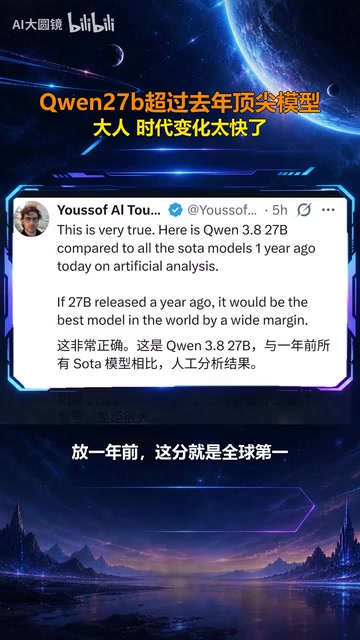
Qwen3-27B is a 27.1B-parameter small model that can run locally on a gaming laptop. In AI Mocha's new comprehensive math, coding, and research test, it scored 34, beating last year's champion GPT-4o at 23 — a rise of nearly half. Although still 24 points behind the current top score of 58, a 34 would have been global number one a year ago. The credibility comes from fully public model weights and evaluation process. The real significance is the shift in deployment paradigm: top-tier capability that once required data-center queues is now landing on personal devices.
A small model with 27.1 billion parameters has beaten last year's world number one. The news came from a video shared on Bilibili and quickly sparked discussion in the AI community. The model is called Qwen3-27B, released in August 2026, and it can run on a single gaming laptop. More importantly, the third-party evaluation organization AI Mocha included it in a comprehensive test of math, coding, and research capabilities. Under the new exam, Qwen3-27B scored 34 points, while last year's champion GPT-4o scored only 23.

34 vs 23: What's Behind the Scores
From 23 to 34 is an increase of nearly half. This comparison is striking because the two sides represent completely different deployment paradigms. One is a champion hidden in a data center, accessible to ordinary users only through an API; the other is a challenger that can be downloaded for free and run on a home GPU.
The evaluation organization AI Mocha released the complete model files and testing process. In the words of the video: "If you don't believe it, run it yourself." This transparency makes the score more convincing. You can download the model, reproduce the evaluation, and verify it with your own eyes, rather than simply trusting some leaderboard ranking.
That said, it should be viewed objectively: 34 points is still some distance from the current top level. The video mentions that the true number one score now is 58, putting Qwen3-27B 24 points behind. But the key point is that a score of 34 would have been global number one a year ago. In one year, a home-grade model has caught up with what was once a top closed-source model.
The "B" in 27B stands for Billion and refers to the model's parameter count — here, 27.1 billion parameters correspond to roughly 54GB of fp16 weights, which after 4-bit quantization can be compressed to about 14GB. That is precisely the key prerequisite for fitting it into a gaming laptop. Parameter scale determines a model's capacity ceiling, but it is not the only deciding factor: training data quality, training strategy, and architecture design matter just as much. Historically, GPT-3 had as many as 175 billion parameters, while Qwen3-27B achieves comparable or even stronger capability at about one-sixth the scale, reflecting the significant improvement in training efficiency over the past two years. The smaller the parameter count, the lower the demand for VRAM and compute during inference, which is the fundamental reason consumer-grade hardware can now deploy models locally.
Why Is This Score Trustworthy?
Why should an evaluation released by a small third-party organization be convincing? The core is verifiability. The model weights are fully public, and the evaluation code and research methods are released as well, so anyone can reproduce the results on their own hardware.

This stands in sharp contrast to how traditional leaderboards operate. In the past, we could only look at rankings published by large institutions, with opaque model details and undisclosed evaluation standards. Now, the combination of open-source models and public evaluation means that "trust" no longer depends on institutional endorsement, but is built on reproducible technical facts.
Of course, results from a single evaluation organization still need more independent verification. Different evaluation sets and different task weightings can all affect the final ranking. But the direction is clear: the capability ceiling of small models is rising rapidly.
Model weights refer to all the parameter values saved after training is complete, and they are the most core asset. Public weights mean anyone can download the complete model and run, fine-tune, or further develop it on their own hardware without relying on an API provided by the vendor. By contrast, closed-source models expose only a remote call entry point, and users cannot know their internal structure, training data, or specific behavior. Open weights with undisclosed training data and process count as "open weights" rather than fully open source, which is a common compromise in the industry today. The value of open weights is that they let third parties independently test model capabilities, audit potential biases, and use the model locally offline without uploading sensitive data, making them an important foundation for the rapid iteration of the small-model ecosystem.
A Home Computer Running Last Year's World Number One
The most impactful part of this event is not the score itself, but what it means. The top model capabilities that a year ago required queuing up to apply for and deploying in a data center can now run locally on a gaming laptop.
For developers, this means they can do more experiments locally without worrying about API costs and data privacy. For ordinary users, high-performance AI is moving from the cloud to personal devices. Many people in the video comments were posting "agree with the plan," imagining what level home computers will be able to run next year.
From "queuing in the North District data center" to "the champion moving onto your desk," this shift took only one year. The prologue to the era of small models may have arrived earlier than we expected.
The Big Trend of Small Models
Qwen3-27B is not an isolated case. The entire industry is moving in a smaller, more efficient, and more open direction. When a 27B-level model can reach the level of last year's top closed-source models on consumer-grade hardware, the pace of AI capability democratization enters a new stage.
What to watch next is clear: How long will this trend continue? How high can the next generation of home-grade models score? And when high-performance AI becomes available to everyone, what new possibilities will emerge at the application layer?
The answers may not be far off.
Background Supplement
Running large models locally usually requires quantization, which compresses weights originally stored in 16-bit floating point (fp16) into 8-bit, 4-bit, or even lower integer representations to greatly reduce VRAM usage and computation. 4-bit quantization generally compresses model size to about one-quarter of the original, with relatively small performance loss on most tasks. On this basis, inference tools such as llama.cpp, Ollama, and LM Studio allow ordinary users to load models on a laptop without writing code. Compared with calling cloud models through APIs, the advantages of local operation include no per-call billing, data never leaving the machine, offline usability, and controllable response latency; the cost is that it is limited by local compute, so speed and performance on long-context and complex reasoning tasks may not match flagship models deployed in data centers.
Related articles

Workbuddy for Absolute Beginners: How a Desktop AI Agent Fits Into Real Workflows
A beginner's guide to the Workbuddy desktop AI agent: installation, claiming credits, file management, and building automated workflows—compared with CodeX for fit and cost, helping professionals shift from AI question-askers to AI managers.

OpenAI's New Agent Stack: Computer Use, Decisions API, and Ultra-Fast Workflows
OpenAI Dev Day unveiled a new agent stack: Computer Use outperforms humans, Decisions API delivers ultra-low-latency classification via Luna, Agents API opens the same Computer Use capabilities, and GPT-6.1 Sol costs only one-seventh of Astra. Core updates, benchmark data, and developer insights.

Liang Wenfeng Open-Sources DeepInfo Inference Framework, Takes On U.S. Ban
DeepSeek open-sources its DeepInfo inference framework after its models, featuring GPU/CPU cross-pipelining, small-model prediction with large-model verification, and full Huawei Ascend and NVIDIA chip support—facing the U.S. federal ban head-on. This article analyzes its significance for AI deployment and open-source strategy.