Qwen3.6 27B: Real-World Testing of Three Unconventional Quantized Models — Code Performance +15.8PP, 40B Distillation, 16GB Adaptation

Three unconventional Qwen3.6 27B quantized models push boundaries in code, writing, and VRAM efficiency.
This article reviews three community-built "unconventional" quantized models based on Qwen3.6 27B: OmniMerge V4 boosts MBPP code test scores by 15.8 percentage points through multi-model weight merging, runs fast, and supports 100K context; the 40B OPUS distilled version expands parameters from 27B to 40B with Claude 4.6 OPUS reasoning distillation, removes safety filters, and supports roleplay with bilingual optimization. These models achieve significant capability enhancements through model merging, parameter expansion, and specialized quantization techniques.
Introduction
After the release of the Qwen3.6 27B dense model, the community has been producing an endless stream of derivative works. Today we'll look at three "unconventional" quantized models based on the 27B — they use non-standard techniques like model merging, parameter expansion, and specialized quantization to achieve breakthroughs in code generation, creative writing, and low-VRAM adaptation. While the approaches are a bit "wild," the real-world results speak for themselves.
OmniMerge V4: Code Performance Jumps 15.8 Percentage Points
Model Overview
OmniMerge V4 is a merged model, hand-crafted by blending weights from three to four 27B models. Its core selling point is dramatically enhanced code capabilities, along with a fix for a fragility issue with Qwen3.6 27B's reasoning tags.
Technical Background on Model Merging: Model merging is a training-free model enhancement technique that has gained traction in the open-source community in recent years. The core principle involves mixing the weights of multiple independently trained models using specific algorithms. Common methods include SLERP (Spherical Linear Interpolation), TIES-Merging (pruning conflicting weights before merging), and DARE (random dropping followed by rescaling). The theoretical foundation is that different models occupy different "capability regions" in parameter space, and weight mixing can stack multiple capabilities into a single model. Compared to traditional fine-tuning, merging requires no GPU compute or training data — ordinary researchers can do it on a CPU, dramatically lowering the barrier to model customization.
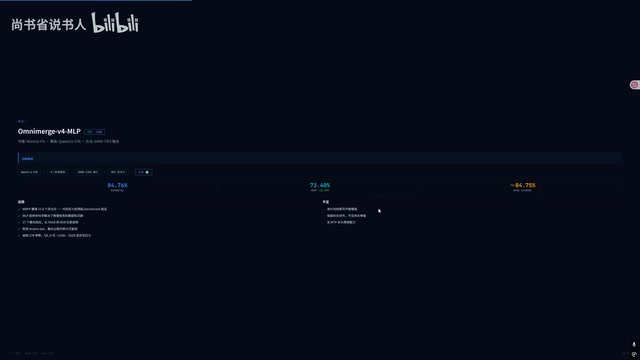
The author benchmarked the model using the industry-standard MBPP (Mostly Basic Python Programming) benchmark — a test that even top models like GPT-4.5, Claude, and Gemini run, giving it high reference value. The results show:
- MBPP Code Test: The original Q6K quantization scored 56.2%, while OmniMerge V4 reached 73.4% — a full 15.8 percentage point improvement
- HumanEval Test: 84.76, on par with the Q6K original
- JPQA Diamond Test: 84.75, equally solid performance
MBPP and HumanEval Benchmark Explained: MBPP (Mostly Basic Python Programming) and HumanEval are the two mainstream benchmarks for evaluating LLM code capabilities. MBPP, released by Google Research, contains approximately 500 Python programming problems covering string operations, math calculations, data structures, and other basic scenarios, with pass@1 (passing unit tests on the first generation) as the core metric. HumanEval, released by OpenAI, contains 164 hand-written programming problems and also uses pass@1 for evaluation. The key difference: MBPP emphasizes practicality and diversity, while HumanEval has more uniformly difficult but fewer problems. Notably, the 56%→73% improvement on MBPP is a significant leap by industry standards — typically achievable only through specialized code data fine-tuning — making it quite rare for a merged model to reach this level.
Hands-On Experience
In actual use, the biggest surprise from this model is its blazing speed. Running the Q5 version on a 5090, both model loading and token generation speeds are noticeably faster than typical Q4 quantized versions. Even more impressive, the Q5 version can handle 100K context length, while standard Q4 quantized versions might only manage tens of thousands of tokens.
Context Length and VRAM Relationship: The relationship between a large language model's context length and VRAM consumption is non-linear, with the core bottleneck being the KV Cache (Key-Value Cache). In the Transformer architecture, attention computation for each token requires caching all historical tokens' Key and Value vectors, with VRAM usage proportional to sequence length. For a 27B model, Q5 quantized weights occupy roughly 18-20GB, but when context extends to 100K tokens, the KV Cache may consume an additional 8-15GB of VRAM — this is precisely why 100K context requires more VRAM. The fact that OmniMerge V4 supports 100K context under Q5 quantization suggests it may employ GQA (Grouped Query Attention) or sliding window attention for KV Cache compression, or quantize the KV Cache itself to reduce memory usage.
The model size is also well-controlled, with the Q5 version under 20GB. The author provides up to 27 quantization tiers, covering everything from 12GB to high-VRAM setups. In code generation testing, I had it write a breakout game — the bridge structure, power-up system, and playability were all solid, validating its code capabilities.
Shortcomings
- Retains safety alignment with topic restrictions
- Does not support MTP (Multi-Token Prediction) speculative decoding
- No noticeable improvement in creative writing compared to the original
40B OPUS Distilled Version: A Parameter Expansion Adventure
Model Overview
This model is pure "unconventional engineering" — the author expanded the 27B model to 40B parameters and injected a substantial amount of specialized data:
- Uses Claude 4.6 OPUS for reasoning distillation to enhance reasoning and code capabilities
- Safety filters removed, no topic restrictions
- Incorporates extensive persona datasets for roleplay scenarios
- Bilingual Chinese-English optimization
Parameter Expansion (Model Upscaling) Technique: Expanding a 27B model to 40B doesn't mean adding parameters from thin air — it's achieved through "Depth Upscaling" or "Width Expansion" techniques. The typical approach for depth expansion is to duplicate some of the original model's Transformer layers, insert them, and then do minimal fine-tuning to help the new layers learn to function effectively. The Korean SOLAR team's "Depth Up-Scaling" method proposed in 2023 is a representative example — their 10.7B model was constructed by stacking two 7B models. Width expansion involves increasing the number of attention heads or FFN dimensions. Such expanded models often exhibit "capability gaps" initially and require distillation or fine-tuning to bridge representational differences between old and new layers. While parameter count increases, actual capability gains are typically less than or equal to what a same-size model trained from scratch would achieve — hence the "unconventional" label.
Knowledge Distillation Technical Principles: Knowledge Distillation was originally proposed by Hinton et al. in 2015. The core idea is to have a small model (student) learn the output distribution of a large model (teacher), rather than learning from hard labels directly. In the era of large language models, "reasoning distillation" typically refers to having the student model learn the teacher model's chain-of-thought reasoning process and output patterns through supervised fine-tuning on teacher-generated responses.
Related articles
 Product Reviews
The Programmer's Desk Setup Guide: Building a Workspace That Feels Like Home
Discover how programmers build productive, comfortable workspaces. From multi-monitor setups to ergonomic design, explore the desk philosophy that drives focus and flow.
 Product Reviews
Qoder vs Cursor Real-World Comparison: Which $20/Month AI IDE Is Better?
Hands-on comparison of Qoder vs Cursor AI IDEs: Agent autonomy, human interaction count, and architecture decisions. Qoder needed only 2 interactions vs Cursor's 8.
 Product Reviews
Cursor Cloud Agent Demo: Eliminating Bottlenecks Across the Entire Software Development Lifecycle
Deep analysis of Cursor's Cloud Agent demo showing how cloud VMs, automated test artifacts, and a full-chain control plane systematically eliminate human bottlenecks across the software development lifecycle.