Qwen3.6 Quantized Local Deployment Benchmark: Which Is Best — NVFP4, APEX, Q4, or Q6?

Comprehensive benchmark of Qwen3.6 quantized versions reveals NVFP4 as the top performer.
The creator benchmarked 7-8 Qwen3.6 quantized models across 8 dimensions and 155 test items. The conclusion: 27B NVFP4 performs best (requires RTX 50-series GPU), followed by 35B MOE APEX quantization and 35B NVFP4. The OPUS distilled version is not recommended yet. Testing also revealed interesting findings: distillation doesn't always improve performance, and all models exhibit confirmation bias in bug-finding scenarios.
Why I Ran This Qwen3.6 Quantization Benchmark
After Qwen3.6 dropped, more and more users want to run it locally. But with different specs like 27B and 35B MOE, plus a dizzying array of quantization options — NVFP4, APEX, Q4, Q6 — which one should you actually pick?
To answer this question, the creator spent several days setting up a BenchLocal testing environment and ran comprehensive benchmarks on 7-8 models from the Qwen3.6 series. Each score was tested at least twice, some even three or four times, to ensure reliable results.
This article breaks down how each quantized version performs across 8 dimensions including tool calling, CLI operations, bug fixing, instruction following, and math reasoning — helping you make the best choice.
TL;DR: Ranked Recommendations from Best to Worst
Here's the conclusion upfront for those short on time:
- Qwen3.6 27B NVFP4 — Top recommendation (requires RTX 50-series GPU)
- Qwen3.6 35B MOE APEX Quantization — Runner-up (Q4 size, Q8 experience)
- Qwen3.6 35B NVFP4 — Close behind
- OPUS Distilled Q6/Q4 — Not recommended yet; wait for the official release
- Original 27B Q4 / Original 35B MOE — Fallback options
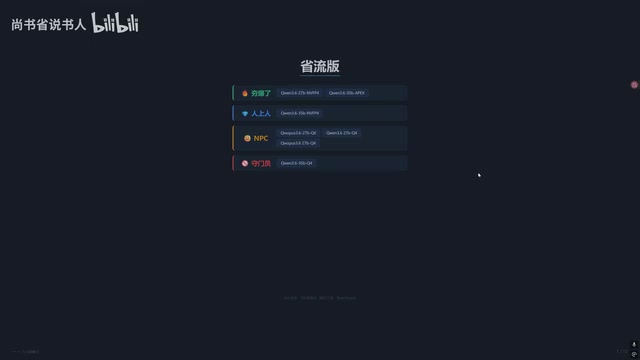
A special note about the previously well-received OPUS 4.6 distilled version (from community contributor Jacker). This version performed great in the 3.5 era, but the 3.6 V1 preview scores are disappointing — even at Q6 precision it can't match NVFP4, and in some tests it even falls behind the original. I'd suggest waiting for the official release.
Testing Methodology and Scoring System
The testing tool used is BenchLocal from GitHub. Its design philosophy focuses on real-world usage scenarios rather than probing a model's theoretical ceiling.
BenchLocal's Design Philosophy: BenchLocal is an LLM benchmark framework designed for local deployment scenarios. Its approach differs from academic benchmarks like MMLU or HumanEval. Academic benchmarks typically test knowledge boundaries and theoretical capability limits, while BenchLocal focuses on model reliability in real workflows — for example, whether tool calls are stable, whether instructions are followed strictly, and whether CLI operations are practical. This "user-scenario-centric" evaluation approach makes its conclusions more relevant for local deployment users, but it also means scores cannot be directly compared with academic leaderboards.
For example: when asked about the weather, does the model correctly call the appropriate tool and provide an accurate answer based on the tool's response, rather than hallucinating an answer on its own?
A total of 8 categories and 155 test items were evaluated, including:
- ToolCore (Tool Calling, 15 items)
- CLI40 (Command-line Operations, 40 items)
- BugFind (Bug Identification & Fixing, 15 items)
- Instruction Following, Hermes Agent, Structured Output, Math Reasoning, Data Extraction, etc.
The scoring rules are straightforward: meeting all conditions earns full marks, partial solutions earn half marks, complete failure earns zero — with a maximum score of 100.
Detailed Analysis Across 8 Dimensions
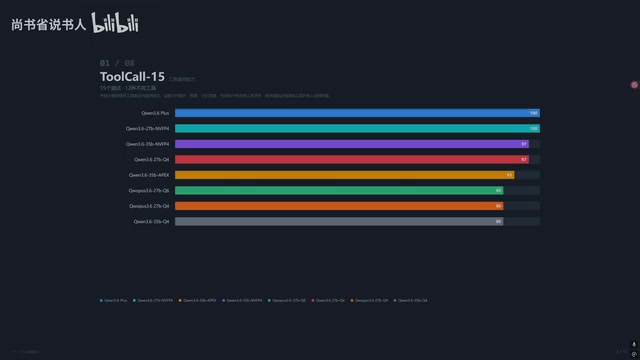
Tool Calling (ToolCore): NVFP4 Achieves Perfect Score
This test evaluates whether the model can correctly invoke 12 different tools to complete tasks, covering scenarios like file operations and search management.
- Qwen3.6 27B NVFP4: Perfect score of 100
- Qwen3.6 35B NVFP4: 97
- Original 27B Q4: 97 (no distillation applied, yet performs surprisingly well)
- OPUS Distilled Q6: Only 90
A noteworthy observation: the original 27B Q4 scored 97 on tool calling, which shows that distillation doesn't always improve performance — sometimes it can cause certain capabilities to degrade.
The Fundamental Difference Between Knowledge Distillation and Quantization: Model quantization compresses model weights from high-precision floating point (e.g., FP16/BF16) to lower-bitwidth integers or floats, aiming to reduce VRAM usage and speed up inference while preserving the original weight structure. Knowledge distillation, on the other hand, uses a large model's (teacher) outputs to guide retraining of a smaller model (student), having the student learn the teacher's "soft label" distribution — fundamentally altering model parameters. The two serve different purposes with task-dependent effects: distillation may improve performance on some dimensions while introducing degradation on others, which is precisely why the distilled versions showed inconsistent results in this benchmark.
Command-line Operations (CLI40): The Hardest Challenge
This is the most difficult of all 8 tests, with 40 CLI testing scenarios. Models easily exhaust their context windows, and runs take a very long time.
Even Qwen3.6 Plus (API version) only scored 76, while locally deployed models generally hover in the 60-70 range. Specifically:
- OPUS Distilled Q4 and Q6 actually performed well here, with only a 1-point difference between them
- APEX quantization and 35B NVFP4 scored identically, once again confirming the claim that "APEX delivers Q4 size with Q8 experience"
- 27B NVFP4 followed closely behind, trailing by just 1 point
- Original 7B and original MOE 35B brought up the rear
Bug Identification & Fixing (BugFind): Every Model Falls for the Traps
Among the 15 scenarios, scenarios #3 and #10 are traps — the code is completely correct, but the prompt implies a bug exists. The results are somewhat disappointing: not a single model passed the trap test, and all "hallucinated" fixes to correct code. DeepSeekAd and Xiaomi's MIMO also failed on these same two traps.
This phenomenon reveals a systemic weakness in current LLMs: models tend to accommodate presuppositions embedded in prompts (i.e., "confirmation bias") rather than independently verifying code correctness. This relates to the heavy use of "find and fix bugs" training data, which causes models to develop an implicit assumption that "if the prompt asks about a bug, there must be one."
The best performer was the APEX-quantized 35B MOE, followed by NVFP4. Only 3 models scored above 90.

Instruction Following: Testing Whether Models "Follow Orders"
This test ignores reasoning ability, creativity, or knowledge — it only measures whether the model can strictly output results according to 3-6 constraint conditions.
Interestingly, Qwen3.6 Plus only scored mid-pack on this one — being too capable actually leads to "overthinking."
Related articles
 Product Reviews
The Programmer's Desk Setup Guide: Building a Workspace That Feels Like Home
Discover how programmers build productive, comfortable workspaces. From multi-monitor setups to ergonomic design, explore the desk philosophy that drives focus and flow.
 Product Reviews
Qoder vs Cursor Real-World Comparison: Which $20/Month AI IDE Is Better?
Hands-on comparison of Qoder vs Cursor AI IDEs: Agent autonomy, human interaction count, and architecture decisions. Qoder needed only 2 interactions vs Cursor's 8.
 Product Reviews
Cursor Cloud Agent Demo: Eliminating Bottlenecks Across the Entire Software Development Lifecycle
Deep analysis of Cursor's Cloud Agent demo showing how cloud VMs, automated test artifacts, and a full-chain control plane systematically eliminate human bottlenecks across the software development lifecycle.