Qwen3.7 Max Deep Dive: How a 1T-Parameter MOE Architecture Creates the Ultimate Agent Foundation

Alibaba launches Qwen3.7 Max, claiming benchmark leadership and broad agent framework compatibility in the global AI race.
Alibaba's newly released Qwen3.7 Max adopts a ~1T parameter MOE architecture with 256K context length, achieving leading benchmarks across agent programming, general-purpose agents, advanced reasoning, and multilingual capabilities. Its core competitive advantage lies in broad compatibility with mainstream agent frameworks like LangChain, CrewAI, and Hermes, delivering consistent "framework-agnostic" performance and positioning itself as a universal agent foundation for the global market.
Introduction
Alibaba's newly released Qwen3.7 Max model, featuring approximately 1 trillion parameters, a Mixture of Experts (MOE) architecture, and a 256K context length, has achieved across-the-board leading benchmark results in four key dimensions: agent programming, general-purpose agents, advanced reasoning, and multilingual capabilities. But what truly deserves attention isn't just the benchmark scores — its broad compatibility with mainstream agent frameworks like LangChain, CrewAI, and others is the real card Alibaba is playing in the global AI competition.
Model Positioning: A Unified Agent Foundation for the Global Market
From Qwen3.7 Max's official promotional materials, elements of mainstream agent frameworks like LangChain, Hermes, and CrewAI are deliberately highlighted. This is no accident — the message Alibaba wants to convey is crystal clear: Qwen3.7 Max is a general-purpose foundation model fully compatible with mainstream agent frameworks.
Key specifications at a glance:
- Parameter Scale: ~1T (trillion-level)
- Architecture: MOE (Mixture of Experts)
- Context Window: 256K tokens
About the MOE Architecture: MOE is one of the core technical approaches for scaling large models in recent years. The basic principle involves dividing the model's internals into multiple "expert" sub-networks, with a Gating Network dynamically selecting only a few experts to participate in computation during each inference pass, rather than activating all parameters. This means that while the model has approximately 1T total parameters, the actually activated parameters per inference are far fewer, significantly reducing computational costs and inference latency while maintaining the expressive power of an ultra-large model. GPT-4, Mistral's Mixtral series, and Google's Gemini 1.5 all employ similar architectures. The engineering challenges of MOE lie in training stability and expert load balancing — if the gating network over-favors a few experts, parameter utilization drops, which is why companies continue to invest heavily in MOE implementation.
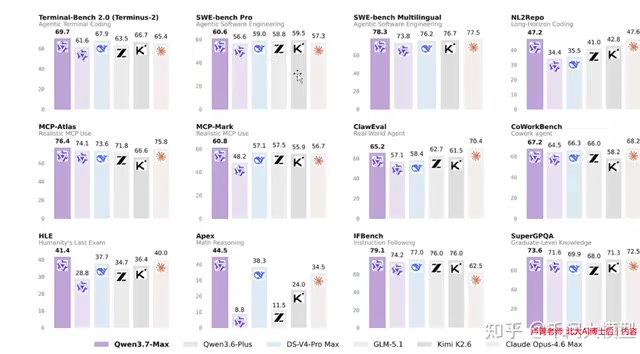
Apart from context length, all other specifications are at industry-leading levels. Alibaba's strategic intent is clear: build a unified foundation that excels in both capability generalization (covering programming, reasoning, and multilingual tasks) and framework generalization (compatible with various agent frameworks).
Four Capability Dimensions: Comprehensive Benchmark Leadership
Official benchmark data shows that Qwen3.7 Max delivers impressive results across four key dimensions.
Agent Programming Capability
This is currently the most widely deployed AI scenario and the one developers care about most. Qwen3.7 Max achieved leading results in typical agent programming scenarios including tool calling, terminal operations, and long-workflow task orchestration, delivering remarkably strong performance.
General-Purpose Agent Capability
This covers real-world application scenarios such as desktop application automation, web navigation, and API tool calling. In these tasks, Qwen3.7 Max surpassed competitors to varying degrees — from slight leads to clear advantages — with the surpassed competitors including Claude series models and Alibaba's own previous-generation Qwen3.6.
Advanced Reasoning Capability
In scenarios involving math competition problems and high-intensity logical reasoning, the model likewise maintained its leading edge. This indicates that Qwen3.7 Max's foundational reasoning capabilities are solid enough, rather than being narrowly optimized for specific tasks.
Multilingual Capability
The strategic significance of multilingual capability is often underestimated. Current AI token consumption is increasingly oriented toward overseas markets — some vividly describe this as "selling China's electricity through tokens." This metaphor reveals the deeper logic of AI industry competition: large model inference is fundamentally compute consumption, and when overseas users call Chinese AI model APIs, the underlying compute consumption occurs in Chinese data centers, constituting a new form of technology service export with revenue directly tied to users' actual token consumption. Currently, non-English internet users account for over 75% of the global total. The strength of multilingual capabilities directly determines whether a model can gain a foothold in the global market — this is essentially a new form of technology export economy.
Framework Compatibility: Why a Good Driver Doesn't Blame the Car
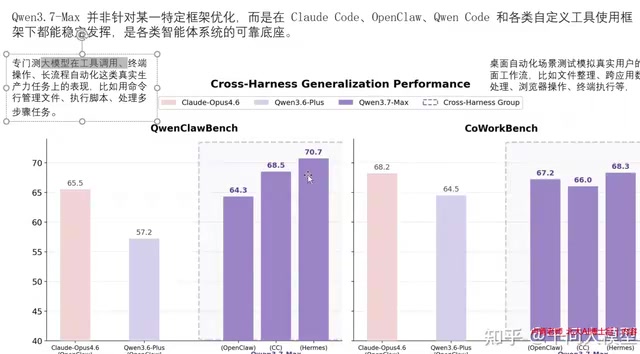
The most noteworthy feature of Qwen3.7 Max for developers is its consistent performance across different agent frameworks. The team conducted systematic testing across Claude Code, Open Code, and Qwen Code — three mainstream agent programming frameworks — and results showed the model performed excellently in long-workflow tasks such as tool calling and terminal operations.
Understanding the Differences Between These Frameworks: LangChain is currently the most widely used agent orchestration framework, providing modular capabilities including chain-of-calls, tool integration, and memory management, allowing developers to flexibly combine LLMs with external APIs, databases, and code execution environments. CrewAI focuses on multi-agent collaboration scenarios, allowing the definition of multiple AI agents with different roles and objectives to cooperatively complete complex workflows. Hermes is a model fine-tuning format specification optimized for Function Calling, widely used for standardization in tool-calling scenarios. These frameworks essentially exist to compensate for early foundation models' shortcomings in instruction following, tool usage, and long-workflow planning.
In scenarios like desktop automation, Qwen3.7 Max also outperforms the Claude series and its own Qwen3.6. This "framework-agnostic" consistency is what truly defines a reliable agent foundation model.
Related articles
Deep Dive into AI Agent Skill Design: …
Deep Dive into AI Agent Skill Design: Engineering Practices from Anthropic and Perplexity
A deep dive into Skill design philosophy from Anthropic's Claude Code team and Perplexity's Agent team, covering the Tax Test, Gotchas Flywheel, progressive disclosure, and Eval-First practices for building high-quality AI Agent skill systems.
Deep Dive into OpenAI's Official GPT-5…
Deep Dive into OpenAI's Official GPT-5.6 Prompting Guide: The Shift from Manual to Automatic
A deep dive into OpenAI's official GPT-5.6 Sol prompting guide: conciseness-first, outcome-oriented design, autonomy boundaries, tool routing, and reasoning intensity tuning.
 Deep Dives
Deep Dive into How OpenClaw (Open-Source Crayfish) AI Agent Works
Deep analysis of OpenClaw AI Agent internals: System Prompt, tool calling, SubAgents, Skill system, memory, and Context Engineering explained.