Qwen3.8 Flash Deep Dive: How Hybrid Architecture Is Reshaping LLM Efficiency
Qwen3.8 Flash Next uses hybrid MoE architecture to activate only 6B of 125B parameters at 1/9 the cost.
Qwen's new Qwen3.8 Flash Next previews the Qwen4 architecture with a hybrid design combining Gated DeltaNet linear attention and standard attention. With 125B total parameters but only 6B activated per token, it cuts training costs to 1/9 of previous flagships. Featuring 51B Ngram embedding parameters, native multimodal support, and a million-token context window via YaRN, it excels at coding, long-horizon tasks, and agent workflows — making enterprise AI automation more accessible than ever.
A Strategic Model Paving the Way for Next-Gen Architecture
The newly released Qwen3.8 Flash Next from Qwen (Tongyi Qianwen) is officially positioned as an "early preview of the Qwen4 architecture." This isn't a routine iteration — it's a top-tier AI lab publicly charting its future technical direction.
The core numbers reveal the breakthrough: 125 billion total parameters, with only ~6 billion activated per token, at a training cost just one-ninth of the previous flagship model. This "high capacity, low activation" design is becoming the dominant approach for reducing costs and boosting efficiency in large language models.
The "high capacity, low activation" design originates from the Mixture of Experts (MoE) architecture. Traditional dense models activate all parameters during inference, whereas MoE partitions the model into multiple "expert" sub-networks and activates only a few for each inference pass. This concept traces back to Jacobs et al. in 1991 and has resurged in popularity with Google's Switch Transformer (2021) and OpenAI's GPT-4 (rumored to use MoE). The core advantage of MoE is maintaining a massive parameter count (boosting model capacity) while dramatically reducing per-inference compute through sparse activation, enabling the model to handle requests with lower latency and energy consumption.
For enterprises and developers concerned about AI deployment costs, a nine-fold cost reduction carries far more practical value than any single benchmark score. This architecture is becoming a critical technical pathway for commercial LLM deployment.
The Efficiency Revolution of Hybrid Architecture
From Full Attention to Gated DeltaNet
Traditional mainstream models use full attention mechanisms: every token attends to every other token in the context. While effective, computation explodes as context length increases.
Full Attention is the core component of the Transformer architecture (introduced in 2017). Its computational complexity is O(n²) — processing a sequence of length n requires computing n×n attention weights. Specifically, for text containing 1,000 tokens, the model needs approximately 1 million attention calculations; when the context expands to 100,000 tokens, that number skyrockets to 10 billion. This quadratic growth leads to two direct consequences: first, inference latency increases dramatically (longer wait times for users), and second, GPU memory usage grows exponentially (requiring more expensive hardware). This is the fundamental reason why early models like GPT-3 had context windows limited to 2,048–4,096 tokens — technically feasible but economically unsustainable.
Qwen3.8 Flash Next instead adopts a hybrid architecture, with Gated DeltaNet at its core — efficiently compressing historical information and working alongside attention mechanisms to filter truly important context, rather than treating every token equally.
DeltaNet belongs to the Linear Attention family of mechanisms, aiming to reduce attention complexity from O(n²) to O(n). The core idea is using mathematical transformations (such as kernel function approximations) to avoid explicitly computing the full attention matrix. Gated DeltaNet adds a gating mechanism on top of this, dynamically deciding which historical information to retain and which to forget — similar to LSTM's gating design but more efficient. The research lineage of such techniques includes Linformer (2020), Performer (2020), Linear Transformer (2020), and others. Notably, linear attention typically excels in long-context tasks but may slightly underperform standard attention on certain tasks requiring precise global dependencies (such as some reasoning problems). Qwen's hybrid architecture is specifically designed to balance both — using DeltaNet for long sequences and standard attention for critical dependencies.
A helpful analogy: full attention is like re-reading an entire book from scratch every time you answer a question; Qwen's approach is like using a smart index to jump directly to the relevant content. This is precisely the key to its "higher per-token efficiency."
Ngram Embedding System for Enhanced Pattern Recognition
The model is equipped with a dedicated Ngram embedding system, adding approximately 51 billion additional parameters.
Ngram is a foundational concept in natural language processing, referring to sequences of n consecutive linguistic units (characters, words, or subwords). For example, in "artificial intelligence," the bigram (2-gram) is "artificial intelligence," and the trigram (3-gram) is the complete phrase itself. Traditional NLP relied on Ngram statistics for language modeling, but deep learning era models mostly depend on single-token embeddings. Qwen's Ngram embedding system is a hybrid representation strategy: it preserves single-token flexibility while capturing fixed phrases, specialized terminology, and common collocations through dedicated Ngram parameters.
These parameters are stored and accessed in a special way — they don't increase the computational cost of ordinary tokens, yet provide the model with massive additional pattern recognition capability. The 51 billion extra parameters don't participate in standard forward propagation; instead, they're activated during specific pattern matching, like equipping the model with a "phrase dictionary." This design is particularly effective in scenarios like code generation (common API call patterns) and specialized domains (medical terminology, legal clauses).
The overall architectural philosophy: 125 billion main parameters + 51 billion Ngram embeddings + only 6 billion parameters activated per token. High capacity provides knowledge reserves, low activation ensures inference efficiency — achieving the best of both worlds.
Multimodal Capabilities and Million-Token Context Window
Qwen3.8 Flash Next natively supports text, image, and video multimodal processing, with a native context window of 262,000 tokens, extendable to 1 million tokens using YaRN technology.
YaRN (Yet another RoPE extensioN method) is a position encoding extension technique proposed in 2023. Transformer models use position encodings to understand the sequential relationships between tokens. The commonly used RoPE (Rotary Position Embedding) fixes a maximum length during training. When inputs exceed this training length during inference, model performance degrades sharply — this is known as length extrapolation failure. YaRN dynamically adjusts the frequency components of position encodings, enabling the model to process sequences much longer than those seen during training without significant performance loss. Specifically, Qwen3.8 supports 262,000 tokens during training and can extend to 1 million tokens via YaRN without retraining. This technology has major implications for enterprises: it means you can train models with shorter contexts (lower cost) but scale on demand to ultra-long contexts when needed, achieving the optimal balance between training cost and inference capability.
A million-token context window is enormously significant for enterprise workflows. It enables feeding "an entire month's worth of community coaching transcripts, posts, and member notes" into the model at once for pattern analysis. This ability to "comprehend massive volumes of long-form text in a single pass" was simply beyond the reach of previous short-context models.
Benchmark Performance and Capability Boundaries
Official benchmark results outline the model's capability boundaries:
- SWE-Bench Pro (real-world coding tasks): 62.5
- Cowork Bench (agent office workflows): 73.9
- Android World (agent control of real Android devices): 84.5
- Live Code Bench: 91.9 / 95.7
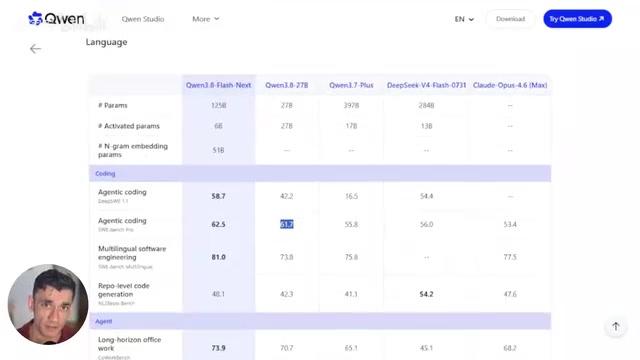
Note that these are Qwen's official numbers and still await independent third-party verification. But more important than any individual score is the trend — the model's strengths are clearly concentrated in coding, long-horizon tasks, and computer-use agents.
Agents represent the cutting-edge paradigm in current AI applications, referring to AI systems capable of perceiving their environment, making autonomous decisions, and executing multi-step tasks. Unlike single-turn Q&A, an Agent needs to: 1) understand complex goals and decompose them into subtasks; 2) invoke external tools (search, code execution, APIs); 3) adjust subsequent actions based on intermediate results; 4) maintain long-term task context (potentially spanning hours or hundreds of steps). SWE-Bench Pro tests whether a model can understand a GitHub issue, locate the relevant code, write a fix, and pass tests; Android World requires the model to operate real Android apps to complete multi-step tasks (e.g., "find nearby restaurants and make a reservation"). These benchmarks evaluate not single-generation quality but sustained reasoning, tool use, and error recovery capabilities — the core requirements of Agent workflows.
These three areas are precisely the most critical application scenarios for AI automation today. A model that can write code, maintain long-task context, and operate real devices is the ideal foundation for building Agent workflows. Qwen's performance on these tasks signals its potential in enterprise scenarios like RPA (Robotic Process Automation), DevOps automation, and customer service automation.
Enterprise Deployment Scenarios in Practice
Using real business cases from AI Profit Boardroom, here are two workflows ready for immediate deployment.
Member Insight Agent
Provide Qwen with member profiles — business type, goals, tutorial progress, coaching records, automation stage — and let the model identify gaps and deliver personalized recommendations.
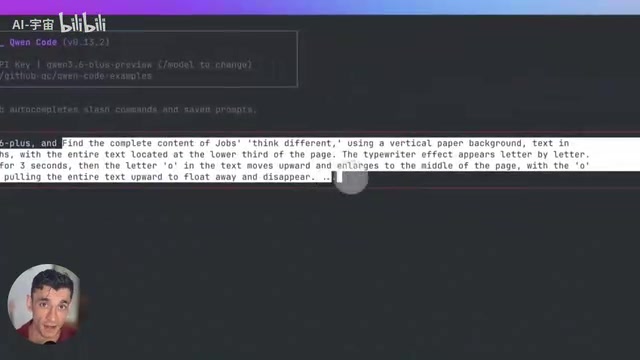
The output is highly structured. For example: goal is "automate lead generation with AI," current level is "intermediate," the gap is "missing a lead qualification workflow," which then leads to specific tutorial recommendations, suggested actions, and follow-up steps.
Structured Output is a critical capability for enterprise-grade AI applications. Traditional LLMs generate free-form text, but enterprise workflows require directly parseable data formats (JSON, XML, etc.) to interface with downstream systems. For instance, auto-filling a CRM requires extracting fields like "customer name, contact info, request type"; data analysis requires generating directly executable SQL queries. Modern LLMs achieve this through two approaches: 1) Function Calling — the model understands a list of available tools and outputs well-formed function call parameters; 2) Constrained Generation — enforcing outputs that conform to a predefined JSON schema during decoding. Qwen supports both modes, enabling seamless integration with enterprise systems.
A single prompt plus structured output can cover all members and automatically prioritize those most in need of support. This is the quintessential use case: input member data, output structured {gap analysis, recommended tutorials, action items}, which can directly trigger downstream automation (sending emails, updating CRM, queuing human follow-up) — no manual parsing of natural language required.
Coaching Call Intelligence Analysis System
Build a workflow based on community content: input batch coaching call transcripts and have the model surface high-frequency member questions, common sticking points, and workflows that are repeatedly requested but not yet available. The output is a prioritized list of tutorial ideas, a curriculum gap checklist, and a list of members requiring personal follow-up.

This is where the million-token context window transforms from a "spec" into a business tool — the input isn't a single paragraph but an entire month's worth of community data.
First-Mover Advantage: Competitiveness Beyond the Tools
In the AI automation race, the winners won't necessarily be those with the best tools — they'll be the ones bold enough to start building systems and knowledge bases before everyone else.
The value of Qwen3.8 Flash Next lies both in its one-ninth training cost and efficient hybrid architecture, and in the fact that it puts powerful coding and agent capabilities into the hands of ordinary enterprises and developers at a much lower barrier to entry. When powerful models are no longer expensive, the real gap comes down to one thing: who puts them to use first.
Related articles
GPT-6 Astra: AI Competition Shifts from Best Answers to Workflow Ownership
AI competition is shifting from single-answer quality to workflow ownership. Explore how GPT-6 Astra signals AI's evolution from passive responder to autonomous workflow agent.
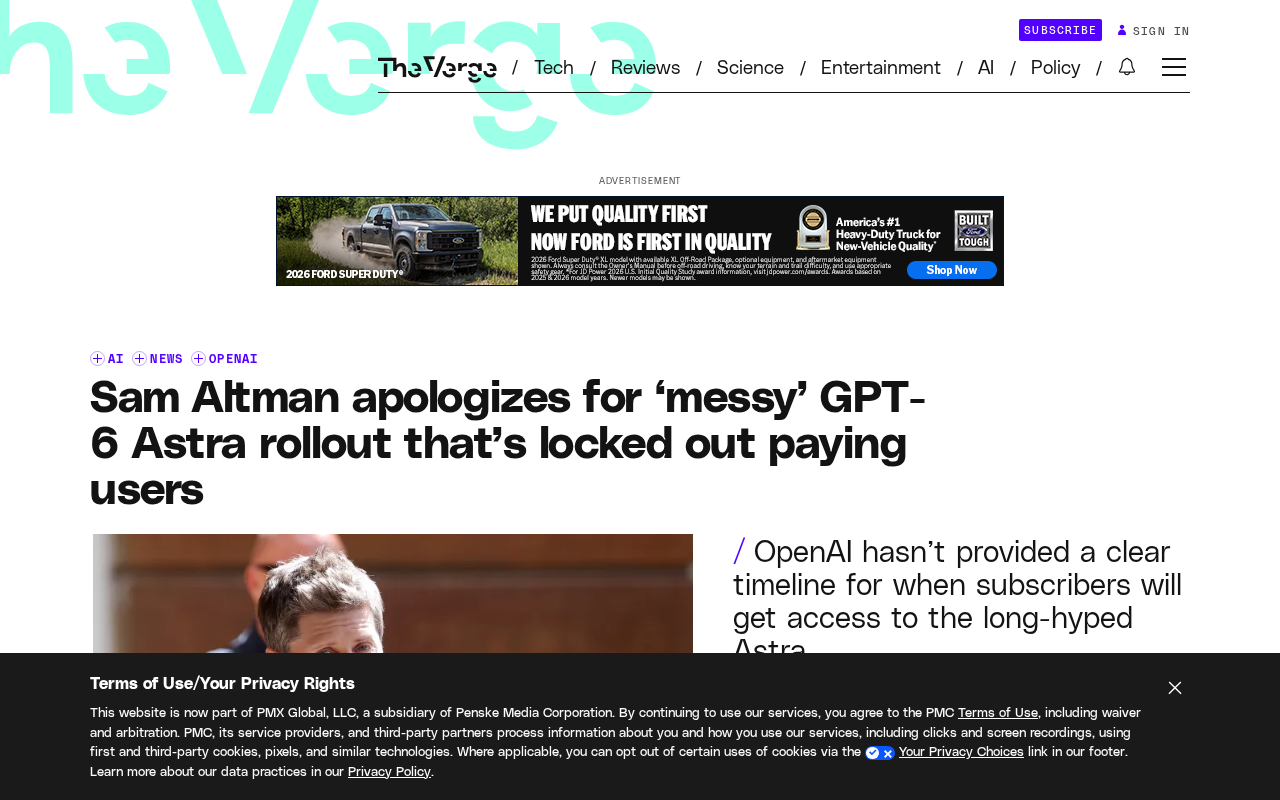
GPT-6 Astra Launch Goes Wrong: Paying Users Locked Out, Altman Issues Emergency Apology
OpenAI's GPT-6 Astra launch backfired as paying subscribers were locked out of the flagship model. CEO Sam Altman apologized within hours, calling it a messy rollout. A deep dive into what went wrong.
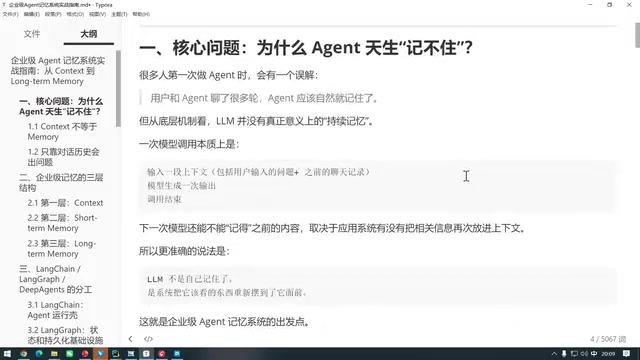
Designing Enterprise-Grade Agent Memory Systems: The Essential Difference Between Context and Long-Term Memory
Deep dive into AI Agent memory architecture: why LLMs have no built-in memory, the key difference between context and memory, and how to design layered enterprise memory systems to avoid context explosion and attention dilution.