Qwen3.8-Flash-Next Deep Dive: How a Static Embedding Table Architecture Takes on DeepSeek

Qwen3.8-Flash-Next uses a 51B static embedding table to challenge DeepSeek V4 Flash in the mid-range AI model arena.
Alibaba's Qwen3.8-Flash-Next is a 181.5B-parameter model featuring an innovative 51B static embedding table that decouples memory from reasoning, keeping active parameters at just 6B for efficient inference. While the architecture cleverly optimizes compute utilization, it demands 256–448GB+ VRAM for deployment. Positioned against DeepSeek V4 Flash, it adds multimodal capabilities as a key differentiator in the increasingly competitive 100B-class enterprise model segment.
Qwen Strikes Back: Qwen3.8-Flash-Next Officially Arrives
The battle over mid-range AI models has been heating up. Alibaba's Qwen (Tongyi Qianwen) series enjoyed a strong run with the 308 MAX and 27B versions, but in the enterprise-focused 100B-class "golden mid-range" segment, DeepSeekAd V4 Flash stole much of the spotlight. Now, Qwen is back with a new contender — the official release of Qwen3.8-Flash-Next (Qwen 308 Flash NEX), a fresh weapon packing a total of 181.5B parameters.
According to analyses from Bilibili content creators, the model's positioning is crystal clear: outperform DeepSeek V4 Flash in code generation and Agent scenarios, while filling in the multimodal capabilities that the competitor lacks — handling both text and image tasks in one package. This means Qwen3.8-Flash-Next isn't just going head-to-head as a pure text model; it's aiming to establish a differentiated advantage through the combination of "multimodal + high performance."
Core Architecture Breakdown: The Ingenious 51B Static Embedding Table
Why can Qwen3.8-Flash-Next deliver impressive intelligence with only about 6B active parameters? The answer lies in its brand-new "Qwen 4 Preview Architecture."

The most creative element of this architecture is an external Static Embedding Table weighing in at 51B parameters. Here's an easy analogy: basic grammar and common vocabulary are resolved by simply "looking them up in a dictionary," freeing up 100% of the precious compute for higher-order logical reasoning. The core idea is to decouple "memory" from "reasoning" — stripping deterministic content that can be retrieved via table lookups out of the computation path, so that the active parameters can focus entirely on complex tasks that genuinely require reasoning capability.
Three Key Factors Behind High-Speed Inference
From a technical standpoint, truly fast, low-latency inference depends on three critical factors:
- Low Latency: End-to-end response time must be short enough
- High Compute Utilization: Every calculation should be spent on critical reasoning
- Smart Parameter Activation Strategy: Activate on demand, avoid redundant computation
The introduction of the static embedding table optimizes compute utilization perfectly — it ensures that every forward pass is spent where it matters most, rather than wasted on repetitive processing of basic grammar.

However, it's important to note that this design is essentially a "trade VRAM for compute" approach. While the static table saves computation, it doesn't save memory. The 51B static table plus the 125B full model weights must all be loaded into VRAM to run, which sets a fairly high hardware bar for deployment environments.
Deployment Barriers: VRAM Requirements Are the Real Bottleneck
Although Qwen3.8-Flash-Next features clever architectural optimizations, VRAM demand becomes an unavoidable reality when it comes to actual deployment.
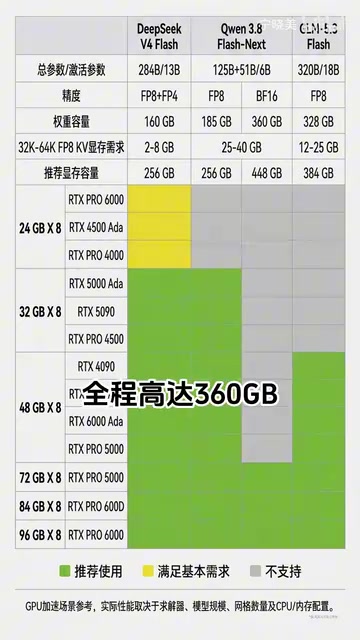
Based on disclosed data, VRAM requirements vary dramatically across precision levels:
| Precision Level | Full Model Weights | Recommended VRAM |
|---|---|---|
| FP8 Quantized | ~185GB | Starting at 256GB |
| BF16 Full Precision | ~360GB | 448GB+ (including KV Cache) |
These VRAM requirements mean that a typical 4-GPU setup simply can't handle it. For enterprises looking to deploy this multimodal model on-premises or in private environments, the hardware investment will be substantial. According to reports, an enterprise-grade compute server equipped with 8x RTX 5090 GPUs can provide 256GB of full VRAM on a single node, comfortably running the FP8 version and meeting the demands of high concurrency and long context windows.
Industry Trends: Three Key Variables from the Mid-Range Battle
From an industry perspective, the release of Qwen3.8-Flash-Next reflects several trends worth watching.
The 100B Class Has Become the Sweet Spot for Enterprise Applications
This parameter range can deliver capabilities approaching those of much larger models while keeping inference costs relatively manageable. The head-to-head clash between DeepSeek and Qwen in this segment shows that vendors have realized the pure parameter arms race is giving way to a more refined competition over "performance-to-cost ratio."
Multimodal Capabilities Are Shifting from Nice-to-Have to Must-Have
Qwen's decision to use multimodal capability as a differentiator against DeepSeek is a strategy whose success will depend on how strong the real-world demand for text-and-image processing is across enterprise use cases. As more and more business scenarios require simultaneous handling of text, images, and even video, multimodal support is evolving from a bonus feature into a baseline requirement.
Take Benchmarks and Marketing Claims with a Grain of Salt
One additional note: the source material for this article comes primarily from a single channel's analysis, which includes content with a product-promotion angle. Therefore, for specific figures like benchmark scores and VRAM requirements, readers are advised to refer to Alibaba's official technical documentation and approach performance claims made in a marketing context with healthy skepticism.
Conclusion: The Mid-Range Battle Has Only Just Begun
Qwen3.8-Flash-Next represents an aggressive counterpunch from the Qwen team in the mid-range model segment. Its static embedding table architecture genuinely showcases ingenuity in compute utilization, but the steep VRAM requirements remind us that a model's "clever" design often comes at a cost in hardware investment.
For enterprise users, choosing a model should go beyond benchmark rankings. Consider these factors holistically:
- Deployment Cost: Whether the VRAM hardware investment fits within your budget
- Scenario Fit: Whether you truly need multimodal capabilities
- Long-Term Maintenance Overhead: Operational complexity and ongoing upgrade costs
The showdown between Qwen and DeepSeek in the mid-range segment has only just begun.
Related articles

Chain of Thought Isn't Just for AI: How Humans Can Use CoT to Improve Thinking Quality
Chain of Thought isn't just a prompt trick for large models. Starting from a Hacker News discussion, this article analyzes why CoT works for human thinking too, breaks down actionable ways to transfer it, and highlights the key differences between human CoT and machine CoT.
Cloudflare Teams Up with OpenAI: Closi…
Cloudflare Teams Up with OpenAI: Closing the Loop from Vulnerability Discovery to Defense with AI
Cloudflare uses OpenAI Daybreak to investigate security vulnerabilities and generate reviewable remediation plans, while developers use Codex to boost coding efficiency and quality.

Orca Multi-Agent Orchestration in Practice: A Guide to Parallel Collaboration with Claude and Codex
Orca is Stable AI's free open-source agent workbench supporting 34 agents like Claude Code and Codex in parallel. Learn its Git worktree isolation, multi-model orchestration, and mobile management.