Qwen3.8 Flash Quantized Version Outperforms Official API in Tests: Which to Choose for Local Deployment?

Tests show Q4 quantized version outperforms official API in engineering delivery, with speed and stability key to selection.
A comparative test of Qwen3.8 Flash (125B) shows that under unified hardware and an engineering-delivery-biased evaluation set, Anslows UD-Q4 quantized version's overall score exceeds the official Flash API, while Swift 1.5's IQ3 ranks last. The official API, at only 30-50 token/s, times out on many questions within 20 minutes, with 43 zero-score items; Anslows Q4 has only 20. Excluding timeouts, Anslows Q4 still leads slightly. Q4 quantization is not full-dimensional degradation; UD preserves high precision for important tensors and calibrates matrices. Swift 1.5 is fastest (147.5 token/s) and shortest total time (6.5 hours), but precision sacrifice yields the lowest score. All three have sub-star ring loops; enable loop detection and interruption recovery.
Title
Qwen3.8 Flash Quantized Version Outperforms Official API in Tests: Which to Choose for Local Deployment?
Meta Description
Qwen3.8 Flash 125B model local deployment test: Anslows Q4 quantized version outperforms official API overall, Swift 1.5 fastest but slightly lower accuracy. This article breaks down evaluation methods, speed-cost comparison, and selection advice.
Article Content
When deploying large models locally, should you choose a quantized version or the official API? A recent comparative test of Qwen3.8 Flash (125B) gives a counterintuitive answer: the Q4 quantized version actually outperforms the official original API in engineering delivery scenarios.
This Bilibili UP host used unified hardware (RTX 5090 32G, 96G RAM, R7 9800X3D) and a self-built evaluation set (803 questions, 920 execution instances) to compare three versions: Anslows' UD-Q4 quantized version, the official Flash API, and Swift 1.5's IQ3 quantized version. The result: Anslows Q4 topped the list by a narrow margin, the official API came second, and Swift 1.5 ranked last.
Evaluation Method and Dimension Weights
The test used Qwen3.8 Max as the judge, with a thinking limit of 100K tokens and a maximum execution time of 20 minutes per question. The question distribution clearly favored engineering delivery: programming accounted for the highest weight at 17%, math 12%, judgment 12%, and promise enhancement 12%. This means the leaderboard reflects "engineering task delivery capability" rather than the model's full-dimensional capabilities.
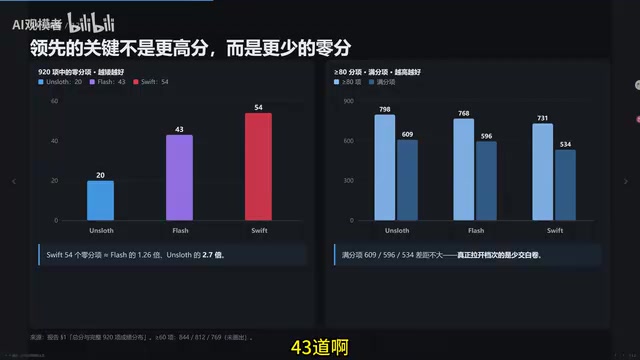
Scoring used two metrics—weighted total score and average score—and both rankings were consistent, indicating the test is stable. The zero-score data is more interesting: Anslows Q4 had only 20 questions with zero score, the official Flash had 43, and Swift had as many as 54.
Inference Speed Metrics: token/s and End-to-End Latency
token/s (tokens output per second) measures throughput during the decoding phase and is jointly affected by model size, quantization precision, batch size, and hardware bandwidth. Under single concurrency, the official API's 30-50 token/s is a medium level; under multiple concurrency, Swift 1.5 can reach 147.5 token/s, indicating better batch scheduling and operator fusion. But what users perceive more directly is end-to-end latency: whether an engineering problem involving multi-turn thinking, tool calls, and code execution can be completed within the 20-minute limit. A thinking token proportion as high as 95% means the model spends most of its time generating internal reasoning chains rather than final answers, which multiplies the gap in decoding speed. Therefore, when evaluating deployment options, you cannot只看 peak token/s; you must also consider the thinking budget and task timeout threshold.
Why Does the Official API Lose to the Quantized Version?
Conventionally, the official original API should be the strongest, but its fatal flaw is being too slow. The Flash version outputs only 30-50 tokens per second, so many questions cannot be completed within the 20-minute limit and are simply submitted blank. The UP host found in the logs that the original version's thinking content accounted for as much as 95%, and complex questions were repeatedly checked without entering the delivery stage.
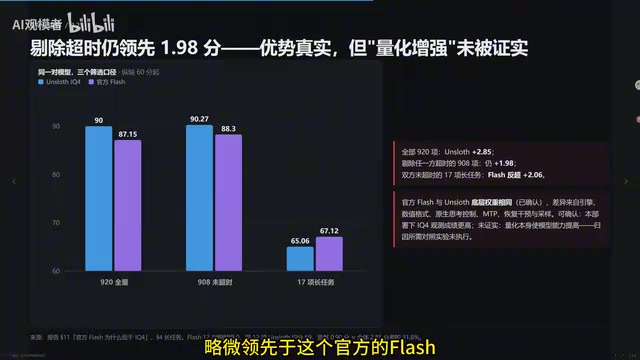
Excluding timeout factors and looking only at questions both completed, Anslows Q4 still led slightly. The only reversal occurred on long tasks—the official original barely won back two points, because the longer the task, the more time the original needs, making delivery within 20 minutes difficult.
This leads to a key insight: Q4 quantization does not equal full-dimensional degradation. Anslows' UD algorithm preserves near-original precision for important tensors during quantization, lowers precision only for unimportant modules, and performs matrix calibration. Many tech bloggers also find it difficult to distinguish Q4 from FP16 in actual comparisons.
Basic Principles of Q4 Quantization and QD (Quantization Degradation)
Large model quantization is a technique that compresses floating-point weights (such as FP16/BF16) into low-bit integers (such as 4-bit) to reduce memory usage and accelerate inference. Q4 means the average weight bit width is about 4 bits (such as INT4 or NF4), and Q3 is about 3 bits. Crude per-tensor uniform quantization significantly loses accuracy, especially for key matrices in attention layers and FFN. UD (Unified Distillation) is a mixed-precision quantization algorithm: first, sensitivity analysis identifies tensors with large impact on output (such as attention output projection and MLP down-projection) and preserves 8-bit or even FP16 precision for them; insensitive modules (such as some embedding layers or shallow MLPs) are reduced to 4 bits, and matrix calibration (such as GPTQ or AWQ calibration) is introduced to compensate for quantization error. Therefore, Q4 is not full-dimensional degradation; on highly sensitive paths, precision is close to the original, which is the prerequisite for Anslows UD-Q4 to match or even slightly outperform the official FP16/FP8 API in engineering tasks.
The Real Gap in Speed, Stability, and Cost
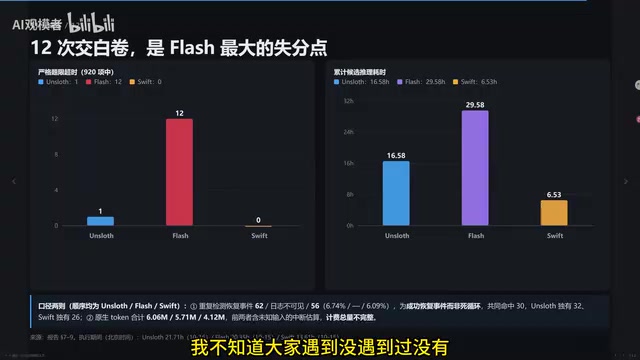
Swift 1.5 has a clear speed advantage: under multiple concurrency it can reach 147.5 token/s, Anslows about 90 token/s, and the official Flash only 53.8 token/s under single concurrency. The time to complete all tests is even more exaggerated—Swift only 6.5 hours, Anslows 16.5 hours, and official Flash 29.58 hours, nearly 5 times the latter.
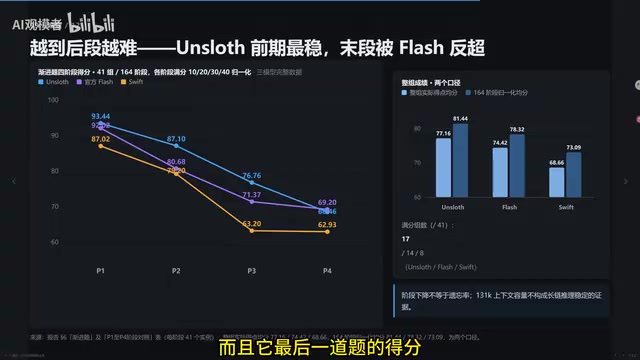
All three models exhibited the "sub-star ring" problem (getting stuck in loops with long input or output), with Anslows detecting more than 60 times and Swift about 50 times. The framework has now added loop detection and interruption recovery mechanisms, and users are advised to enable them in settings.
The "Sub-Star Ring" Loop Problem
"Sub-star ring" is a community term for models falling into repetitive generation loops in long-context or long-output scenarios (similar to a repeater phenomenon), manifesting as the model repeatedly outputting the same phrases, steps, or code blocks and failing to converge to a terminator. Causes include: quantization error causing attention distribution shift, unstable positional encoding extrapolation, overfitting of long-tail patterns in training data, and improper sampling parameters (such as insufficient repetition penalty). Detection methods usually include n-gram repetition rate monitoring, output entropy drop alerts, and hard truncation of maximum generation length. The interruption recovery mechanism forcibly inserts a termination prompt or rolls back to the previous checkpoint for regeneration after detecting a loop. For local deployment, it is recommended to adjust the repetition penalty to 1.05-1.15 and set a reasonable max_new_tokens to reduce the probability of loops.
Selection Advice: Match According to Hardware and Patience
Pursuing comprehensive delivery quality and sufficient hardware: First choice is Anslows UD-Q4. High quantization quality, leading score, acceptable speed.
Don't want to wait, want speed, can accept Q3 precision: Swift 1.5 is a reasonable choice. Although 83.62 points is lower than the other two, it still clearly leads compared with 27B models, and it is fast, outputs briefly, and takes the shortest time.
Official original API: Not recommended unless you are willing to wait one or two hours for medium or long tasks and don't mind paying—slow and costly.
This test's taste favors engineering delivery and reasoning and cannot represent all model capabilities. But for users who want to run a 125B model on a 12G graphics card, it provides a pragmatic selection framework: the quantized version is not necessarily a compromise, and the official API is not necessarily the endpoint.
One-line Summary
Tests show the Q4 quantized version outperforms the official API in engineering delivery scenarios, with speed and stability as key selection factors.
Paragraph Summary
A comparative test of Qwen3.8 Flash (125B) shows that under unified hardware and an evaluation set biased toward engineering delivery, Anslows UD-Q4 quantized version's overall score exceeds the official Flash API, while Swift 1.5's IQ3 version ranks last. The official API, with output speed of only 30-50 token/s, times out on many questions within the 20-minute limit and submits blanks, with as many as 43 zero-score items; Anslows Q4 has only 20. Excluding timeout factors, Anslows Q4 still leads slightly. Q4 quantization is not full-dimensional degradation; the UD algorithm preserves high precision for important tensors and performs matrix calibration. Swift 1.5 is fastest (147.5 token/s) and takes the shortest total time (6.5 hours), but precision sacrifice leads to the lowest score. All three models have the sub-star ring loop problem, and it is recommended to enable loop detection and interruption recovery.
Related articles

Chain of Thought Isn't Just for AI: How Humans Can Use CoT to Improve Thinking Quality
Chain of Thought isn't just a prompt trick for large models. Starting from a Hacker News discussion, this article analyzes why CoT works for human thinking too, breaks down actionable ways to transfer it, and highlights the key differences between human CoT and machine CoT.
Cloudflare Teams Up with OpenAI: Closi…
Cloudflare Teams Up with OpenAI: Closing the Loop from Vulnerability Discovery to Defense with AI
Cloudflare uses OpenAI Daybreak to investigate security vulnerabilities and generate reviewable remediation plans, while developers use Codex to boost coding efficiency and quality.

Orca Multi-Agent Orchestration in Practice: A Guide to Parallel Collaboration with Claude and Codex
Orca is Stable AI's free open-source agent workbench supporting 34 agents like Claude Code and Codex in parallel. Learn its Git worktree isolation, multi-model orchestration, and mobile management.