Qwen4 Local Deployment Speed Preview: VRAM Isn't Everything — Two Approaches Compared

Don't fixate on VRAM for local LLM deployment — KV cache and workspace are the real must-haves.
The article tackles the hot question of whether to stockpile GPUs before Qwen4's release, noting that the real bottleneck for local large model deployment is the often-overlooked KV cache and runtime workspace, not model weights. It outlines two mainstream approaches: Strada, which keeps hot expert modules in VRAM and offloads the rest to RAM and CPU (low barrier but CPU-bound, with latency spiking under frequent calls), and large-capacity unified memory, which reduces data movement and leaves ample headroom, delivering smooth output speed in hands-on tests. The author warns against only checking whether the model fits, urges leaving enough headroom for the KV cache, and stresses that Qwen4's official configuration must be verified after release. It closes with "output speed vs. context length" as the core selection trade-off.
Qwen4 hasn't been officially released yet, but plenty of people have already started stockpiling GPUs for local deployment. But is more VRAM always better? Bilibili creator "千万在这边RGB Fresh Next" offered a reality check through hands-on testing: when deploying large models locally, beyond the model weights themselves, it's the KV cache and runtime workspace that truly consume VRAM. Many people buy expensive GPUs only to end up with slideshow-level performance — the problem usually comes from failing to account for this space.
Two Mainstream Local Deployment Approaches
Centering on the core question of "can small VRAM run large models," the creator breaks down two approaches, each corresponding to different hardware configurations and performance expectations.
Approach 1: The Strada Method — Low Barrier, but Speed Limited by CPU
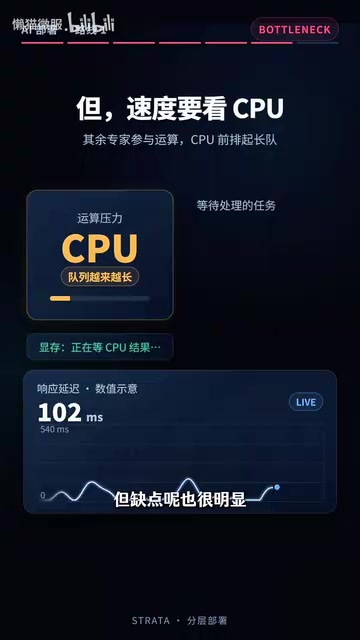
The Strada approach is about "division of labor": expert modules of popular models stay in VRAM, the rest goes to RAM and CPU, and some data can even be placed on disk. Its advantage is a low barrier — even ordinary configurations can attempt large model deployment.

The cost is equally direct: speed depends entirely on the CPU. As call frequency rises, latency spikes, and whatever VRAM you saved needs the rest of the system's hardware to compensate. This approach suits users with limited budgets who are willing to trade speed for runnability.
Mixture of Experts (MoE) architecture is the premise for understanding the Strada approach of "expert modules in VRAM, the rest in RAM." An MoE model consists of multiple feedforward expert networks plus a routing gate — each token activates only a few experts, so the total parameter count can far exceed the parameters actually used in a single computation. This "many parameters, few activations" characteristic makes on-demand loading possible: keep frequently used experts resident in VRAM, leave cold experts in RAM or on disk, and fetch dynamically based on routing results. The cost is that routing switches introduce extra data movement and synchronization overhead — the more intensive the calls, the more easily CPU and memory bandwidth become bottlenecks.
Approach 2: Large-Capacity Unified Memory — The Top Choice for Speed
The other approach centers on large-capacity unified memory. The creator used a configuration with 128GB of RAM and space shared between CPU and GPU as a reference. Unified memory reduces data movement while leaving ample headroom for both the model and the KV cache.

According to the hands-on test, this configuration can smoothly max out output speed with the relevant models. Specific parameters and performance still need to be verified after Qwen4's official release.
Unified Memory refers to CPU and GPU sharing the same physical address space, so data doesn't need explicit copying between them. In traditional discrete GPU architectures, the model and KV cache must reside entirely in VRAM — exceeding capacity means errors or forced offloading to RAM with repeated transfers; unified memory allows the model to reside on demand in a shared pool that the GPU accesses directly, eliminating PCIe transfer overhead. The trade-off is that shared memory bandwidth is typically lower than dedicated VRAM, and actual throughput depends on the chip's memory bandwidth specs. Apple's M series, AMD APUs, and some server platforms all use this design — which is the fundamental reason why "running large models on 128GB of RAM" experiences vary so widely.
Key Reminder: Don't Just Look at Model Size
The creator offered two reminders for users preparing to buy. First, don't just check whether the model fits — hardware must leave sufficient headroom for the KV cache and runtime workspace. Second, Qwen4's official configuration and performance need to be verified after release — don't rush into hardware purchases blindly.
This also explains a common misconception: a bigger VRAM number doesn't mean smooth performance. The KV cache grows with context length, and usage rises significantly in long-conversation scenarios. Ignore this requirement, and even the most expensive GPU may stutter.
KV Cache (Key-Value Cache) is a key memory cost during Transformer inference. During autoregressive generation, each output token requires recomputing its attention against all previous tokens; to avoid redundant computation, frameworks cache the Key and Value tensors from each attention layer, and subsequent tokens reuse them directly. Cache size is roughly proportional to "layers × attention heads × head dimension × sequence length × batch size × precision bytes," so the longer the context and the more concurrency, the more noticeably usage grows. For a 7B-class model at FP16 precision, for example, a long context of tens of thousands of tokens could consume several GB or even a dozen-plus GB of VRAM — precisely the common reason why "the model weights fit but it won't run."
Output Speed vs. Context Length — How to Choose?
The creator closes with a question worth pondering: for local deployment, do you value output speed more, or the length of material you can process?
This choice maps directly to the two approaches. For speed, choose the unified memory solution; for a low barrier to runnability, choose the Strada approach. The two aren't strictly opposed, but the budget allocation logic differs. For users waiting for Qwen4 to go open-source and preparing to adapt it, figuring out your core scenario first and then deciding where to invest in hardware is more practical than blindly stockpiling GPUs.
One-line Summary
Don't fixate on VRAM for local large model deployment — KV cache and runtime workspace are the real must-haves.
Paragraph Summary
The article addresses the hot topic of "should you stockpile GPUs before Qwen4's release," pointing out that the real bottleneck for local large model deployment isn't model weights but the often-overlooked KV cache and runtime workspace. The author outlines two mainstream approaches: the Strada method keeps hot expert modules in VRAM and offloads the rest to RAM and CPU — low barrier but speed depends entirely on CPU, with latency spiking under frequent calls; the large-capacity unified memory approach reduces data movement and leaves ample headroom for model and cache, with hands-on testing showing smooth output speed. The article reminds users not to just check whether the model fits, but to leave enough headroom for the KV cache, and emphasizes that Qwen4's official configuration needs verification after release — don't blindly stockpile GPUs. It closes with "output speed vs. context length" as the core trade-off for selection.
Related articles

Anthropic's IPO: Is a $1.4 Trillion Valuation AI's Future or the Peak of a Bubble?
Anthropic is about to list on Nasdaq with a valuation of up to $1.4 trillion, potentially raising over $60 billion to become the second-largest IPO in history. This article breaks down its revenue, the truth behind its hundred-billion-dollar book loss, compute costs, control design, and lock-up pressure, and analyzes the IPO's chain effects on the AI sector.

Anthropic Races Toward Nasdaq: Ticker ANT, Can a Trillion-Dollar Valuation Hold?
Anthropic files its S1 for a Nasdaq IPO under ticker ANT, led by Goldman Sachs and Morgan Stanley. We break down revenue, massive compute lease commitments, founder voting control, and the valuation debate.

How Anthropic Uses a Four-Layer Narrative to Prop Up a $2 Trillion Valuation
Anthropic's estimated $2 trillion valuation: a breakdown of its positioning theory and four-layer narrative — civilization-level fear, identity, product, and business — and how founder essays, technical docs, and opinion leaders support the AI safety guardian valuation story.