Qwen4-Max Launches: Price Cut and Benchmark Analysis

Qwen4-Max cuts input and output prices by 25%, but benchmarks are vendor-only—build your own tests.
Qwen4-Max is live on QwenCloud at $1.50 input / $4.50 output per million tokens, both 25% cheaper than Qwen3.8-Max, notably benefiting output-heavy generative apps. But benchmark data is vendor-reported with no specific scores, evaluation sets, or third-party reproduction, and key specs like context window, inference speed, and tool calling are undisclosed. The article recommends a five-dimension self-testing plan and small-scale experiments before migration.
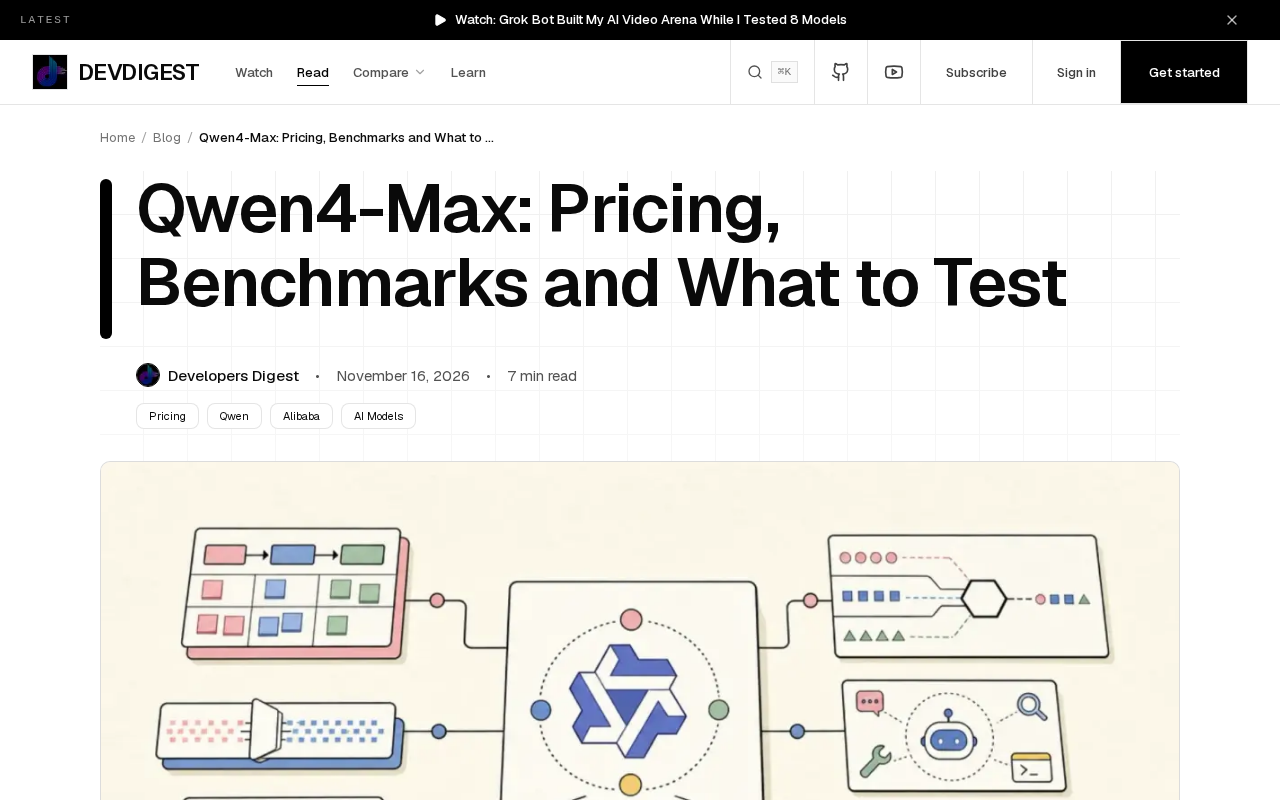
Qwen4-Max is now live on QwenCloud, with input pricing reduced to $1.50 per million tokens and output pricing at $4.50—a 25% drop from Qwen3.8-Max's $2 and $6 respectively. This article sorts out which information comes from official vendor reports, which key data is still missing, and lays out an actionable testing plan.
What the Price Adjustment Means
From Qwen3.8-Max to Qwen4-Max, the per-token unit prices for both input and output have been lowered in tandem. Per million tokens, input drops from $2 to $1.50 and output from $6 to $4.50—both a 25% reduction. For high-frequency LLM applications, this price change directly affects cost structure, especially in scenarios where output tokens make up a large share, such as long-form text generation, code completion, and multi-turn dialogue.
To be clear, the above prices come from QwenCloud's official pricing page and are vendor-published information. Whether additional fees may apply in practice (such as caching, batch inference discounts, or regional differences) is not addressed in the source material, so it's advisable to check the latest price list before integration.
Benchmarks: What Comes from Vendor Reports
Qwen4-Max's benchmark data currently comes primarily from vendor reports. This means the numbers are published by the model provider itself, and the testing conditions, evaluation set versions, and comparison baselines may not be fully disclosed. Common benchmarks include language understanding, reasoning, code generation, and multilingual tasks, but the source material does not provide specific scores, evaluation set names, or a list of comparison models.
In the absence of independent third-party reproduction, a reasonable approach to vendor reports is to treat them as a reference ceiling rather than an absolute conclusion. Differences in prompt design, few-shot settings, and decoding parameters across vendors can all significantly affect final scores.
Vendor-reported benchmarks refer to evaluation results that model vendors publish themselves at launch. Such data typically uses vendor-selected subsets of evaluation sets, specific prompt templates and decoding parameters, and does not necessarily disclose all experimental details. As a result, vendor reports are widely regarded in the industry as an "upper-bound reference": they prove the model can achieve a certain score under that configuration, but cannot guarantee the same results when reproduced by a third party. In contrast are independent evaluations (such as LMSYS Chatbot Arena, HELM, Open LLM Leaderboard, etc.), where neutral organizations test multiple models under a unified protocol. When independent evaluations are lacking, the prudent approach is to use vendor scores only for rough horizontal screening, with final decisions still relying on A/B tests with your own business data.
Missing Information
The source material does not disclose the following key details:
- Specific benchmark tasks and corresponding scores
- Cross-model comparison data with similar models
- Specification parameters such as context window length and maximum output length
- Inference speed, latency, and throughput metrics
- Whether function calling, structured output, or multimodal input are supported
- Training data cutoff date and knowledge update scope
These gaps mean that the currently public information alone is insufficient to make a comprehensive judgment about Qwen4-Max's capabilities. If your use case relies heavily on long context or specific tool-calling capabilities, you'll need to verify them yourself.
Suggested Testing Plan
For Qwen4-Max, we recommend designing tests across the following dimensions:
1. Cost comparison testing
Using the same prompts and output lengths, call Qwen4-Max and Qwen3.8-Max separately and record actual token consumption and costs. Since input and output prices are both down 25%, focus on whether tasks with a high share of output tokens yield significant cost savings.
2. Quality regression testing
Select representative samples from your business covering Q&A, summarization, code generation, and multi-turn dialogue, and compare output quality between the old and new models. Don't just look at vendor benchmark scores—run A/B comparisons with your own data.
3. Edge case testing
Test boundary scenarios such as long input, long output, mixed languages, and structured output, and observe whether the model exhibits truncation, format errors, or performance degradation.
4. Latency and stability
Measure time to first token and overall response time in a real network environment, and repeat calls at different times of day to observe service stability.
5. Tool calling and structured output
If your application relies on function calling or JSON output, separately verify format accuracy and field completeness.
Time to First Token (TTFT) refers to the time from sending a request to receiving the first output token, primarily reflecting queuing and prefill stage duration, and it has the greatest impact on the "responsiveness" of interactive applications. Overall response time includes the generation process for all output tokens and is related to output length and tokens generated per second (tokens/s). The two should be measured separately: TTFT may rise significantly in long-context scenarios, while streaming output lets users see content sooner. Additionally, throughput (requests or tokens processed per unit time) determines the cost efficiency of batch tasks. When measuring, fix input length, output length, and concurrency, and record P50/P95 percentiles rather than just averages to reflect true service stability.
Who Should Pay Attention
The Qwen4-Max price cut is attractive to cost-sensitive teams, especially generative applications that need large amounts of output tokens. But vendor-reported benchmark data is not enough to replace actual testing. Before a formal migration, it's advisable to run a small-scale traffic comparison experiment while keeping the option to fall back to Qwen3.8-Max.
For teams with strict compliance or reproducibility requirements, it's safer to wait for independent third-party evaluation results before deciding.
One-line Summary
Qwen4-Max cuts both input and output prices by 25%, but benchmark data comes only from the vendor—build your own tests to verify.
Paragraph Summary
Qwen4-Max is now live on QwenCloud, with input pricing at $1.50 per million tokens and output at $4.50—both 25% lower than Qwen3.8-Max's $2 and $6—a notable cost impact for generative applications with a high share of output tokens. However, current benchmark data comes primarily from vendor reports, lacking specific scores, evaluation set names, and independent third-party reproduction; key specs such as context window, inference speed, and tool-calling capabilities are also undisclosed. The article therefore recommends building your own testing plan across five dimensions: cost comparison, quality regression, edge cases, latency and stability, and tool calling and structured output, and emphasizes running small-scale comparison experiments before formal migration while keeping fallback options.
Related articles
The AI Agent Era: Building a New Product Paradigm with Evals
AI Agents are becoming the next users of products. This article explains how to use Evals to observe Agent usage behavior, test changes before launch, and compare new model performance, helping product teams establish a development methodology for the Agent era.
Microsoft Global Email Outage Leads to Chlorine Leak at German Hotel, Injuring 15
A Microsoft 365 and Outlook global outage prevented a chlorine safety alert from reaching a German Phantasialand hotel, injuring 15 guests and exposing the fragility of cloud-dependent safety systems.
iPhone Duo to Support Face Unlock Using Only the Front Camera
Apple is developing front-camera-only face unlock for the iPhone Duo, now testing in the iOS 27.3 beta. We analyze the technical approach, user experience, and security trade-offs.