Qwen4-Max Released: 2.4 Trillion Parameters, Yet Still 16 Points Behind Opus?

Qwen4-Max debuts with 2.4T parameters and low prices, but wins only 4 benchmarks as the flagship turns closed.
Alibaba releases Qwen4-Max, its largest model with a 2.4T-parameter MoE architecture, 71B activated parameters, native vision, and million-level context. Official benchmarks show only 4 wins out of 16, with an independent index score of 43—16 points behind Opus. Its API pricing is aggressive, with output cost less than a quarter of Opus's and actual task cost about one-third. The flagship weights are closed, offered only via API hosting, without self-hosting, fine-tuning, or batch inference—a departure from Qwen's previous open-source strategy. The article argues that parameter scale is no longer the sole yardstick; balancing performance, price, and openness is key, and choice depends on task distribution and cost sensitivity.
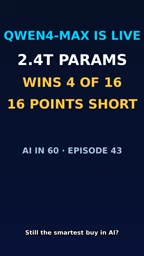
Alibaba's largest model to date, Qwen4-Max, is now officially live. With a 2.4 trillion parameter mixture-of-experts architecture, 71 billion parameters activated per token, native vision support, and a context window reaching the million-token level, its specs are impressive. However, the official benchmark charts show it wins only 4 out of 16 evaluations, with an independent index score of 43—a full 16 points behind Opus. This mismatch between "parameter scale" and "actual performance" reveals a core contradiction in the current large model competition: stacking parameters is no longer a guarantee of victory; the trade-off between price and openness is what matters.
Topping the Parameter Scale, But Winning Less Than 30%
Qwen4-Max's spec sheet is stunning enough: 2.4 trillion total parameters, 71 billion activated parameters, native multimodality, and a million-token context. In Alibaba's own tests, it did capture some key scenarios—scoring 75.7 on DeepSWE, slightly ahead of Opus; and scoring 21 on a specialized legal test, nearly double its competitor. But the problem is that it wins only 4 out of 16 benchmarks. According to statistics from the YouTube channel Labcoat AI, Opus leads in the remaining 7 (the channel claims this is based on its "math" accounting). The independent evaluation firm Artificial Analysis gives a composite index of 43, a gap of 16 points from Opus.
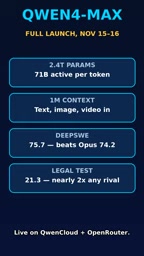
This combination of "largest parameters, smallest win rate" is unusual. It suggests that Qwen4-Max's design goal may not be comprehensive superiority, but rather excellence in specific scenarios (such as code and legal) while trading price for market share.
Mixture of Experts (MoE) is a sparse activation model design: the model contains multiple "expert" subnetworks, but each token is routed to only a few of them for computation. Qwen4-Max's 2.4 trillion total parameters are distributed across a large number of experts, while only 71 billion parameters are activated per token, meaning the actual computation during inference is far less than the total parameter scale. The advantage of MoE is that it can scale model capacity at lower computational cost, but the challenge lies in the efficiency of routing algorithms and expert load balancing. Compared to dense models (where every token passes through all parameters), MoE typically achieves better performance under the same computational budget, but it also relies more on the diversity of training data and the design of routing strategies.
Context window refers to the maximum number of tokens (including input and output) that a model can process in a single pass. A million-level context means the model can read in about 750,000 English words or 1.5 million Chinese characters at once, enough to handle long documents, large codebases, or multi-turn long conversations. However, long-context capability depends not only on window size but is also limited by the model's attention effectiveness over long sequences and positional encoding design. In practical applications, excessively long contexts can lead to increased inference costs and dilution of key information, so how to efficiently utilize long windows remains an engineering challenge.
Price Disruptor: Cost Less Than a Quarter of Opus
Qwen4-Max's pricing is highly aggressive: $1.50 per million input tokens and $4.50 per million output tokens. Compared to Opus's $4.20 (on the output side), Qwen4-Max's output price is less than a quarter of the former. If calculated by the actual cost of completing a task, Artificial Analysis gives figures of $3.27 versus $10.04—a gap of more than three times. Alibaba's own data also shows a 62% reduction in cost per task.
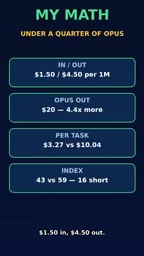
For developers who frequently call APIs, this price difference is enough to offset some of the performance disadvantage. Especially when tasks are concentrated in Qwen4-Max's strong areas (such as the DeepSWE scenario in code generation), the cost-effectiveness advantage is further amplified.
A Closed Flagship: The Shift in Open Strategy
The most intriguing change comes from openness. The Qwen series was previously known for open-source weights, but Qwen4-Max's weights are closed, offered only through Alibaba Cloud API and OpenRouter hosting, with no download or self-hosting available. Officials promise to open smaller Qwen4 models later, but the flagship version remains locked. In addition, the total length of the thinking process plus the final answer is limited to 262,000 tokens, and fine-tuning and batch inference are not supported.
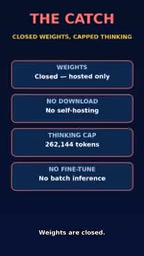
This shift means Alibaba has chosen a "price for openness" route for its flagship model. For developers, convenience improves (no deployment needed, on-demand calls), but flexibility and data sovereignty decline. For Alibaba, this is a clear trade-off between commercialization and ecosystem control.
Open-weight refers to the public download of a model's parameter files after training, allowing developers to deploy, fine-tune, or even commercialize it themselves (subject to license terms). In contrast, closed weights provide inference services only through APIs, and users cannot access the model internals. Open weights are conducive to ecosystem building, transparency, and data sovereignty, but difficult to control abuse and commercialization; closed weights facilitate unified management by vendors, ensuring service quality and continuous iteration. Multiple previous versions of the Qwen series used open weights, while Qwen4-Max has turned closed, reflecting the trade-off of flagship models between commercial interests and ecosystem openness.
Fine-tuning refers to continuing to train a pre-trained model with domain-specific data to adapt it to downstream tasks. Batch inference allows multiple requests to be processed in packages to improve throughput and reduce unit costs. Qwen4-Max does not support these two features, meaning developers cannot customize the model for private data, nor can they further optimize costs through batch processing. For enterprises requiring high customization or large-scale offline inference, this constitutes a practical limitation that may prompt some users to turn to open-source models that support fine-tuning or other API services.
Choose the Cheaper or the Stronger?
The question Labcoat AI posed at the end of its video is worth every technical decision-maker's consideration: would you choose a model that is cheaper but loses half the benchmarks, or pay more than four times the price for Opus? The answer depends on the task distribution. If the workload is concentrated in the scenarios covered by the 4 benchmarks that Qwen4-Max wins, and cost-sensitive, it may be the most cost-effective choice currently available. If the task requires comprehensive and balanced capabilities, or if there are concerns about closed weights, Opus still leads.
Parameter scale is no longer the only yardstick. Qwen4-Max traded 2.4 trillion parameters for local advantages and price advantages, but failed to achieve comprehensive leadership. This may be a signal that large model competition has entered its second half: whoever finds the best balance between performance, price, and openness will win developers' long-term trust.
One-line Summary
Qwen4-Max enters the market with 2.4 trillion parameters and low prices, but wins only 4 benchmarks as the flagship turns closed.
Paragraph Summary
Alibaba has released its largest model to date, Qwen4-Max, featuring a 2.4 trillion parameter mixture-of-experts architecture with 71 billion activated parameters per token, native vision support, and a million-level context. However, official benchmarks show it wins only 4 out of 16 evaluations, with an independent index score of 43, 16 points behind Opus. Its API pricing is highly aggressive, with output prices less than a quarter of Opus's, and actual task costs about one-third. Meanwhile, the flagship model's weights are closed, offered only through API hosting, without support for self-hosting, fine-tuning, or batch inference—different from Qwen's previous open-source strategy. The article argues that parameter scale is no longer the only yardstick; the balance of performance, price, and openness is the key to competition, and the choice depends on task distribution and cost sensitivity.
Related articles

RePlan-VLA: Progress-Aware Replanning Breakthrough for Long-Horizon Robotic Manipulation
The RePlan-VLA framework converts VLA models' short-horizon capabilities into reliable long-horizon execution through progress-aware adaptive replanning, improving success rates by 21.9% and 10.4% on RoboCasa365 and CALVIN, and validating real-world deployment on a Franka Research 3 robot.

Geometric Bridge Flow Matching: A New Breakthrough in Blind Rigid Motion Correction
Geometric bridge flow matching enables blind rigid motion correction in head CBCT, achieving 37.1 dB PSNR and 0.27 mm RPE on simulated data in ~9.1 minutes, outperforming existing methods.

Google Releases Gemini 4 Hydrogen: 2.5x Faster Without Sacrificing Intelligence
Google releases the lightweight Gemini 4 Hydrogen: 2.5x faster task completion, AA Intelligence Index of 54 beating its flagship sibling, 7.3s single-step on Agent Arena faster than Claude and GPT rivals, four thinking levels with pay-as-you-need pricing, now available across AI Studio and more.