RACER: A Training-Free Reflective Agent That Solves the Key Frame Selection Challenge in Long Videos

RACER solves long-video frame selection with a training-free agent using query rewriting, vector retrieval, and reflection loops.
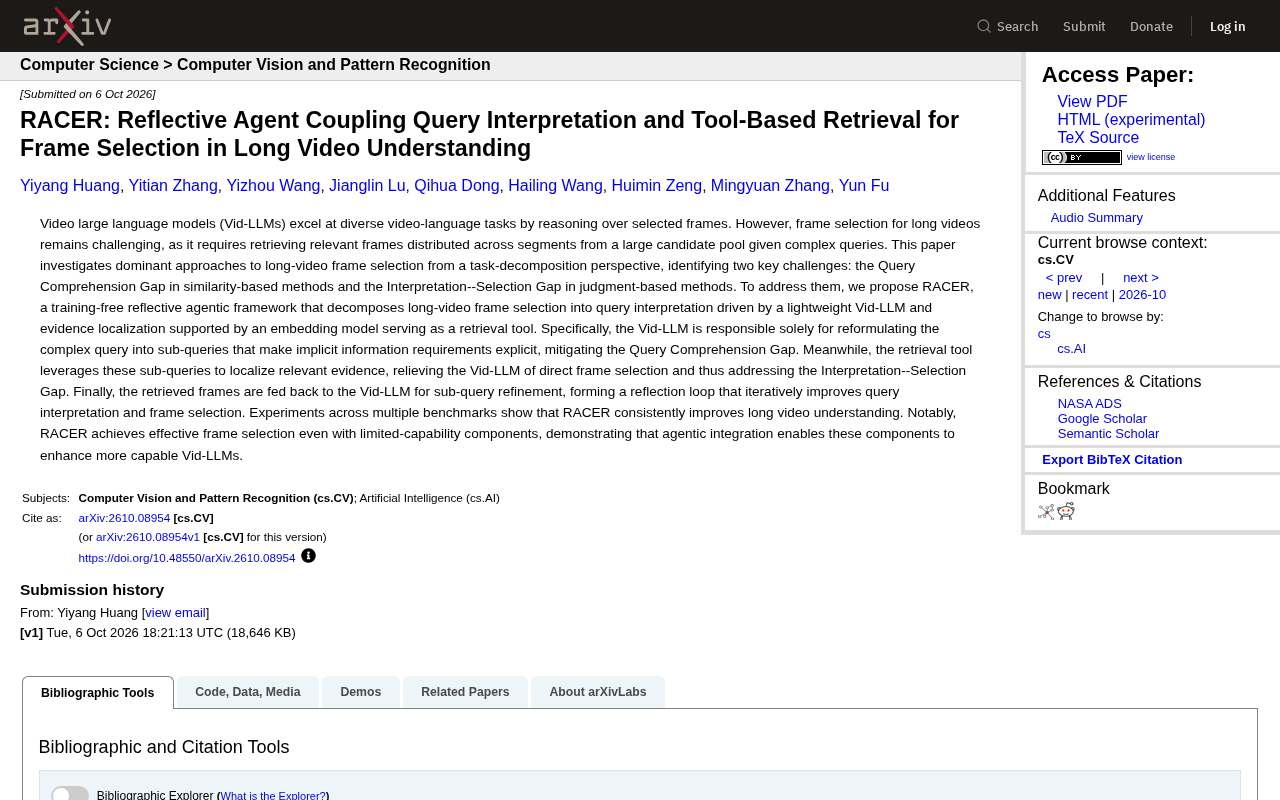
Vid-LLMs face two core frame selection challenges in long video understanding: similarity-based methods fail to grasp complex queries (Query Comprehension Gap), while judgement-based methods struggle to translate understanding into accurate frame selection (Interpretation–Selection Gap). RACER addresses both by having a lightweight Vid-LLM rewrite queries into sub-queries, delegating efficient frame retrieval to an embedding model, and iteratively refining results via a reflection loop — all without any additional training. Experiments show this agent-based design can enhance powerful Vid-LLMs even with limited individual components.
The Core Bottleneck in Long Video Understanding: Frame Selection
Video Large Language Models (Vid-LLMs) have demonstrated impressive performance across a range of video-language tasks, but their reasoning capabilities depend on one critical prerequisite — selecting the right frames from a video in the first place. For short videos, this is rarely a problem. But for long videos, frame selection becomes a genuine obstacle.
Long videos contain an enormous pool of candidate frames, with relevant information scattered across different segments, and user queries are often complex with multiple implicit information needs. Precisely identifying the handful of truly useful frames from this massive pool directly determines the success or failure of downstream tasks. A recent paper from arXiv, titled RACER, targets exactly this pain point.
Two Gaps Afflicting Two Mainstream Approaches
The paper examines current mainstream approaches to long-video frame selection through the lens of task decomposition, and identifies two critical flaws.
The "Query Comprehension Gap" in Similarity-Based Methods
One class of methods relies on similarity matching: both the query and video frames are encoded as vectors, and the most similar frames are retrieved. These methods are fast and scalable, but the problem is that they cannot truly understand the implicit intent behind complex queries. When a query contains multiple conditions or requires reasoning, simple similarity matching tends to miss key evidence — this is known as the Query Comprehension Gap.
These methods typically rely on vision-language pretrained models like CLIP to map frames and queries into a shared embedding space, then rank results using metrics like cosine similarity. The advantage is retrieval speed — approximate nearest-neighbor search can be performed over hundreds of thousands of frames. However, embedding vectors are inherently compressed semantic representations. Faced with composite queries containing temporal logic and implicit conditions — such as "who is still in the kitchen after the person in the red jacket leaves the room" — a single vector struggles to capture all semantic layers, resulting in retrieval that matches surface-level keywords rather than the true information need.
The "Interpretation–Selection Gap" in Judgement-Based Methods
Another class of methods asks a Vid-LLM to directly judge which frames are relevant. While the model can understand the query, having it make selection judgements across a large pool of candidate frames is computationally expensive, and a gap often emerges between "understanding the query" and "correctly selecting the frames." The model knows what to look for, but may not accurately execute the selection action — this is the Interpretation–Selection Gap.
These two gaps correspond to the problems of "insufficient understanding" and "imprecise execution" respectively, and together form the root cause of why long-video frame selection has been so difficult to crack.
RACER's Approach: Collaborative Division of Labor with Reflection
RACER stands for Reflective Agent Coupling Query Interpretation and Tool-Based Retrieval. The core idea is to decompose the frame selection task into two specialized components and introduce a reflection loop. Crucially, it is a training-free agent framework — no additional model training is required for deployment.
Let the Vid-LLM Focus Solely on "Understanding"
In RACER, a lightweight Vid-LLM no longer directly selects frames. Instead, it focuses on rewriting complex queries into a series of sub-queries, making implicit information needs explicit. This step directly addresses the Query Comprehension Gap — the model concentrates its effort on language understanding, which is its core strength.
Let the Retrieval Tool Handle "Localization"
The rewritten sub-queries are handed off to an embedding model, which acts as a retrieval tool to locate relevant evidence frames. This frees the Vid-LLM from the burden of direct frame selection, and the Interpretation–Selection Gap is bridged — understanding and execution are handled by separate components, each doing what it does best.
The embedding model here refers to a text or multimodal encoder specialized for dense retrieval, such as models in the E5, BGE, or CLIP families. It encodes sub-queries and video frames separately as high-dimensional vectors, then retrieves the most relevant frames via vector similarity. Compared to having a large language model score frames one by one, vector retrieval reduces computational complexity from O(n)-level per-frame inference to approximately O(log n) index lookups — an especially significant efficiency advantage when the number of frames is very large. RACER's innovation lies in the fact that what's fed into the retriever is no longer a vague original query, but a set of sub-queries refined by the Vid-LLM, making each retrieval step target a more specific semantic goal.
The Reflection Loop: Iterative Refinement
The retrieved frames are fed back to the Vid-LLM to further refine the sub-queries, forming a reflection loop. Through multiple iterations, both the quality of query interpretation and frame selection improve progressively. This "understand–retrieve–reflect" cycle is what distinguishes RACER from one-shot selection methods.
The reflection loop design draws inspiration from the "generate–evaluate–revise" paradigm widely validated in recent reasoning-oriented agents, similar to self-inspection mechanisms found in frameworks like ReAct and Reflexion. In RACER, after each iteration the Vid-LLM reviews whether the retrieved frames sufficiently cover all information needs from the original query, and if gaps remain, generates new sub-queries to trigger the next retrieval round. This iterative design effectively handles situations where information is sparse in the video or key evidence is buried under noisy frames, while also giving the entire retrieval process a degree of adaptability — simple queries may converge in one or two rounds, while complex multi-step reasoning queries automatically expand the retrieval depth.
Experimental Results and Implications
The paper validates RACER across multiple benchmarks, with results showing consistent improvements in long video understanding performance.
One particularly noteworthy finding is that RACER achieves effective frame selection even when using components with limited individual capability. In other words, the agent-based integration design allows these relatively weaker components to collectively enhance more powerful Vid-LLMs. This has significant practical implications — it means you don't need to rely on the most powerful and expensive models. Through thoughtful task decomposition and tool collaboration, excellent long-video processing capability can still be achieved.
Value and Outlook
RACER's significance extends beyond improving a few benchmark scores. More importantly, it offers a replicable methodology: when facing complex tasks, rather than having a single large model handle everything, decompose the task across components with complementary strengths and connect them with a reflection mechanism.
This "division of labor + reflection" agent paradigm is emerging as a general-purpose approach for handling long-context and complex-query tasks. For practical applications like video retrieval, surveillance analysis, and long-video question answering, RACER's training-free, low-dependency characteristics give it strong engineering practicality. As Vid-LLMs and multimodal retrieval technologies continue to evolve, agent frameworks of this kind are poised to further lower the barrier to long video understanding.
Related articles

MCP Protocol in 60 Seconds: A Real Session, Message by Message
Dissecting a real MCP session message by message: how an Agent dynamically discovers tools, forwards call requests, and has an MCP server execute them — all in just 9 JSON messages, with the model and reasoning loop untouched.

n8n 40-Minute Masterclass: Build Your First AI Automation Workflow from Scratch
Distilled from a 40-minute n8n masterclass: the core differences between automation, AI, and AI Agents, a comparison of n8n's four deployment methods, and a complete guide from dashboard to your first workflow.

Why Does a 35GB Quantized Model Blow Up an 80GB GPU? The Truth About KV Cache VRAM
Why does a 35GB 4-bit quantized LLM still blow up an 80GB GPU? This article breaks down the four components of inference VRAM, provides precise KV Cache formulas, compares GQA vs DeepSeek MLA memory, and offers production-grade OOM prevention like FP8 KV Cache.