Radix: A Visual UI Tool Built for Agentic Programming

Radix provides a visual interface for agentic programming to tackle the transparency and control challenges of autonomous AI execution.
Radix is an early-stage tool that debuted on Hacker News as a Show HN post, positioned to provide a visual interface for agentic programming. As AI coding assistants evolve from passive code completion to autonomous agents capable of decomposing tasks, modifying multiple files, and looping through tool calls, developers face a serious black-box problem. Radix aims to make agent execution flows, task structures, and code changes visible through a graphical interface, enabling genuine human-in-the-loop oversight. This reflects a broader industry trend: developers are shifting from writing code to reviewing and guiding AI, and the tooling for observation and control is still in its early stages.
When Agentic Programming Meets Visual Interface
As LLM-powered programming assistants (agentic programming) become increasingly mainstream, a real problem has begun to surface for developers: while command-line interfaces and plain-text conversations are flexible, when tasks grow complex — involving multi-step planning and changes across multiple files — it becomes difficult to clearly understand what an AI agent is actually doing through text exchanges alone. Radix, which recently debuted on Hacker News as a Show HN post, targets exactly this pain point, attempting to provide a visual UI layer for agentic programming.
While the project is still in its early stages (13 upvotes and 11 comments at the time of writing), the direction it represents is worth paying attention to: how to make collaboration between human developers and AI programming agents more transparent and controllable.
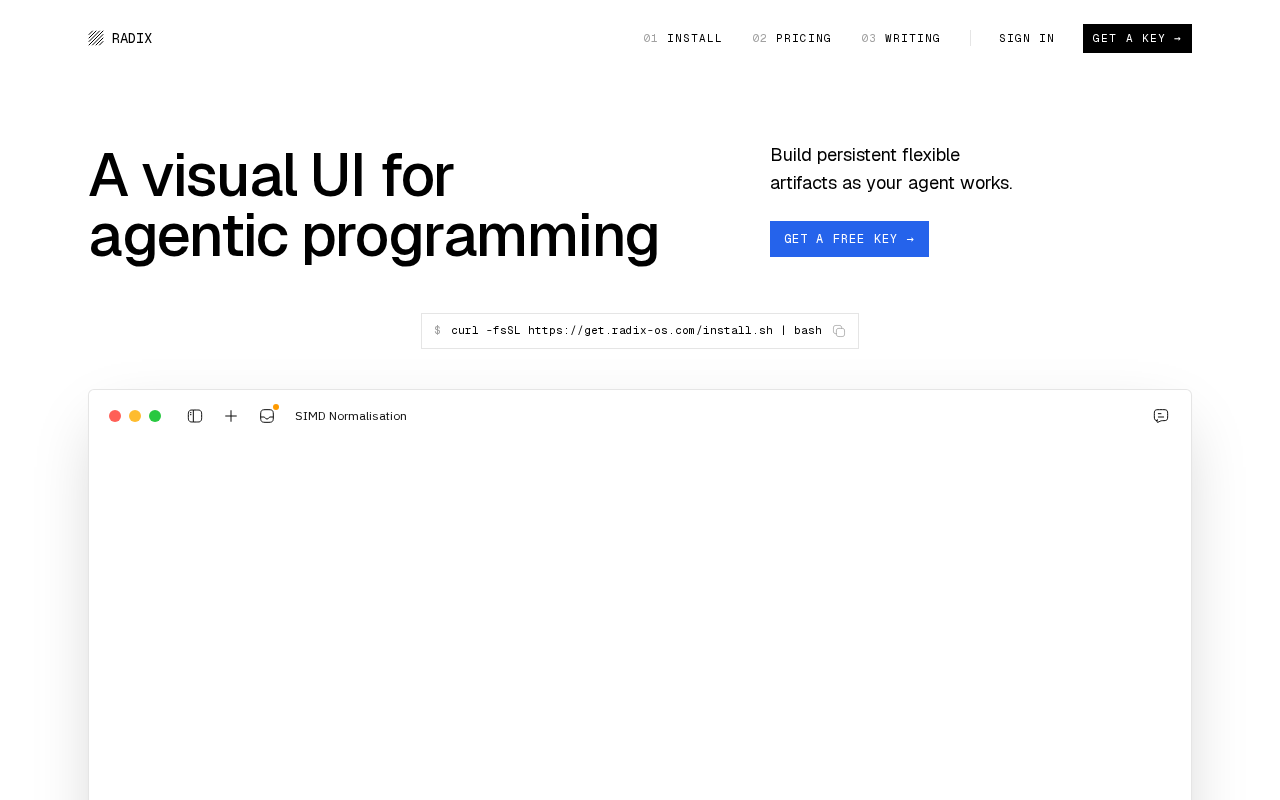
What Problem Is Radix Trying to Solve
The core of agentic programming is that AI is no longer passively completing a single line of code — it can autonomously break down tasks, plan steps, call tools, modify multiple files, run tests, and adjust strategies based on results. This autonomy brings efficiency gains, but also introduces a "black box" problem: developers can often only evaluate whether an agent's behavior met expectations after the fact, by reading logs or reviewing the final output.
Radix's positioning is to insert a visual layer into this process. Compared to traditional plain-text terminal interactions, a graphical interface can theoretically present an agent's execution flow, task decomposition structure, and the impact of each operation on the codebase in a far more intuitive way. For programming tasks that run for extended periods and involve complex context, this kind of visual feedback can significantly reduce the cognitive load of understanding what's happening.
The Value of a Visual Interface
Visualization matters for more than aesthetics. When an agent touches multiple files and executes multiple rounds of operations at once, developers need to quickly determine which changes are safe and which require human intervention. A graphical interface can map these abstract execution states into clickable, reviewable elements — making "human-in-the-loop" supervision practically feasible, rather than leaving developers to drown in a scrolling stream of text.
Human-in-the-loop is an AI system design paradigm that preserves the opportunity for human decision-making or approval at critical nodes in an automated process, rather than allowing the system to run autonomously to completion. The concept originates from cybernetics and automation engineering, and has gained widespread attention in AI safety circles in recent years as large model capabilities have expanded. In the context of agentic programming, the challenge of implementing human-in-the-loop isn't primarily technical — it's about how information is presented. When an agent makes dozens of tool calls and modifies several files within seconds, the information density of plain-text logs often exceeds what humans can process in real time, creating a situation where supervision exists in name only, but meaningful intervention is impossible. Visual interfaces address this by structuring and making execution state interactive, turning human oversight from a theoretical ideal into a practical reality.
Trends in the Agentic Programming Tool Landscape
Radix is not an isolated phenomenon. The tooling ecosystem around AI programming assistants is rapidly differentiating: on one end are completion-style tools deeply integrated into editors; on the other are agentic frameworks capable of autonomously executing longer task chains. Radix sits closer to the infrastructure side of the latter — it doesn't necessarily need to replace a specific programming model, but instead provides a better observation and control interface for running agents.
The rise of tools like this reflects a growing consensus: as AI takes on heavier programming workloads, the human role is shifting from "the person writing code" to "the person reviewing and guiding agents." To succeed in this new role, developers need better interfaces to observe, intervene in, and correct agent behavior. Whoever makes this layer of interaction feel natural will be better positioned to secure a place in the developer workflow.
Agentic Programming vs. Traditional Code Completion — The fundamental difference between agentic programming and traditional code completion tools lies in the degree of autonomy. Completion tools like GitHub Copilot are essentially context-aware autocomplete, with each interaction still driven by the human. Agentic frameworks (such as OpenAI's Codex Agent, Anthropic's Claude Code, and the open-source SWE-agent) can accept a high-level goal (e.g., "fix this bug" or "implement this feature") and then autonomously decompose subtasks, iteratively executing a "think-act-observe" loop until the goal is reached. These systems typically rely on architectures like ReAct (Reasoning + Acting) combined with tool-calling capabilities such as file read/write, terminal execution, and browser control. It is precisely this ability to autonomously execute multi-step operations that makes observation and control interfaces far more important than they were in the era of code completion.
Opportunities and Challenges for an Early-Stage Project
As a project that just debuted on Hacker News, Radix faces both clear opportunities and real challenges. The opportunity lies in how new the space is — no dominant player has yet emerged in the visual interface niche for agentic programming. The challenge is developer habit: many power users are deeply accustomed to terminal and plain-text interactions, and convincing them to switch to a graphical interface requires demonstrating a meaningful efficiency gain.
Based on the limited public information available, Radix is still at a stage where it needs community feedback to validate its product direction. The Show HN format is itself a way of soliciting opinions from the technical community, and the comment section typically surfaces real users' thoughts on feature positioning, integration approaches, and actual experience. For developers tracking the evolution of AI programming tools, early-stage projects like this are worth watching — they may offer a preview of what human-AI collaborative programming will look like in the next phase.
Closing Thoughts
Radix represents a natural evolutionary direction as agentic programming tools mature: the more AI can do, the more humans need good interfaces to understand and control it. Whether visual UI will become a standard fixture of agentic programming still requires time and market validation to determine — but the problem it points to, transparency and controllability, is undeniably a core challenge this field cannot sidestep.
Note: Due to limited source material, descriptions of Radix's specific features in this article are inferred from its stated positioning. For actual usage experience, please refer to the official documentation and community feedback.
Related articles

LoopRec: On-Demand Compute Allocation for Sequential Recommendation, Moving Beyond Fixed Depth
LoopRec introduces an item-level adaptive recursion framework that uses gating to dynamically allocate computation depth per item in sequential recommendation, outperforming fixed-depth baselines with interpretable allocation patterns.

Ollama Local LLM Deployment Tutorial: From Installation to GUI Client
Complete Ollama local LLM deployment tutorial: three-platform installation, importing GGUF and SafeTensors models, connecting GUI clients to OpenCode and WebSearch with hands-on testing, plus key settings like model storage paths and selection advice.

TenetBench: Testing AI Compliance with Russian Professional Ethics Clauses
TenetBench is a benchmark of 3,433 Russian professional ethics clause-conflict requests evaluating whether LLMs comply with professional codes. It finds 11 of 14 model configurations generate violating content, and reasoning mode may reduce refusal rates.