RAG Isn't as Complex as You Think: A Back-to-Basics Practical Guide

RAG is just retrieve, concatenate, and generate — stop overcomplicating it.
RAG has been over-mystified by complex tooling and marketing hype. At its core, it's three simple steps: find relevant content, stuff it into a prompt, and let the LLM generate a grounded answer. This guide explains why developers overcomplicate RAG, when advanced techniques like reranking and hybrid search are actually needed, and how to build effective RAG systems by starting simple and adding complexity only when real bottlenecks emerge.
The Over-Mystification of RAG
Retrieval-Augmented Generation (RAG) has become practically standard for LLM applications over the past two years. Whether it's enterprise knowledge base Q&A, document assistants, or vertical-specific intelligent customer service, RAG is widely regarded as the go-to solution for tackling LLM "hallucination" and knowledge freshness issues.
Hallucination refers to the phenomenon where large language models fabricate plausible-sounding but factually incorrect information during text generation. The root cause lies in how LLMs generate text — they are fundamentally probabilistic next-token predictors, optimized to produce linguistically "fluent" text rather than factually "correct" text. While a model's parameters encode knowledge from its training data, this encoding is fuzzy and compressed — nothing like a database you can query precisely. RAG addresses this by providing externally retrieved factual evidence at generation time, transforming the model's task from "recalling knowledge" to "reading comprehension," which dramatically reduces the probability of hallucinations. That said, RAG doesn't eliminate hallucinations entirely — if the retrieved content itself is inaccurate, or if the model ignores evidence in the context, hallucinations can still occur.
However, the technical narrative around RAG has grown increasingly complex. Vector databases, embedding models, chunking strategies, reranking, hybrid search, query rewriting… concepts pile on top of each other, leading many developers to believe that building a functional RAG system requires a massive tech stack and meticulous tuning. The article RAG Is Simpler Than You Think, which sparked discussion on Hacker News, aims to pop this "complexity bubble."

The Essence of RAG: Retrieve + Concatenate + Generate
Strip away the fancy engineering wrappers, and RAG's core logic is remarkably simple — it boils down to three steps:
Step 1: Find Relevant Content
When a user asks a question, the system needs to find the most relevant passages from the knowledge base. This can be done using vector similarity search, traditional keyword matching (like BM25), or even simple full-text search in small-scale scenarios. One of the article's key points is: most teams don't need to deploy a dedicated vector database right from the start.
It's worth understanding the difference between these two mainstream retrieval approaches. Vector similarity search converts text into high-dimensional vectors using an embedding model, then finds the semantically closest document fragments using metrics like cosine similarity or Euclidean distance. Its advantage lies in capturing semantic similarity — for example, "how to get a refund" and "return process" are lexically different but semantically close. BM25, on the other hand, is a classic retrieval algorithm based on an improved version of TF-IDF (Term Frequency–Inverse Document Frequency). It calculates relevance scores by measuring how frequently query terms appear in a document and how rare those terms are across the corpus. BM25 excels at exact keyword matching and has extremely low computational cost — no GPU inference required. In practice, each approach has its strengths: vector search is better at semantic generalization but may miss precise information, while BM25 excels at exact matching but can't understand synonyms. This is exactly why "hybrid search" emerged — combining results from both methods to get the best of both worlds.
Step 2: Stuff the Retrieved Content into the Prompt
The retrieved text is directly concatenated into the prompt sent to the LLM, serving as contextual evidence for answering the question. There's no magic here — it's essentially string concatenation.
That said, there's an often-overlooked preprocessing step before concatenation — chunking. Chunking is a critical step in RAG preprocessing, where original documents are split into smaller segments suitable for retrieval and model processing. Common strategies include: fixed-length chunking (e.g., 512 tokens per chunk), semantic chunking by paragraph or section, and sliding window chunking (where adjacent chunks overlap to prevent information fragmentation). The choice of chunk granularity directly affects retrieval quality — chunks that are too large reduce retrieval precision and waste context window space; chunks that are too small may lose necessary contextual information. As context windows for models like Claude and GPT-4 have expanded to 128K tokens and beyond, some teams have started experimenting with "large chunk retrieval + full document injection" strategies, further simplifying the chunking process. This also validates the article's point from another angle: as foundation model capabilities improve, many RAG engineering tricks are becoming unnecessary.
Step 3: Let the Model Generate an Answer Based on Context
The LLM reads the complete prompt containing the retrieved content and generates a grounded answer. That's the entire meaning of "Retrieval-Augmented Generation."
In other words, a minimum viable RAG implementation might require just a few dozen lines of code: a retrieval function, a prompt template, and one API call. The so-called complexity is largely engineering optimization layered on later to chase marginal performance gains — not an entry barrier.
Why Developers Overcomplicate RAG
The Tool Ecosystem Fuels the Hype
The current AI infrastructure market is flooded with vector database products, orchestration frameworks, and "RAG-as-a-Service" platforms. The marketing language of these tools naturally emphasizes the complexity of the problem — after all, their products only have value if developers believe "RAG is hard." This objectively raises the psychological barrier for developers approaching RAG.
Between 2023 and 2024, vector databases became one of the hottest segments in AI infrastructure. Products like Pinecone, Weaviate, Qdrant, Milvus, and Chroma secured significant funding, while major cloud providers rolled out managed vector search services. The core problem these products solve is: how to perform fast Approximate Nearest Neighbor (ANN) searches across millions or even billions of vectors, using index algorithms like HNSW and IVF to accelerate retrieval. However, for scenarios with fewer than tens of thousands of documents, PostgreSQL's pgvector extension, SQLite's vector search plugins, or even loading all vectors into memory for brute-force search can handle the job perfectly well. Whether to choose a dedicated vector database or a lightweight solution fundamentally depends on data scale and query concurrency requirements.
Equally noteworthy is the controversy around orchestration frameworks. The most prominent examples are LangChain and LlamaIndex. LangChain attempts to provide a standardized abstraction layer for LLM applications, covering model invocation, retrieval, memory management, tool usage, and more. It significantly lowered the barrier for prototyping in its early days, but as its layers of abstraction kept growing, it attracted substantial criticism: over-encapsulation making debugging difficult, frequent abstraction leaks, and version updates often introducing breaking changes. Many experienced developers began advocating for a "framework-free" approach — using native SDKs from OpenAI, Anthropic, and others, combined with minimal custom code to build RAG pipelines. This reflection aligns closely with the article's core argument: don't let the complexity of your tools obscure the simplicity of the problem itself.
The Premature Optimization Trap
Many teams rush to introduce reranking models, hybrid search, and query expansion before even validating whether the core pipeline works or whether retrieval quality is adequate. The result is a system that's hard to debug, with the real issues buried under layers of optimization. The article suggests that getting it working with the simplest possible approach first, then optimizing based on specific needs, is the right engineering cadence.
Confusing "Good Enough" with "Optimal"
A simple RAG system that can answer 80% of common questions is often more valuable than a theoretically perfect but never-shipped complex system. Developers need to distinguish between two different goals at two different stages: "making the system work" versus "tuning the system to perfection."
When Do You Actually Need a Complex RAG Setup?
Simplification doesn't mean dismissing the value of advanced techniques. As business scale and quality requirements grow, the following scenarios genuinely call for more sophisticated design:
- Massive document retrieval: When your knowledge base reaches millions or even hundreds of millions of documents, the retrieval efficiency and scalability advantages of dedicated vector databases truly come into play.
- Retrieval quality bottlenecks: If you find that retrieved content is frequently irrelevant, that's when introducing a reranking model or hybrid search makes sense. Reranking models (such as Cohere Rerank, BGE-Reranker, cross-encoder models, etc.) pair the query with each candidate document and compute a fine-grained relevance score for each pair, then re-sort the results. Unlike the bi-encoder used in initial retrieval, reranking models use a cross-encoder architecture that performs token-level cross-attention between the query and document, producing more accurate relevance judgments — but at a higher computational cost. This is why reranking is typically run only on the Top-K results rather than scanning the entire database.
- Complex query intent: For multi-hop reasoning or questions that require synthesizing information from multiple sources, techniques like query rewriting and multi-round retrieval become essential.
The key principle: complexity should be problem-driven, not predetermined. You should introduce solutions only when you encounter specific bottlenecks, not build an all-encompassing architecture at the project's outset.
Practical Advice for Building RAG Systems
This article resonates because it reflects a widespread anxiety in the AI application development community: technical concepts evolve too fast, there are too many tools to choose from, and it's all overwhelming. The advice it offers is clear and pragmatic:
- Start with the simplest implementation — a retrieval function plus one model call. Get the pipeline working first.
- Validate with real data — observe which questions are answered well and which aren't. Let the data tell you where the bottlenecks are.
- Introduce complexity on demand — only bring in advanced techniques when you've confirmed that a specific component is actually the bottleneck.
This "simple-to-complex" approach isn't just applicable to RAG — it's universal wisdom for building any engineering system. In an era where AI engineering is increasingly over-complicated, returning to fundamentals and resisting the temptation of premature optimization is, paradoxically, a rare form of clarity.
Conclusion
The core of RAG has never been some sophisticated technical component — it's the simple idea of "finding relevant content and giving it to the model as reference." Once developers understand this, they can break free from the anxiety manufactured by tool marketing and focus their energy on what truly matters — understanding business requirements, validating retrieval quality, and iteratively improving the experience. As the article's title says: RAG is simpler than you think.
Related articles
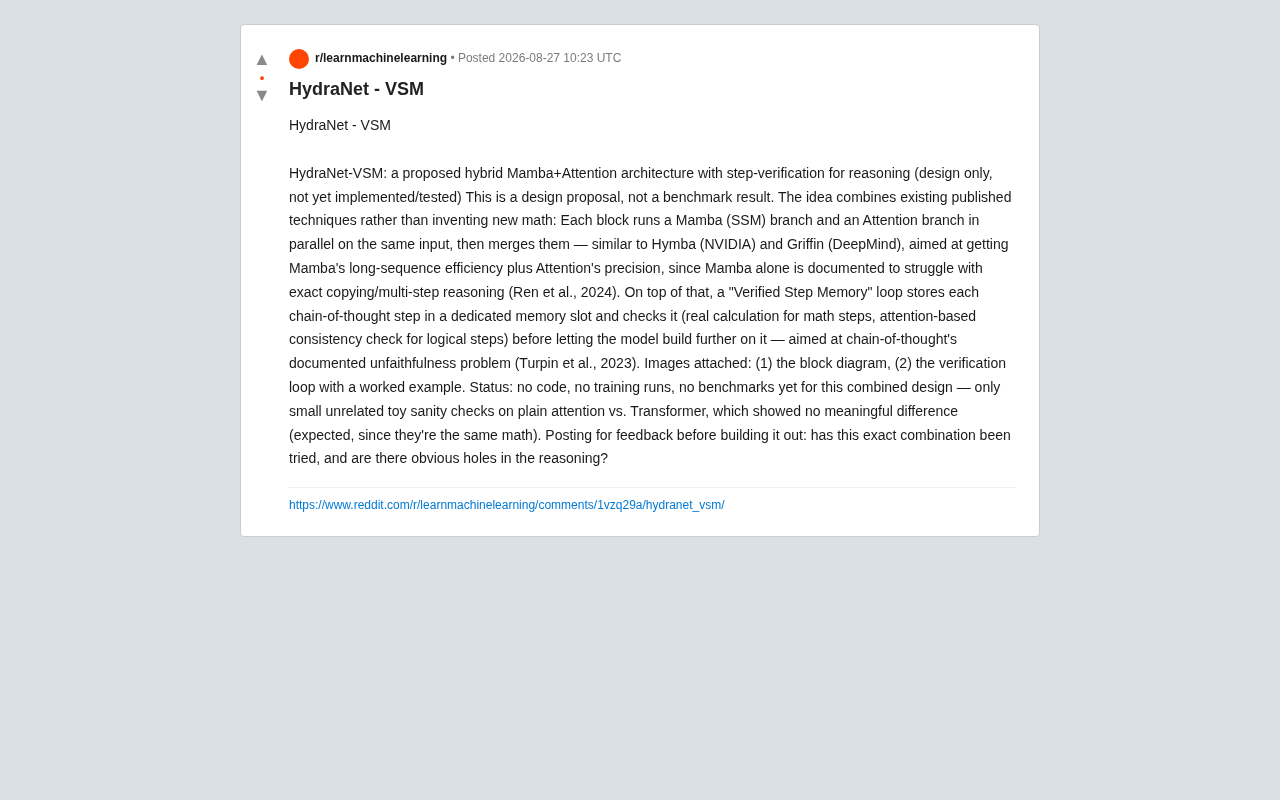
HydraNet-VSM Architecture Analysis: A New Approach to Reasoning Through Parallel Fusion of Mamba and Attention Mechanisms
Deep dive into the HydraNet-VSM hybrid architecture proposal: parallel fusion of Mamba SSM and Attention mechanisms, plus how Verified Step Memory tackles Chain-of-Thought unfaithfulness.

Claude Code Creator's Advice: For Big Changes, Align Before You Code
Claude Code creator Boris shares AI coding best practices: for big changes, read the repo first, confirm the plan, then code and verify immediately. Master this workflow to avoid costly rework.
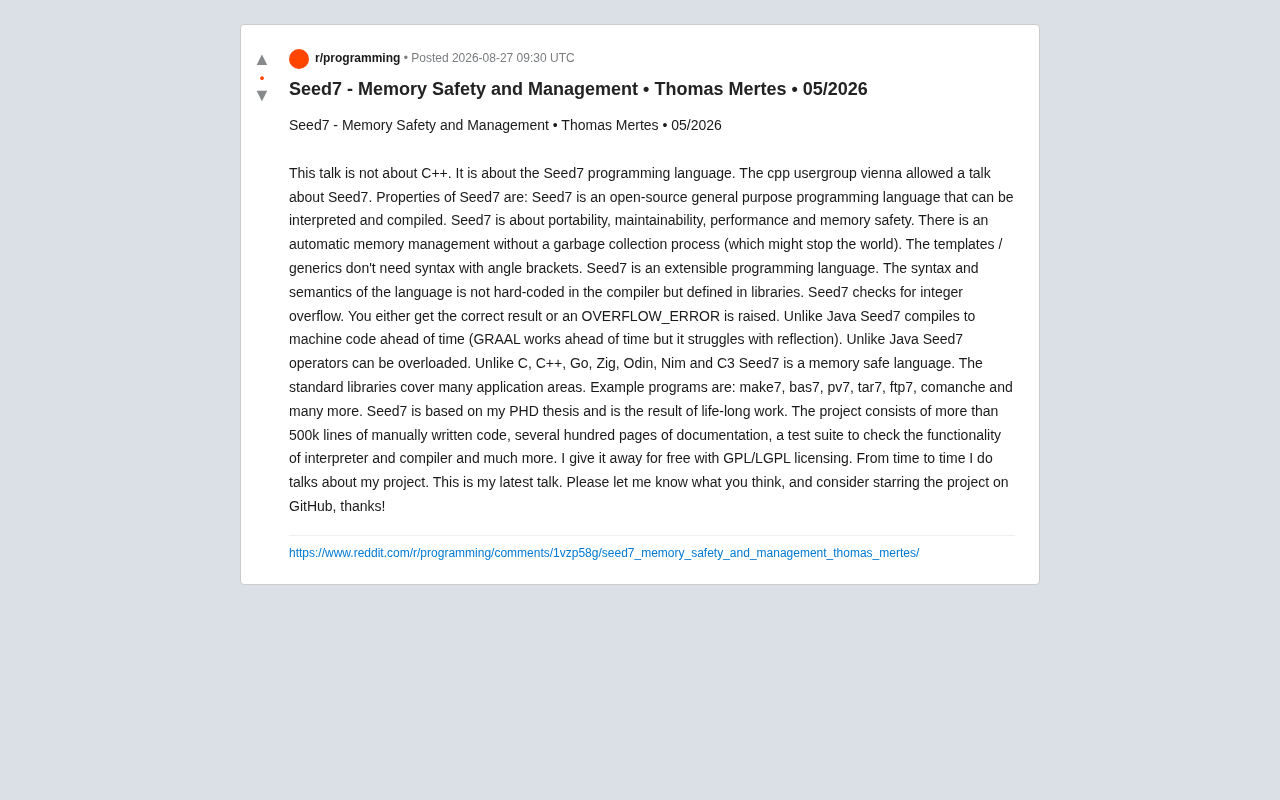
Seed7 Programming Language: A Unique Design Achieving Memory Safety Without GC
Deep dive into how Seed7 achieves memory safety without GC, exploring its AOT compilation, extensible syntax, integer overflow checking, and comparisons with C++, Rust, and Java.