RainbowSay: Learn Languages Live with Shows You Love
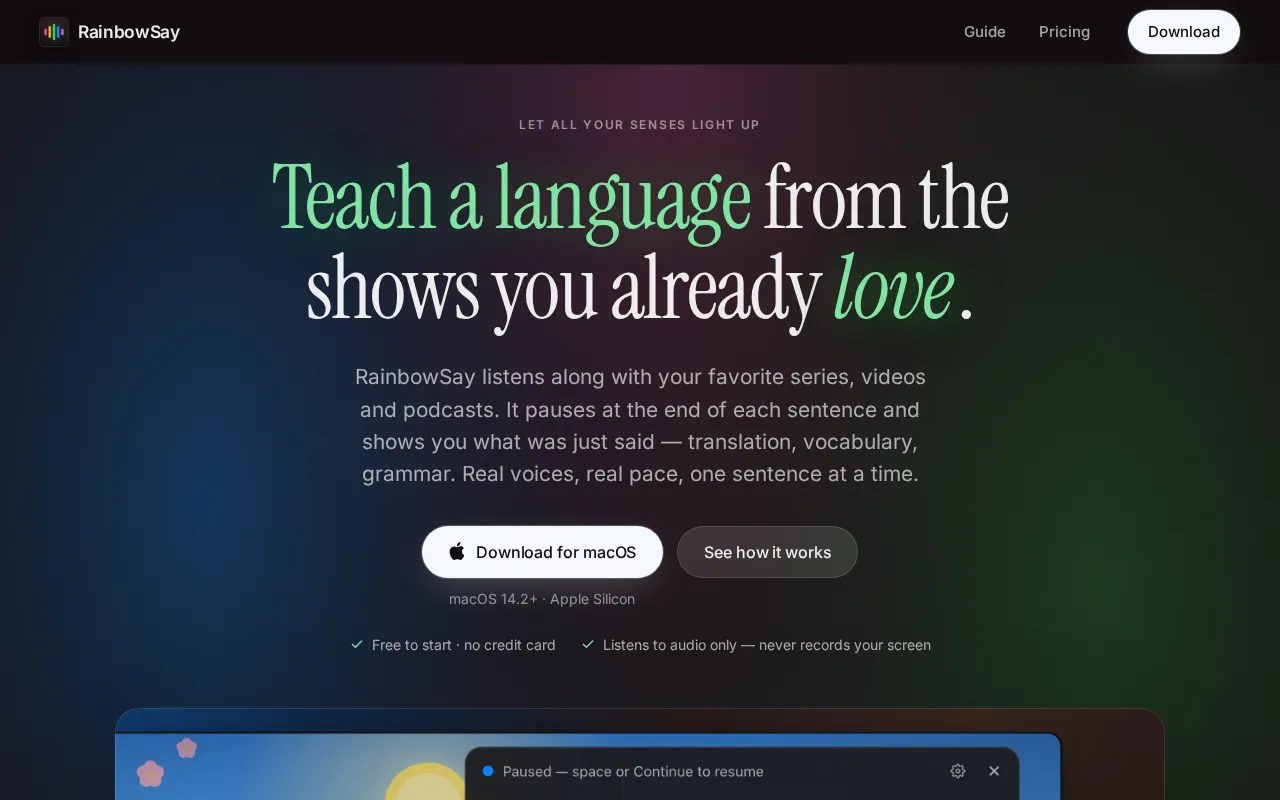
RainbowSay launched on Hacker News to learn, teach, and research languages live with shows you love.
RainbowSay appeared in the Show HN section of Hacker News with the tagline of learning, teaching, and researching languages live with shows you love. The product covers three roles — learners, teachers, and language researchers — with shows as the core medium and real-time interaction as the mode, attempting to combine watching shows with language practice, explanation, and discussion to sustain motivation through interest. The entry received only 5 points and 0 comments, placing it at an early exposure stage where community discussion has yet to form. The article considers its direction clear and appealing, but notes that differing needs across roles create design challenges, and actual effectiveness still requires product iteration and user feedback to verify.
Language learning tools are hardly scarce, but products that can turn "the shows you love to watch" into live interactive classrooms are rare. RainbowSay appeared in the Show HN section of Hacker News with the tagline "Learn, teach, research languages live with shows you love" — use the shows you enjoy to learn, teach, and research languages in real time.
Product Positioning: Show-Driven Live Language Learning
Breaking down the title, RainbowSay attempts to cover three types of roles: learners, teachers, and language researchers, with "shows" as the core medium and "live" as the mode of interaction. This suggests it may not be just another recorded-course platform, but rather something that combines watching shows with language practice, explanation, and discussion. For learners, interest-driven content often sustains long-term motivation better than textbooks; for teachers, familiar show material can lower the barrier to lesson preparation; and for researchers, language phenomena in authentic corpora are valuable objects of study.
"Show HN" is a section on the Hacker News community specifically for showcasing new work by individuals or teams. Users post with the title "Show HN: Project Name," attaching a project link and a brief introduction, and community members can vote and comment. It is an important channel for early-stage products to gather feedback from the tech community, but exposure varies enormously: popular projects can earn hundreds of points and extensive discussion, while obscure ones quickly sink. Points and comment counts are direct indicators of community attention, but low points do not necessarily mean poor product quality — they more often reflect timing, title appeal, and community fit.
The Imaginative Space of Multi-Role Scenarios
"Teach" and "research" being written into the title alongside learning shows that the product is not content with being a single-purpose learning tool. If designed well, teachers could annotate language points on show clips and organize live discussions; researchers could observe learners' comprehension and output processes in authentic contexts. This multi-role coverage also brings challenges: the needs of different roles vary greatly, and the product needs to balance experiences within the same show-interaction framework.
"Authentic corpus" refers to language material from real communicative contexts that is not adapted for teaching purposes, such as films, TV shows, podcasts, and news. The opposite is artificially written or simplified dialogue found in textbooks. In second language acquisition research, authentic corpora are considered to provide richer vocabulary, sentence patterns, and pragmatic information, helping learners encounter natural speech rates, accent variation, and cultural context. But authentic corpora also bring problems such as uncontrolled difficulty and dense unfamiliar words, so they often need to be paired with auxiliary tools (such as subtitles, annotations, and grading). By using shows as its medium, RainbowSay is essentially seeking a meeting point between authentic corpora and learning support.
Early-Stage Signals and Assessment
It should be noted objectively that this entry received only 5 points and 0 comments on Hacker News, which is typical early-stage exposure. This neither means the product lacks value nor indicates that the community has yet generated discussion heat. For readers interested in language learning tools or edtech, RainbowSay is worth observing as a sample: whether show-driven live learning can solve the pain points of traditional tools — "boring content and difficulty sticking with it" — still needs product iteration and user feedback to verify.
Conclusion
RainbowSay's idea — using beloved shows as a live vehicle for language learning and teaching — is clear in direction and appealing. In the absence of more public details, interested users are advised to visit its page directly to try it out and evaluate its practicality in light of their own learning or teaching scenarios.
One-line Summary
RainbowSay launched on Hacker News to learn, teach, and research languages live with shows you love.
Paragraph Summary
RainbowSay appeared in the Show HN section of Hacker News with the tagline of learning, teaching, and researching languages live with shows you love. The product covers three roles — learners, teachers, and language researchers — with shows as the core medium and real-time interaction as the mode, attempting to combine watching shows with language practice, explanation, and discussion to sustain motivation through interest. The entry received only 5 points and 0 comments, placing it at an early exposure stage where community discussion has yet to form. The article considers its direction clear and appealing, but notes that differing needs across roles create design challenges, and actual effectiveness still requires product iteration and user feedback to verify.
Related articles

OpenAI Breaks ETH? P=NP Could Upend the Cryptography World
OpenAI reportedly disproved ETH with a sub-exponential algorithm, sparking P=NP speculation. What it means for RSA, blockchain, and protein folding.
When an Anti-Fingerprinting Script Is …
When an Anti-Fingerprinting Script Is Flagged as a Bioweapon: The Detection Dilemma of Security Tools
An anti-fingerprinting script was flagged as a bioweapon by security scanning, sparking Hacker News debate. This analysis covers the causes of keyword-matching false positives, how developers respond, and the long-term imbalance between automation and precision in security tools.
41,000 DHS Employee Records Leaked, Including Undercover ICE Agents
Data breach exposes 41,000 DHS employees, including undercover ICE agents. Analysis of sensitive data risks, law enforcement security gaps, and protection measures like access control and auditing.