Random Pruning of the DPO Computation Graph: 1.4x Training Speedup and Lower Peak Memory

New framework randomly prunes three stages of the DPO computation graph, cutting training time by ~30% with a slight accuracy drop.
This article introduces a new work on DPO training efficiency. The authors note that DPO cost is spread across output scoring, sequence execution, and backpropagation, so reducing only the supervision signal yields little savings. They propose a unified framework that independently randomly samples response positions, response prefixes, and preference branches, prunes before the corresponding operations so skipped computation truly does not occur, and uses inverse probability weighting for a conditionally unbiased single-branch gradient estimate. Controlled experiments show branch pruning yields a 1.426x step-time speedup and ~30% less training time than vanilla DPO; position and sequence pruning mainly lower peak memory. The cost is a slight average accuracy drop, with open-ended benchmark scores varying by benchmark, so pruning strategies must be chosen by bottleneck.
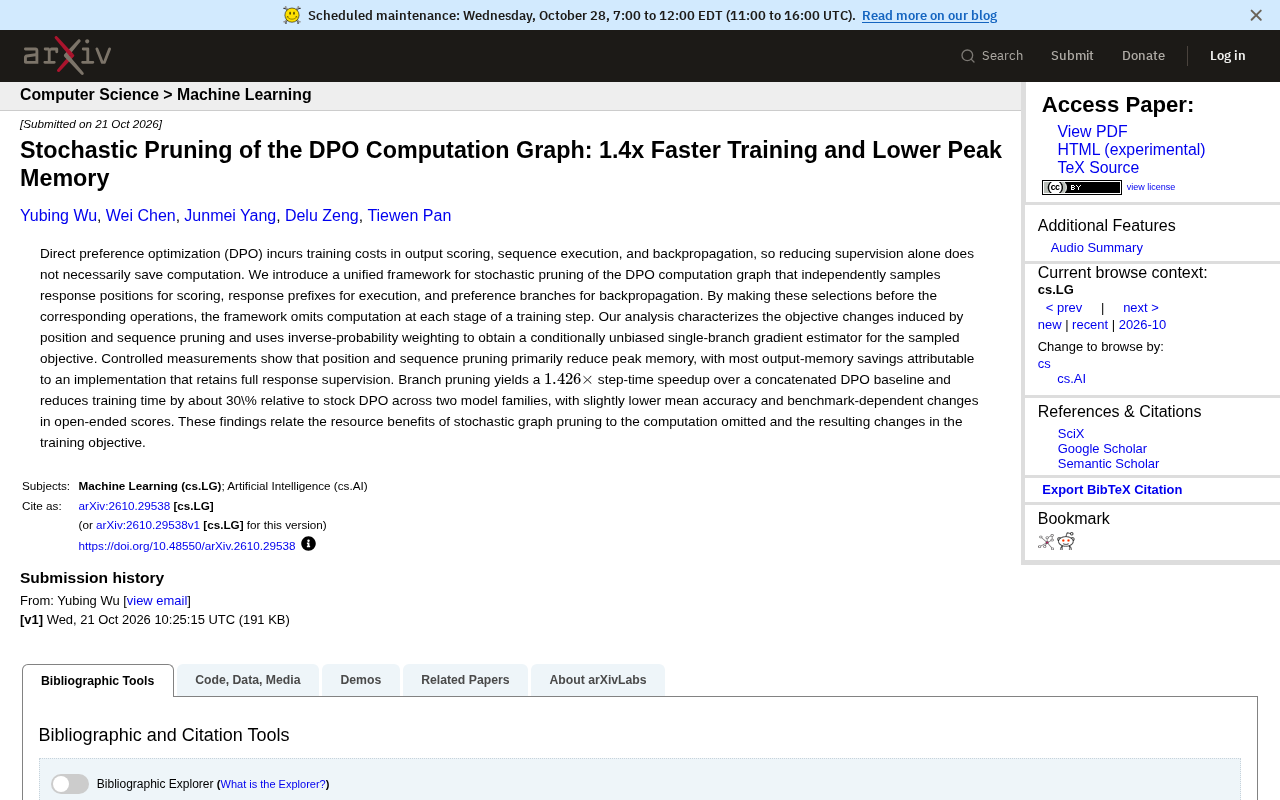
Direct Preference Optimization (DPO) training cost is spread across three stages: output scoring, sequence execution, and backpropagation. Merely reducing the supervision signal does not necessarily save computation. A new paper proposes a unified framework that randomly prunes the DPO computation graph: it independently samples the response positions involved in scoring, the prefixes involved in execution, and the preference branches involved in backpropagation, completing the selection before the corresponding operations, thereby omitting computation at each stage of the training step. Controlled measurements show that branch pruning yields a 1.426x step-time speedup, reducing training time by about 30% relative to vanilla DPO.
Why reducing only the supervision signal is insufficient
The DPO loss depends on scoring both responses in a preference pair, and the gradient must flow through the entire sequence's execution and backpropagation. This means the cost of a training sample does not come solely from "supervised tokens" but from three paths: forward execution, scoring, and backpropagation. The paper points out that if one only removes part of the supervision at the loss level without simultaneously pruning computation in execution and backpropagation, the computational savings are extremely limited.
This observation forms the starting point of the entire framework: to truly save compute, one must make choices independently at three separate stages of the computation graph—which response positions participate in scoring, which response prefixes participate in execution, and which preference branches participate in backpropagation.
Direct Preference Optimization (DPO) is an alignment method that optimizes a language model directly on preference-pair data without relying on an explicit reward model. It converts the relationship in human preference data that "the chosen response is better than the rejected response" into a classification-like loss: under the same prompt, the model's log-probability ratio for the two responses must satisfy the preference direction. Compared with the two-stage pipeline of first training a reward model and then aligning via reinforcement learning (e.g., PPO), DPO eliminates the reward model and online sampling, making training more stable and simpler to implement. The cost, however, is that each training sample still requires forward scoring and backpropagation over two complete responses; the longer the sequences and the more preference pairs, the greater the computation and memory overhead—this is also an important motivation for subsequent work on DPO acceleration and pruning.
A unified framework for three-stage random pruning
The paper decomposes pruning into three independently controllable dimensions:
- Position pruning: compute scores only for sampled response positions, reducing computation and memory on the output side.
- Sequence pruning: execute only sampled response prefixes, shortening the forward sequence length.
- Branch pruning: backpropagate only through sampled preference branches, restricting gradient computation to a single branch.
The key is that these choices occur before the corresponding operations, rather than as post-hoc masking. Thus skipped computation never happens at all, rather than being computed and then discarded.
Using inverse probability weighting to guarantee unbiased gradients
Random pruning changes the training objective. The paper analyzes the objective changes introduced by position pruning and sequence pruning, and applies inverse probability weighting to the sampled objective to obtain a conditionally unbiased single-branch gradient estimate. This is equivalent to using importance sampling to correct sampling bias, so that the randomized gradient still points to the original objective in expectation, rather than introducing systematic drift.
Inverse Probability Weighting (IPW) originates from importance sampling and causal inference. The core idea is: when a sample or computation path is sampled with probability (p), weighting its contribution by (1/p) restores the result of full computation in expectation. In the random pruning setting, the retained positions, prefixes, or branches represent only a subset of the whole; directly summing them would systematically underestimate or overestimate the gradient. Multiplying by the inverse of the sampling probability makes the estimator consistent with the original objective in expectation, i.e., "conditionally unbiased." The cost is that variance may increase, especially when sampling probabilities are too small. Therefore, practical implementations often need to trade off unbiasedness against variance, for example by setting a minimum sampling probability or combining with gradient clipping.
Empirical results: memory gains mainly come from position and sequence pruning
Controlled measurements yield a noteworthy conclusion: position pruning and sequence pruning mainly reduce peak memory, and most of the output-side memory savings come from an implementation that retains full response supervision. In other words, memory gains are directly related to "which computations are pruned," rather than simply arising from reduced supervision signal.
The effect of branch pruning is reflected in time. Relative to the concatenated DPO baseline, it achieves a 1.426x step-time speedup; on two model families, training time is reduced by about 30% relative to vanilla DPO.
The cost in accuracy and open-ended scoring
The speedup is not without cost. The paper reports a slight decrease in average accuracy, and open-ended benchmark scores vary depending on the specific benchmark. This suggests that the benefits of three-stage pruning need to be weighed against the task's sensitivity to accuracy—for latency- and memory-sensitive scenarios, a 30% reduction in training time may be worth accepting slight accuracy fluctuations; for preference alignment tasks with stringent accuracy requirements, more conservative sampling ratios are needed.
Peak memory refers to the highest watermark of GPU memory usage during one training step, typically determined jointly by activations, gradients, and optimizer states. For Transformer-style models, the forward pass must save activations from each layer for use in backpropagation; the longer the sequence and the more tokens involved in computation, the larger the activation footprint. Therefore, shortening the execution sequence (sequence pruning) or reducing the positions involved in scoring (position pruning) can directly lower activation scale, thereby reducing peak memory; branch pruning only reduces backpropagation computation for one preference branch, with a relatively limited impact on total activations. This also explains the decomposition conclusion in the paper that "memory gains mainly come from position and sequence pruning, while time gains mainly come from branch pruning."
Which step should resource gains be attributed to?
The most valuable part of this work is that it establishes a correspondence between resource gains and "omitted computation" and "changes in the training objective." Previous discussions of DPO acceleration often conflate memory and time gains, whereas the decomposition here shows that pruning along the position and sequence dimensions mainly affects memory, while pruning along the branch dimension mainly affects step time.
For engineering practice, this means pruning strategies can be selected according to the bottleneck: when memory is tight, prioritize position and sequence sampling; when training duration is the bottleneck, prioritize branch sampling. The unbiased estimate from inverse probability weighting provides a relatively safe default configuration, avoiding objective drift caused by randomization.
The paper also leaves open questions: what the Pareto frontier of accuracy versus speed looks like under different sampling ratios, and whether the gains remain proportional on larger models and longer sequences, still require further validation.
One-line Summary
A new framework randomly prunes three stages of the DPO computation graph, reducing training time by about 30% with a slight accuracy drop.
Paragraph Summary
This article introduces a new work on the training efficiency of Direct Preference Optimization (DPO). The authors point out that DPO cost is spread across three stages—output scoring, sequence execution, and backpropagation—and that merely reducing the supervision signal cannot significantly save compute. To this end, they propose a unified framework that independently randomly samples response positions, response prefixes, and preference branches, and completes pruning before the corresponding operations so that skipped computation truly does not occur; meanwhile, inverse probability weighting is used to obtain a conditionally unbiased single-branch gradient estimate. Controlled experiments show that branch pruning yields a 1.426x step-time speedup, reducing training time by about 30% relative to vanilla DPO; position and sequence pruning mainly reduce peak memory. The cost is a slight decrease in average accuracy, with open-ended benchmark scores varying by benchmark, so pruning strategies need to be selected according to the bottleneck.
Related articles

DeepCell: One-Click AI Generation of Documents, Spreadsheets, and Slides
DeepCell tops Product Hunt with one-click generation of documents, spreadsheets, and slides, using the .deepcell format for linked updates, designed for System 2 tasks like modeling and sales reviews.

Doneas: 15-Minute Daily Accountability Calls That Keep Indie Developers From Procrastinating
Doneas is a daily accountability tool for indie developers: plan tasks on Monday, join a 15-minute call with five builders each day, and log deliveries on a public progress page. This article analyzes its core mechanics, effectiveness, and potential issues around retention and matching.

Fastlane 2.0: Fully Automated AI Ad Campaigns, From Creative to Optimization
Fastlane 2.0 is an AI ad automation tool: enter your website and it learns your brand, generates video and image ads, and runs and optimizes them on Meta, TikTok, Instagram, and YouTube.