RankControl: The AI SEO Tool That Gets Your Content Cited by ChatGPT and Ranked on Google

RankControl targets the GEO space with an all-in-one platform for AI visibility tracking, content creation, and distribution.
As users increasingly turn to ChatGPT and Perplexity for information, getting brand content cited by AI models has become a new marketing imperative. RankControl positions itself as an all-in-one platform covering the full content lifecycle — offering visibility tracking across ChatGPT, Claude, Gemini, and Grok, competitor gap analysis, AI-optimized content generation, backlink acquisition, and article-to-social conversion. With a single flat plan and 7-day free trial, it targets the emerging GEO space, though opaque AI citation mechanisms and potential trade-offs in feature depth remain key challenges to validate.
AI search is reshaping the rules of content distribution. As more users turn directly to ChatGPT or Perplexity instead of typing keywords into Google, a new challenge has emerged: how do you get your brand's content not just indexed by search engines, but actively cited by generative AI? RankControl — a new tool that earned 78 upvotes and a #13 ranking on Product Hunt — is built specifically to fill that gap.
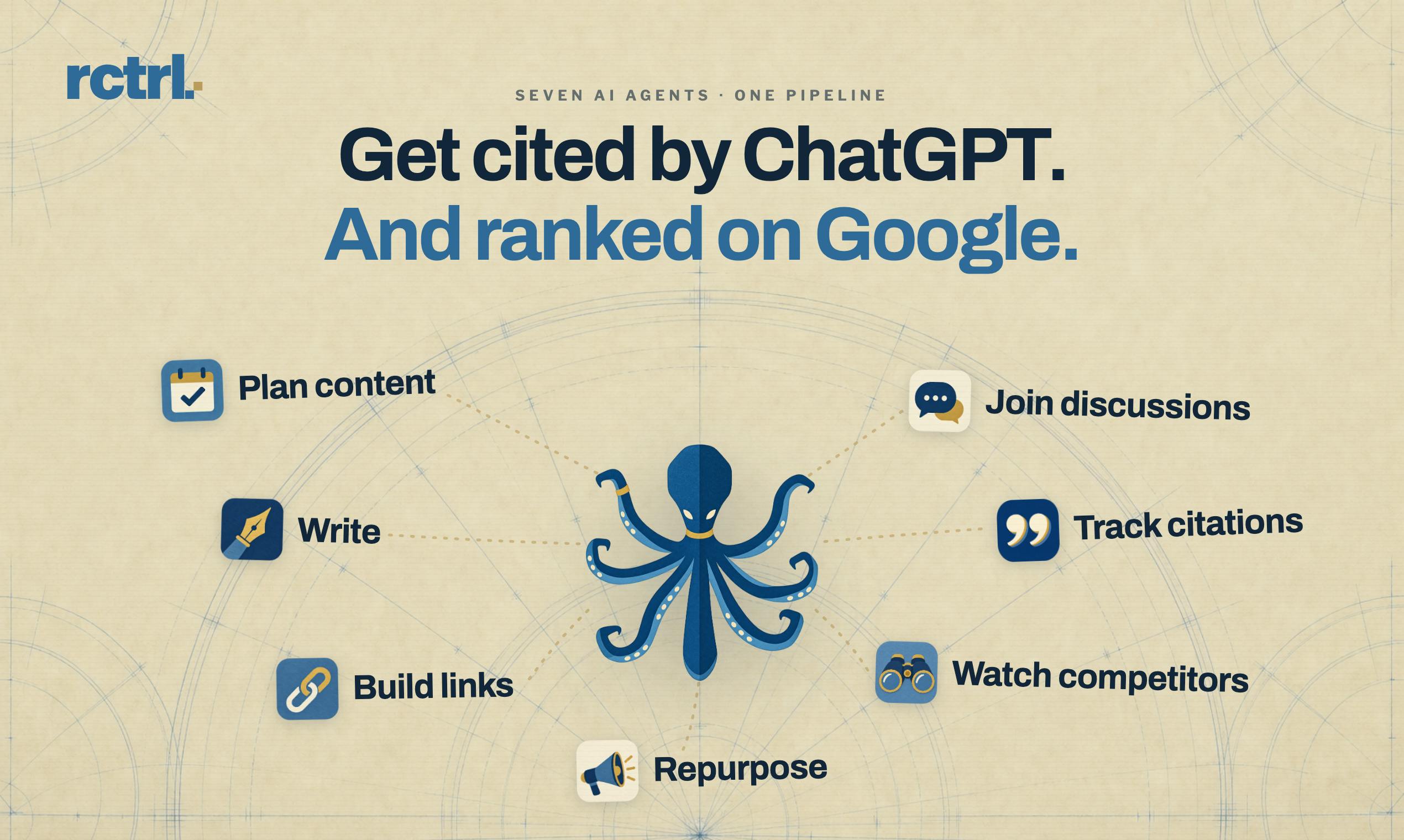
From "Getting Mentioned" to Full Lifecycle Coverage
Most AI SEO tools on the market today stop at monitoring — they tell you where your brand appears in AI-generated answers, and that's about it. The RankControl team believes that's nowhere near enough.
According to its official description, the product's core value proposition is covering the complete content lifecycle: from creating content that both AI and Google want to recommend, to publishing it as native articles on your own domain, to tracking visibility and analyzing crawl data — forming a closed loop. This "all-in-one" positioning aims to consolidate work that's typically scattered across monitoring, creation, publishing, and optimization into a single platform.
This reflects a broader industry shift: the SEO battleground is expanding from traditional search results pages to the answer-generation layer of large language models. Brands are no longer just competing for Google's front page — they're competing to be "remembered" and "cited" by AI.
Cross-Platform AI Visibility Tracking
RankControl's most differentiated feature is its visibility monitoring across multiple mainstream AI platforms. It claims to track how your content appears in ChatGPT, Perplexity, Claude, Gemini, Grok, and other models.
This directly addresses a real anxiety among today's marketers. Different AI models have their own training data and retrieval mechanisms — a brand that's frequently cited in ChatGPT might be virtually invisible on Perplexity. Cross-platform monitoring helps content teams understand their actual penetration across different AI ecosystems, rather than guessing.
The tool also offers competitor gap analysis, helping users identify topics or keywords that competitors cover but they don't. This kind of "intelligence" capability is well-established in traditional SEO and is now being applied to AI visibility.
Understanding the underlying mechanisms by which different AI platforms cite content is key to assessing the value of tools like this. ChatGPT (especially in browsing mode) and Perplexity use real-time Retrieval-Augmented Generation (RAG) — they actively fetch web content to support their answers, meaning discoverability, authority signals (like backlink counts), and content structure directly influence citation probability. Claude, Gemini, and similar models without web plugins rely primarily on training data, so their "memory" updates are constrained by training cycles — a fundamentally different optimization path. This is why cross-platform tracking isn't simply a "unified dashboard" — it requires differentiated detection methods tailored to each model's retrieval logic, and that's where the real technical moat lies.
An Automated Chain from Content Creation to Distribution
Beyond monitoring, RankControl connects the creation-to-distribution pipeline. According to the product description, it can:
- Generate content that AI and Google are inclined to recommend, and publish it as native articles on your own domain
- Help acquire backlinks to strengthen domain authority
- Convert articles into social media drafts with one click for broader reach
- Provide analytics reports and AI crawl reports
The emphasis on publishing to your own domain rather than a third-party platform is a noteworthy design choice. It means content assets belong to you — the authority you build over time won't be wiped out by platform policy changes. And converting articles into social drafts aligns with the real-world workflow of repurposing content across multiple channels.
Pricing and Market Positioning
RankControl uses a single flat plan with a 7-day free trial. This simplified pricing lowers the decision threshold and is particularly friendly to small teams and independent creators, avoiding the frustration of tiered plans common among similar tools.
Based on Product Hunt data, 78 upvotes, 5 comments, and a #13 ranking on launch day suggests meaningful but not explosive traction. The product was built by Sri Ram and is categorized under marketing, SEO, and artificial intelligence.
Questions Worth Considering
RankControl's product narrative squarely targets the emerging field of Generative Engine Optimization (GEO). But whether the tool can deliver on its promises hinges on a few key points that still need validation.
First, AI citation mechanisms are highly opaque — the retrieval and citation logic of each model is not publicly disclosed, so any tool claiming to "optimize citation rates" needs real-world data to back its methodology. Second, the all-in-one integration pitch is appealing, but it may also mean that individual features lack the depth of specialized vertical tools.
For teams exploring content strategy in the age of AI search, RankControl offers a compelling framework for connecting monitoring, creation, and distribution. Whether it's the optimal solution remains to be seen, but it clearly represents one concrete direction in which SEO tools are evolving for the AI era.
The concept of Generative Engine Optimization (GEO) was formally introduced in late 2023 by researchers at Princeton and other institutions. Their core finding: citation frequency in AI-generated answers correlates strongly with the richness of statistical data in the content, the presence of citable authoritative sources, and clear question-and-answer structure — a logic quite different from traditional SEO's reliance on keyword density and backlink volume. There are currently no widely accepted standards for measuring GEO effectiveness, and the significant variation in prompts, model versions, and content types tested by different research teams makes it difficult to compare the "citation rate improvements" claimed by various tools. For teams using tools like this, the most reliable way to validate value is to establish your own baseline measurements — systematically recording how often your brand is cited in response to specific queries before and after using the tool.
Related articles

Felix Rieseberg Personal Homepage
Felix Rieseberg's personal homepage sparks attention on Hacker News. This article covers the Slack engineer's technical background, the rise and fall of nativefier, and the value of a developer homepage as a tech calling card.

@ai-sdk/vue 3.0.306 Patch Release Syncs with [email protected] Update
@ai-sdk/vue 3.0.306 released, synced with [email protected]. A routine patch release for the Vercel AI SDK ecosystem with no public API changes; the Vue adapter layer stays version-aligned with the core package.

Gemini 4 Argon API Launches: The Era of Million-Token Output Begins
Google launches Gemini 4 Argon with sparse MoE architecture, up to 1M output tokens, and a 68.90% Vals Index score, available across API, AI Studio, and the Gemini app.