Ray-Ban Meta Audio Launched: Camera-Free Smart Glasses Starting at $349

Meta launches camera-free Ray-Ban Meta Audio, focusing on audio and AI, starting at $349.
Meta has partnered with Ray-Ban to launch Ray-Ban Meta Audio, whose biggest change is dropping the camera module and focusing entirely on audio processing, voice control, and AI integration, starting at $349. It offers two classic frames, Burbank and Clubmaster, is operated via buttons and a touchpad on the right arm, and includes built-in microphones and speakers for calls and music. Removing the camera brings clear battery benefits: 12 hours on a single charge, plus 48 hours from the charging case. Functionally, it connects to a phone via Bluetooth and is managed by the Meta AI app, supporting voice commands, navigation, communication, and some health apps, but not photos, video, or visual recognition. Overall, it's closer to "Bluetooth earbuds + AI voice assistant worn on your face" and represents Meta's pragmatic "subtraction" attempt in the smart glasses race.
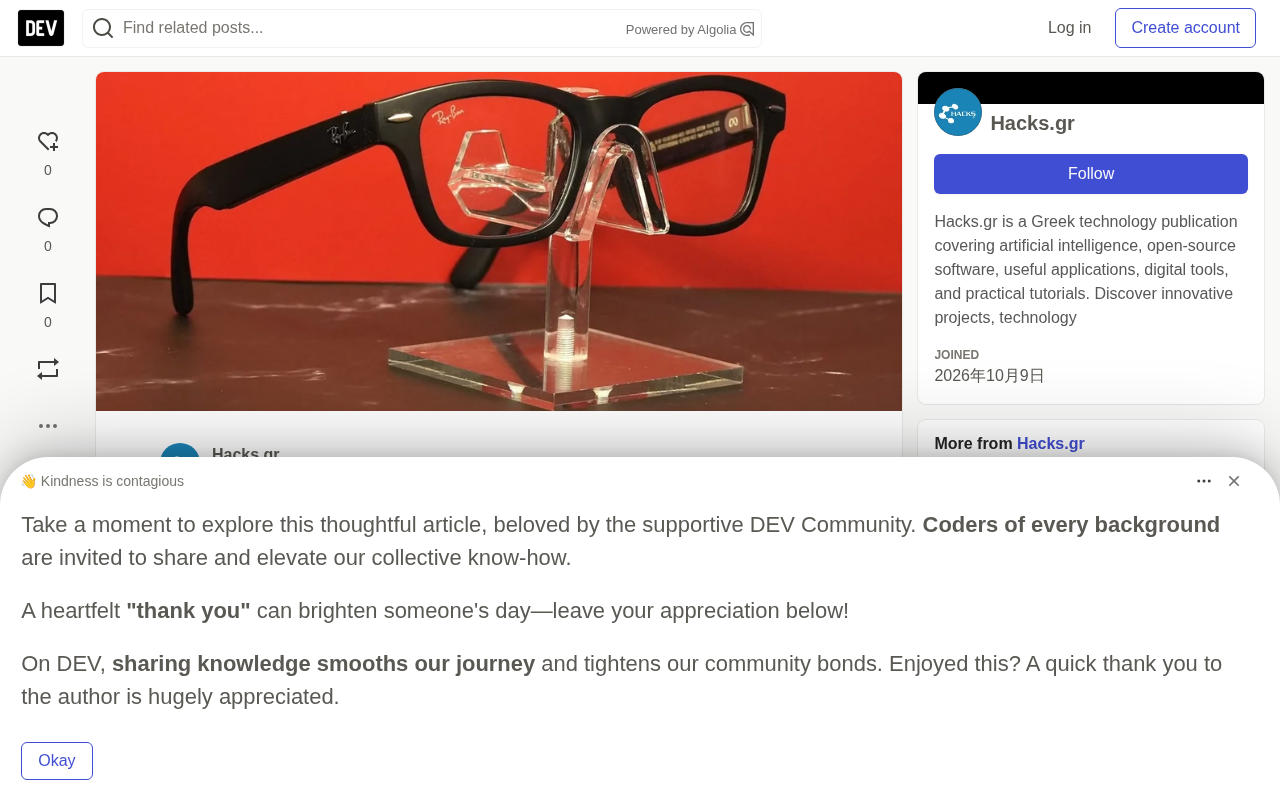
Meta has partnered with Ray-Ban to launch a new product line — Ray-Ban Meta Audio. Unlike the previous Ray-Ban Meta smart glasses with a camera, this new model drops the camera module entirely and places all its focus on audio processing, voice control, and AI integration. It starts at $349 and comes in two frame options: Burbank and Clubmaster.
This shift in product strategy is worth paying attention to. Meta's previous smart glasses focused on shooting and visual recognition, but the privacy controversies and battery drain caused by the camera were always unavoidable issues. The arrival of the Audio version can be seen as Meta's attempt at "subtraction" in the smart glasses race: removing the most controversial feature while keeping audio interaction and AI assistant — two high-frequency use cases.
Product Design and Frame Options
Ray-Ban Meta Audio offers two frame styles. The Burbank series comes in both regular and large sizes with multiple lens options; the Clubmaster series uses preset combinations and is available in only one size.
In terms of interaction, the right arm of the glasses integrates buttons and a touchpad, with built-in microphones and speakers for calls and music playback. This design logic is consistent with the previous generation — operations are completed through physical buttons and touch areas on the temple arms, without needing to pull out your phone.
You may not have noticed, but after removing the camera, the glasses' overall weight and appearance should be closer to regular glasses. For users who feel uncomfortable with "a camera worn on your face," this is a clear signal: this product isn't for shooting — it's for listening.
The origins of Burbank and Clubmaster: These two names aren't Meta's inventions — they're classic frame models from Ray-Ban's history. Burbank is a square acetate frame that Ray-Ban introduced in the mid-20th century, with a rugged, business-oriented style. Because the frame is thicker, there's more internal space to accommodate batteries and circuitry, which is why Meta can offer both regular and large sizes and allow users to choose their own lenses. Clubmaster is a "browline" design that debuted in the 1950s, with a thick acetate upper half and thin metal wire lower half, offering a stronger vintage feel. However, the metal temple arms leave less room for batteries, so Meta only offers preset combinations and a single size. Choosing these two classic frame styles is essentially about hiding smart modules inside an appearance users are already familiar with and willing to wear daily, reducing the jarring feeling of a "tech product."
Battery Life and Charging Solution
Removing the camera module directly brings battery life benefits. Ray-Ban Meta Audio lasts 12 hours on a single charge, and the charging case provides an additional 48 hours of battery life.
Compared to the camera-equipped version, this battery performance is a clear improvement. For an audio device designed for all-day wear, 12 hours of single-charge battery life can basically cover usage needs from morning to night. The charging case's 48-hour supplementary power solves battery anxiety during business trips or short travels.
Meta clearly made trade-offs between battery life and features. No camera means lower power consumption, as well as a lighter body and longer usage time — for an audio-centric product, this trade-off direction is the right one.
Connectivity and Functional Boundaries
The glasses connect to your phone via Bluetooth, are managed through the Meta AI app, and support voice commands. Users can access communication, navigation, and health apps, as well as some music services.
The functional boundaries are also clear: without a camera, you can't take photos, record videos, or perform visual recognition. This means the product doesn't offer the ability to "recognize whatever you see" — all interactions revolve around audio.
From a product positioning standpoint, Ray-Ban Meta Audio is more like "Bluetooth earbuds + AI voice assistant worn on your face" rather than a wearable computer. The core problem it solves is: in situations where it's inconvenient to pull out your phone, how do you quickly make calls, listen to music, and invoke an AI assistant?
The actual capabilities of the Meta AI voice assistant: The article's reference to "managed through the Meta AI app" means the glasses themselves are not independent computing devices. Instead, they upload voice commands to the paired phone, which then processes them through Meta AI (based on the Llama series of large models). Therefore, its response speed and available features are constrained by the phone-side app and network conditions, and its capabilities shrink significantly when offline. Current voice interactions mainly cover tasks like querying information, sending messages, controlling music playback, and setting reminders — falling within the "voice assistant" category rather than being a true conversational AI companion. Understanding this makes it clear why the article emphasizes that "the AI experience is the key to user retention" — the hardware is only responsible for picking up sound and playing audio, while the true ceiling of intelligence depends on how fast Meta AI iterates on the phone side.
Market Positioning and Competitive Logic
A starting price of $349 isn't cheap in the smart glasses market, but in the "premium Bluetooth audio glasses" subcategory, it's competitive.
Meta's calculation is probably this: use the camera-equipped version to attract tech early adopters, and use the Audio version to cover a broader range of everyday users. The latter may be interested in AI features but don't want to wear a device that could be recording at any moment. The lower price barrier also helps expand the user base.
Whether this strategy works depends on two factors: first, whether consumers are willing to pay $349 for "audio + AI"; second, whether Meta AI's voice interaction experience can truly make people "unable to live without it" in daily use. Hardware is just the vehicle — the AI experience is the key to user retention.
For consumers who are on the fence about smart glasses, Ray-Ban Meta Audio offers a simpler, cheaper, and less controversial option. It doesn't try to be an "all-purpose device" but honestly does a good job at audio. At the current stage, this pragmatic product approach may be more likely to win the market than piling on features.
One-line Summary
Meta launches Ray-Ban Meta Audio without a camera, focusing on audio and AI, starting at $349.
Paragraph Summary
Meta has partnered with Ray-Ban to launch the new Ray-Ban Meta Audio, whose biggest change is dropping the camera module and placing full focus on audio processing, voice control, and AI integration, starting at $349. The product offers two classic frames, Burbank and Clubmaster, is operated via buttons and a touchpad on the right arm, and has built-in microphones and speakers for calls and music playback. Removing the camera brings clear battery benefits: 12 hours on a single charge, with the charging case providing an additional 48 hours. Functionally, it connects to a phone via Bluetooth, is managed by the Meta AI app, and supports voice commands, navigation, communication, and some health apps, but cannot take photos, record videos, or perform visual recognition. Overall, it's positioned closer to "Bluetooth earbuds + AI voice assistant worn on your face," representing Meta's pragmatic "subtraction" attempt in the smart glasses race.
Related articles

Workbuddy for Absolute Beginners: How a Desktop AI Agent Fits Into Real Workflows
A beginner's guide to the Workbuddy desktop AI agent: installation, claiming credits, file management, and building automated workflows—compared with CodeX for fit and cost, helping professionals shift from AI question-askers to AI managers.

OpenAI's New Agent Stack: Computer Use, Decisions API, and Ultra-Fast Workflows
OpenAI Dev Day unveiled a new agent stack: Computer Use outperforms humans, Decisions API delivers ultra-low-latency classification via Luna, Agents API opens the same Computer Use capabilities, and GPT-6.1 Sol costs only one-seventh of Astra. Core updates, benchmark data, and developer insights.

Liang Wenfeng Open-Sources DeepInfo Inference Framework, Takes On U.S. Ban
DeepSeek open-sources its DeepInfo inference framework after its models, featuring GPU/CPU cross-pipelining, small-model prediction with large-model verification, and full Huawei Ascend and NVIDIA chip support—facing the U.S. federal ban head-on. This article analyzes its significance for AI deployment and open-source strategy.