Razer DeathStalker V2 Pro TKL Wireless Keyboard on Sale for Nearly Half Price

Razer DeathStalker V2 Pro TKL wireless keyboard hits $130 on Woot, nearly half its $219.99 retail price.
The Razer DeathStalker V2 Pro TKL wireless mechanical keyboard is currently on sale at Woot for $130, nearly half off its $219.99 retail price. Key specs include 2.4GHz low-latency wireless, low-profile linear optical switches, and a TKL layout — all aimed at competitive gamers who prioritize fast response and desk space. Optical switches eliminate metal contact debounce for near-instant actuation, while the TKL form factor frees up mouse room and improves portability. The deal window is limited, making it worth a look for gaming-focused buyers.
Razer DeathStalker V2 Pro TKL Wireless Keyboard on Sale for Nearly Half Price
For competitive gamers who demand fast response times, a low-latency, highly responsive keyboard can make a subtle but real difference in critical moments. Woot has dropped the price of the Razer DeathStalker V2 Pro TKL wireless mechanical keyboard to $130 — nearly half off its regular retail price of $219.99 — making this a rare opportunity to pick up a premium peripheral at a significant discount.
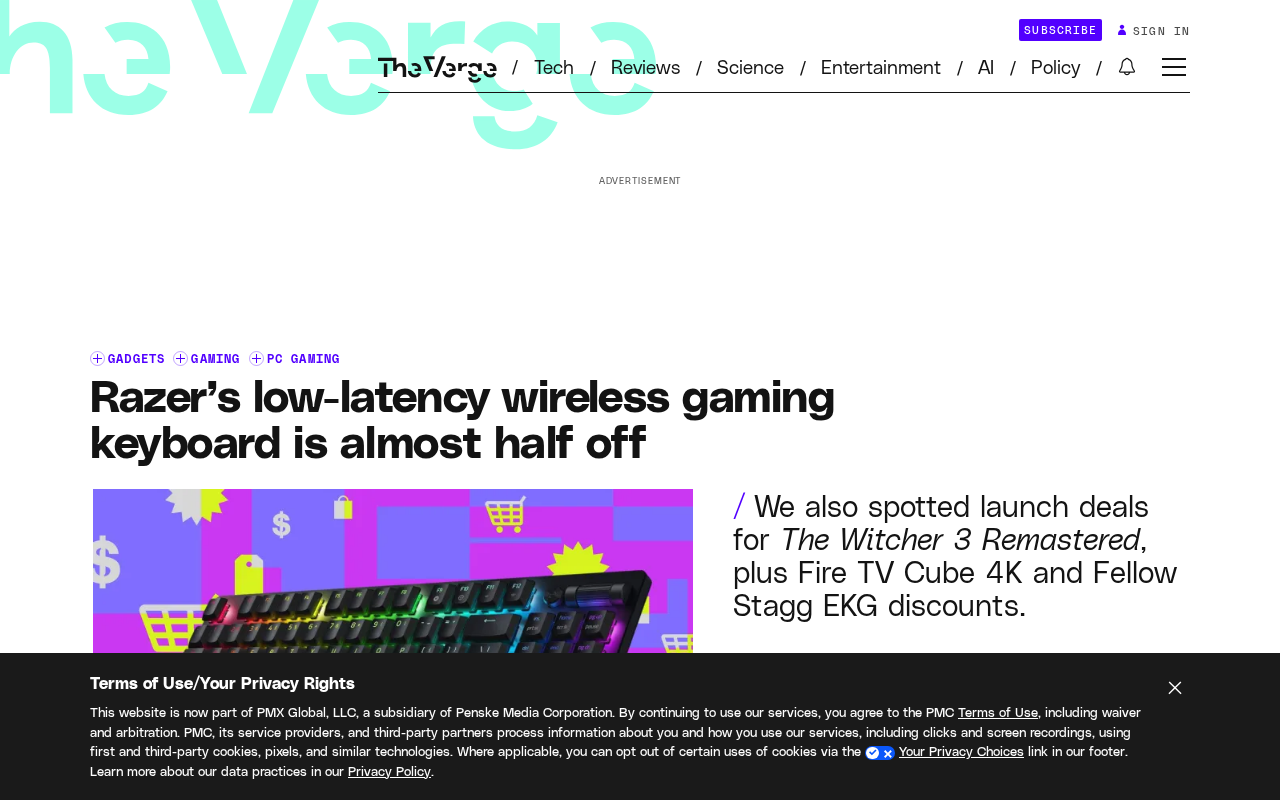
Hardware Built for Competitive Gaming
The DeathStalker V2 Pro TKL's core appeal lies in its design philosophy centered around competitive play. It features low-latency 2.4GHz wireless connectivity, striking a balance between wireless convenience and response speed — which is the main battleground among today's high-end gaming keyboards. For input-sensitive genres like first-person shooters and fighting games, a dedicated 2.4GHz wireless channel delivers noticeably lower perceived latency compared to Bluetooth.
The keyboard uses low-profile linear optical switches. Compared to traditional mechanical switches, optical switches trigger via a light signal rather than physical contact, which theoretically enables faster actuation with a lighter keystroke. This means less finger travel per input, reduced fatigue during long gaming sessions, and faster rapid-fire keypresses.
The fundamental difference between optical and traditional mechanical switches comes down to actuation mechanism: mechanical switches rely on physical metal contact to register a keypress, while optical switches embed an infrared beam inside the switch housing — interrupting the beam when the key is pressed triggers the signal instantly. This eliminates the metal contact bounce (debounce) time that traditional switches require. Standard mechanical keyboard firmware typically waits around 5ms to confirm a stable signal, whereas optical switches convert input almost instantaneously, with theoretical actuation latency under 0.2ms. The low-profile variant takes this further by reducing the switch height, shrinking total travel from the standard 4mm down to roughly 2.8mm and raising the actuation point accordingly — further shortening the distance your fingers need to press.
The Trade-offs of TKL Layout
This keyboard uses a TKL (Tenkeyless) layout, which removes the numeric keypad on the right side for a more compact form factor. TKL layouts are widely popular in esports circles because they free up desk space and give the mouse more room to move — especially important for players who use low sensitivity settings and need wide sweeping motions. The smaller footprint also makes it easier to carry to LAN events.
The trade-off, of course, is losing the number pad, which makes it less ideal for tasks requiring heavy numeric input like office work or data entry. This further reinforces its positioning: a peripheral built for gaming performance, not all-purpose productivity.
TKL isn't the only compact layout option, but it's the most mainstream way to reduce size while keeping a full alphanumeric block and function row. More aggressive options include 75% (retains arrow keys but compresses the function row), 65% (drops the function row entirely), and 60% layouts. TKL has become dominant in competitive gaming rather than these smaller formats largely because it retains the F1–F12 function keys and dedicated arrow keys — both of which are still frequently used for in-game keybinds. Dropping them entirely creates a steep learning curve for adapting muscle memory. This is why TKL is widely regarded as the optimal balance between compactness and practicality.
Pricing and Buying Advice
Dropping from $219.99 to $130 significantly improves the value proposition of what was originally a premium-tier keyboard. The combination of low-profile optical switches, low-latency wireless, and TKL layout targets a specific user: someone who wants portability without sacrificing competitive feel.
For gamers looking for a wireless competitive keyboard but unwilling to pay full price, deal windows like this tend to be time-limited. If your primary use case is gaming, desk space is at a premium, and you prefer a light, fast keystroke feel, the DeathStalker V2 Pro TKL at this price point is worth adding to your shortlist.
Note that flash sale inventory and pricing can change at any time — the final price at checkout is what counts.
Related articles

Understanding DeepSeek in 3 Minutes: The Rise from a Quant Hedge Fund to an Open-Source AI Leader
DeepSeek's history in 3 minutes: from High-Flyer Quant's compute build-up to V2's MLA inference cost cuts, V3's $5.576M training bill, R1's open-source global shock, and V4 with a $7B Series A.

Local Creative Writing Model Showdown: Fine-tuned Qwen3.8 27B Wins, DeepSeek v4.1 Underwhelms
Bilibili creator tests seven local creative writing models: Hemingway and HumanLike Chat based on Qwen3.8 27B perform best, DeepSeek v4.1 is plain, Dongfang Shuo ranks last with confused characters. Includes three test prompts, scores, and usage advice.

Liang Wenfeng's Three Big Bets: Why Did DeepSeek Open-Source Its 82% Gross Margin?
Why did DeepSeek open-source DeepInfer, its 82% gross margin inference framework, and then launch a hundred-billion funding round? An analysis of Liang Wenfeng's three big bets and the open-source strategy.