REA: The Open-Source Tool Letting AI Reverse Engineer Any Application (29k Stars)

REA is an open-source MCP tool that lets AI agents automatically reverse engineer apps down to the binary level.
REA (Reverse Engineer Anything) is an open-source tool built on the MCP protocol that lets developers point an AI agent at any application and locate the underlying implementation logic of any feature — tracing all the way down to the binary level. Rather than manually picking through obfuscated or minified code, developers can let AI handle the entire tracing process. It installs with a single command (`npx rea-agents setup`), is free under the MIT license, and has earned ~29,000 GitHub Stars. The tool reflects a broader trend: MCP is rapidly extending AI capabilities into traditionally high-barrier domains like reverse engineering, though users should remain mindful of the legal and compliance implications.
A Tool That Lets AI See Through an Application's Internal Logic
Reverse engineering has always been a tough challenge for developers. When faced with minified, obfuscated code or opaque binary files, figuring out how a particular feature is implemented often means spending hours guessing and trial-and-error. An open-source tool called REA (Reverse Engineer Anything) is trying to hand that entire process over to AI.
According to its GitHub data, REA has already accumulated roughly 29,000 Stars — a clear signal of how strong the developer community's appetite is for this kind of capability. Its pitch is straightforward: point your AI agent at any application, ask "how does this feature work," and let the AI go find the answer itself.
How REA Works
At its core, REA is an MCP (Model Context Protocol) server. MCP has been spreading rapidly through the AI tooling ecosystem as a standard protocol for connecting AI agents to external tools. REA leverages this protocol to package "reverse engineering" into a capability that AI agents can call directly.
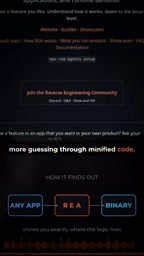
The workflow looks roughly like this: you point an AI agent at an application and ask a question about a specific feature, and REA traces all the way down to the binary level to find the answer. That means it doesn't stop at source code or the UI layer — it digs into the actual low-level logic where the program truly runs to locate how something is implemented.
For minified and obfuscated frontend code, the traditional approach is basically manual line-by-line analysis. REA's value is that it hands this tedious tracing work off to AI, surfacing the answer to "where does the logic live" directly in front of you.
MCP (Model Context Protocol) is an open standard introduced by Anthropic in late 2024, designed to solve the interoperability problem between AI models and external tools and data sources. Think of it like a USB-C port — it gives AI agents a unified way to call local tools, access the filesystem, execute code, or interact with third-party services. Before MCP, every AI tool integration required custom development. MCP standardizes that communication protocol, so any MCP-compatible AI client (like Claude Desktop, Cursor, etc.) can seamlessly connect to any MCP server. REA exists as an MCP server, which means as long as your AI tooling supports the MCP protocol, you can "plug" REA's reverse analysis capabilities directly into your existing workflow — no custom integration layer required.
Deploy with a Single Command
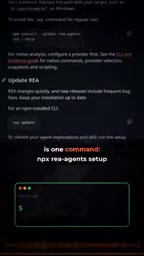
Beyond its capabilities, REA has also kept things simple on the usability front. According to the official docs, the entire installation takes just one command:
npx rea-agents setup
This "out of the box" design lowers the barrier to entry — developers don't need to configure a complex environment to plug this reverse analysis capability into their AI workflow.
REA is also released under the MIT open-source license, making it completely free to use. The permissive nature of the MIT license means developers can freely use, modify, and even commercialize it — which is part of why it's been able to accumulate such attention in a short time.
What It Signals
REA's emergence reflects a broader trend: AI tools are pushing deeper into lower-level development scenarios. Reverse engineering was once considered a high-barrier, experience-intensive discipline, but the combination of MCP and AI agents is standardizing and productizing these capabilities.
From a practical standpoint, tools like this could prove useful in several scenarios: understanding how a third-party application implements a feature, troubleshooting the behavioral logic of a complex system, or studying the technical approach behind a well-built product. That said, reverse engineering itself involves legal and ethical boundaries — users should pay attention to the target application's licensing terms and compliance requirements, a point the tool doesn't address directly but is worth handling carefully on your own.
It's worth noting that available information is still fairly limited. Details around REA's tracing accuracy on real-world complex applications, the range of platforms it supports, and its compatibility with different languages and architectures are yet to be verified. For developers who are curious, the best approach is probably to spin it up locally with a single command and judge its practical value against your own projects.
The legal boundaries around reverse engineering deserve a separate note. Laws in many jurisdictions — such as the U.S. Digital Millennium Copyright Act (DMCA) and the EU Software Directive — restrict unauthorized reverse engineering, while also preserving exceptions for purposes like interoperability research. Generally speaking, the compliance risk is lower when analyzing software you own, systems you've been authorized to examine, or code being studied for security research purposes. However, extracting commercial logic from a competitor's product or bypassing DRM protections can carry legal risk. When using REA in practice, it's advisable to first check whether the target application's terms of service explicitly prohibit reverse engineering, and in enterprise contexts, to seek legal counsel. The tool's neutrality does not absolve users of their compliance responsibilities.
Related articles

Chain of Thought Isn't Just for AI: How Humans Can Use CoT to Improve Thinking Quality
Chain of Thought isn't just a prompt trick for large models. Starting from a Hacker News discussion, this article analyzes why CoT works for human thinking too, breaks down actionable ways to transfer it, and highlights the key differences between human CoT and machine CoT.
Cloudflare Teams Up with OpenAI: Closi…
Cloudflare Teams Up with OpenAI: Closing the Loop from Vulnerability Discovery to Defense with AI
Cloudflare uses OpenAI Daybreak to investigate security vulnerabilities and generate reviewable remediation plans, while developers use Codex to boost coding efficiency and quality.

Orca Multi-Agent Orchestration in Practice: A Guide to Parallel Collaboration with Claude and Codex
Orca is Stable AI's free open-source agent workbench supporting 34 agents like Claude Code and Codex in parallel. Learn its Git worktree isolation, multi-model orchestration, and mobile management.