REA Tops GitHub in One Day: The Open-Source Tool Letting AI Reverse Engineer Any Software

REA lets AI coding assistants reverse engineer any software by wrapping disassembly tools into callable interfaces.
REA is an open-source project that rapidly topped GitHub by wrapping traditional reverse engineering toolchains into AI-callable interfaces, enabling coding assistants like Claude Code, Codex, and Cursor to analyze compiled binaries directly. Users simply tell the AI which feature to study; it traces call chains, maps data flows, and outputs findings in a layered "confirmed vs. pending" format to minimize misidentification. Most importantly, REA closes the loop from analysis to implementation — developers can use reverse-engineering findings as a direct reference to build similar features in their own projects. However, reversing third-party software carries copyright and licensing risks, and the line between legitimate research and infringement remains the developer's responsibility to navigate.
An open-source reverse engineering project called REA recently went viral on GitHub, surpassing even the previously popular Jev in traction. According to a Bilibili content creator, REA's core value proposition is this: it transforms the traditionally high-barrier world of software reverse analysis into a tool chain that AI can directly invoke — giving coding assistants like Claude Code, Codex, and Cursor the ability to "understand how other software works under the hood."
What REA Actually Does
REA is positioned as a reverse analysis toolkit that AI can call directly. You can use it to reverse engineer almost any type of software — examples cited include a PPT application called Cellworld, macOS system components, and even games like Grand Theft Auto. In other words, whether the target is a desktop app, an operating system, or a large-scale game, REA can theoretically help you disassemble and reconstruct your own analyzed version of it.
The key insight isn't just getting AI to "write code" — it's giving AI the means to study existing software. Previously, AI coding assistants could only generate functionality based on your text descriptions. Now, they can follow the internal logic of a real program to reverse-engineer implementation details, then feed those findings back into your own project.
Reverse engineering is fundamentally about reconstructing program logic from compiled binaries without access to source code. Traditional toolchains include disassemblers (like IDA Pro and Ghidra) and decompilers (like Binary Ninja), which convert machine code into human-readable assembly or pseudocode — but interpreting that output requires deep assembly language expertise and years of experience. REA's innovation lies in wrapping these tools into structured interfaces that AI can call directly. Instead of manually translating cryptic disassembly output, AI can retrieve high-level information like function signatures, call graphs, and data structures through tool calls. This makes analysis work that once required senior security researchers far more accessible with AI assistance.
How AI Takes Over the Reverse Engineering Workflow
The overall workflow is designed to be straightforward. Once you connect REA to Claude Code, Codex, or Cursor, the AI can invoke these reverse analysis tools to inspect the internal implementation of a program. When you spot a feature in some application that interests you, just tell the AI which part you want to study — it will trace through the relevant code from there.
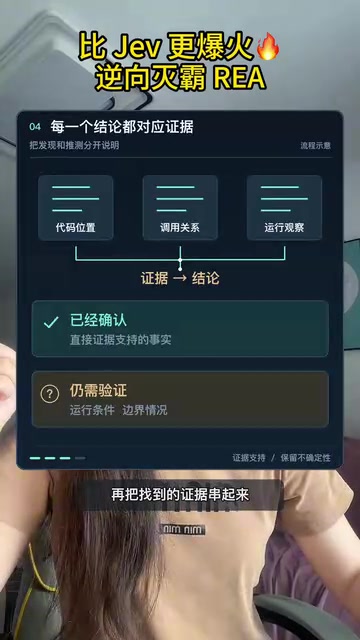
Specifically, the AI will map out where a feature is invoked, what data it touches, and how that data is processed — then piece together the findings into a coherent chain of evidence. Crucially, it distinguishes between what has been confirmed and what still needs further verification. This "cite your evidence, hedge your claims" approach is far more reliable than AI speculating from scratch.
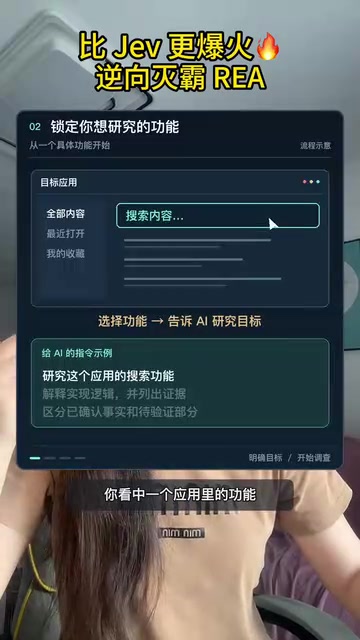
This layered reasoning capability is highly valuable in practice. Misidentification is the biggest risk in reverse engineering — if AI presents guesswork as fact, it can easily lead developers astray. REA's workflow emphasizes separating "confirmed" findings from "pending verification," effectively attaching a confidence rating to each conclusion.
Closing the Loop: From Understanding to Usable Code
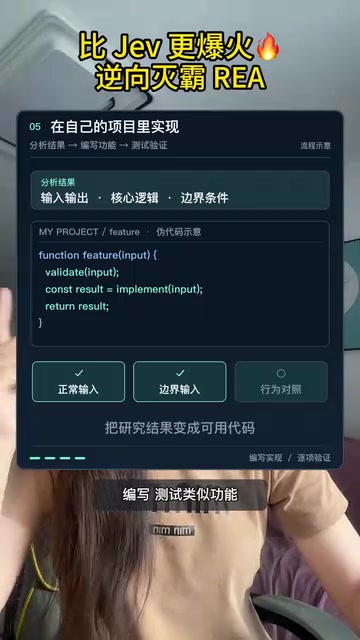
What truly resonates with indie developers is that REA bridges the final gap between analysis and implementation. Once you understand how a feature works, you can have the AI write similar functionality in your own project based on those findings — converting pure research output directly into working code.
This could meaningfully shift how developers approach product building. Previously, when you saw a feature you liked, the best you could do was describe "what you want" to an AI and hope it generated something close. With REA, you can go a step further: let the AI investigate how that feature is actually implemented, then use that as a reference to build your own version. For indie developers who lack deep reverse engineering expertise, this significantly lowers the barrier to technical exploration.
A Moment of Reflection Behind the Hype
REA topping GitHub in a single day signals that the "AI + reverse engineering" combination has clearly struck a nerve with developers. As tools like Claude Code, Codex, and Cursor become mainstream, developers are increasingly comfortable delegating research and coding tasks to AI — and REA extends AI's capability boundary from "generating" to "understanding existing systems."
That said, it's worth staying clear-headed about the implications. Reverse engineering someone else's software carries real risks around copyright, licensing agreements, and legal liability. Using it for learning and research is a fundamentally different matter from copying commercial features. REA provides a technical capability; how to use it responsibly is entirely up to the developer.
On the legal front, the compliance boundaries of reverse engineering vary significantly by jurisdiction and intended use. In the United States, Section 1201 of the Digital Millennium Copyright Act (DMCA) generally prohibits circumventing technological protection measures, but reverse engineering for software interoperability is typically exempt. Article 6 of the EU Software Directive also explicitly permits reverse engineering for interoperability purposes. China's Copyright Law similarly distinguishes between "fair use" and infringement. In practice, most commercial software EULAs explicitly prohibit reverse engineering — even where legal exemptions exist, violating the EULA can still create civil liability. There is a fundamental legal distinction between using reverse-engineered findings to build a competing product versus purely academic research. Users should carefully review the license terms of any target software before proceeding.
Related articles

How Big Can Stars Really Get? The Physical Limits of the Largest Stars
Red supergiants are the largest stars by volume, with radii up to 2,000 times the Sun, engulfing the inner solar system. But there is no precise upper limit on stellar size—models predict up to 15,000 solar radii. The most massive blue stars are far smaller than red supergiants—biggest and heaviest are two different things.

Apple HomeView Smart Display Full Feature Breakdown: Wall-Mount or Desktop, $299
Apple launches HomeView, a $299 smart display with wall-mount and desktop options, 12MP camera for facial recognition, smart home control, music playback, and recipe step-by-step cooking. Full breakdown of watch faces, apps, privacy, and cooking integration.

Where Did the Promised New Studio Go? Craft Computing Answers After Five Years
Craft Computing's host responds to viewer questions: the new studio promised five years ago was shelved as construction costs soared from $30,000 to $75,000, and was replaced by a 168-square-foot garage conversion.