Readwise Launches Reading App to Challenge Amazon Kindle and Goodreads

Readwise Books integrates book buying, tracking, statistics, and AI to challenge Kindle and Goodreads.
Readwise launches Readwise Books, combining an ebook store, reading progress tracking, detailed statistics, and AI features into one app, directly targeting Amazon's Kindle and Goodreads. Its strategy is an integrated experience with AI-assisted note organization as a differentiator, continuing Readwise's knowledge accumulation positioning. But Amazon's triple lock-in and Goodreads' network effects are hard to overcome, so it's more likely to attract heavy readers first.
Reading tool maker Readwise is expanding its battle lines from "note syncing" to the entire reading ecosystem. Its latest app, Readwise Books, bundles an ebook store, reading tracking, detailed reading statistics, and AI features into one package, directly targeting Amazon's Kindle and Goodreads.
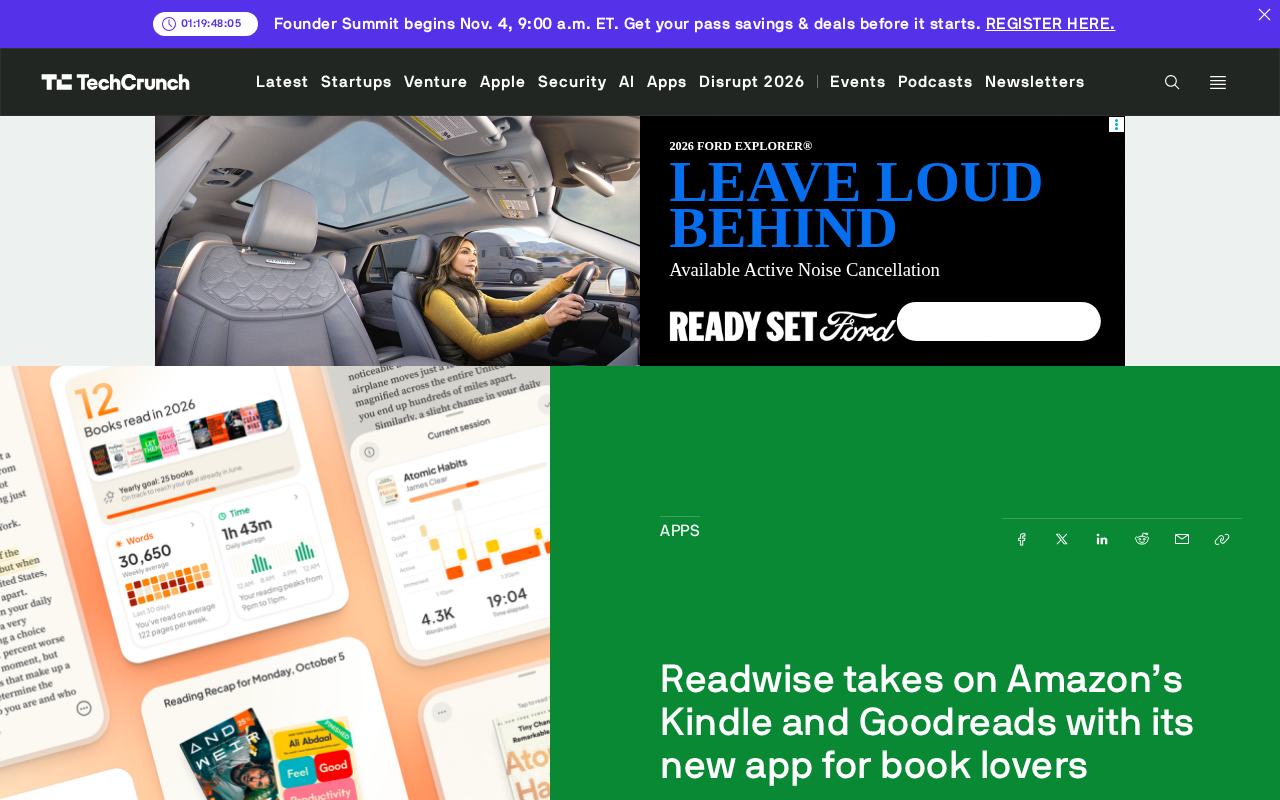
One App for Buying, Reading, and Tracking Books
Readwise's core capability has traditionally been aggregating handwritten notes, ebook highlights, web highlights, and other content into one place for easy retrieval and review. Readwise Books takes this further: users can not only purchase ebooks within the app but also track reading progress and view reading statistics.
This combination of "store + tracker + statistics dashboard" is exactly the scenario Amazon covers through two separate products, Kindle and Goodreads. Readwise chose to merge them, reducing the cost of switching between apps. For readers accustomed to buying books on Kindle and then checking in on Goodreads, this is a shorter path.
About Readwise and Its "Knowledge Accumulation" Positioning
Readwise was originally a highlight and note aggregation tool that connects to sources like Kindle, Apple Books, Pocket, Instapaper, and Twitter, syncing users' scattered highlights, annotations, and bookmarks into a unified library, with spaced repetition for periodic review. Its core users are heavy readers who value knowledge management, not ordinary consumers. Understanding this is key: Readwise Books isn't entering the reading market from scratch but extending upstream from its existing "note aggregation" user base into the purchasing and reading stages, forming a closed loop from buying books to reading to accumulating notes. This also explains why it treats AI features as a natural extension—its existing products were already built around "turning what you've read into reusable knowledge."
AI Features as a Differentiation Point
In competing with the Amazon ecosystem, Readwise Books makes AI capabilities a key lever. Although the source material doesn't disclose specific feature details, based on Readwise's consistent product philosophy, AI is likely used to help organize reading notes, distill book content, or generate reading insights.
The value of this direction lies in the fact that Kindle excels at selling and reading books, Goodreads excels at social features and book lists, but both are relatively weak at "turning what you've read into reusable knowledge." Readwise's core business happens to be knowledge accumulation, and AI is a natural tool to amplify this advantage.
Where the Challenge to Amazon's Ecosystem Gets Hard
Amazon's advantage isn't just product features but a triple lock-in of content library, device ecosystem, and user habits. Kindle users' libraries, annotations, and reading history are all stored in their Amazon accounts, making migration costly. For Readwise Books to win over these users, it needs to offer sufficiently smooth solutions for book source richness, cross-device experience, and data import.
Another variable is the social aspect. Goodreads' core value lies in book reviews, book lists, and reader community—network effects that are hard to replicate through feature stacking. Readwise Books' disclosed focus is currently on personal reading management rather than community operations, meaning it's more likely to attract heavy readers and knowledge management enthusiasts first, rather than mass-market readers.
About the Lock-in Effect of the Ebook Ecosystem and DRM
Amazon's competitive barriers include not only its content library and hardware but also the switching costs created by digital rights management (DRM). Most ebooks purchased on Kindle are DRM-protected and cannot be directly transferred to other reading apps; users' annotations, reading progress, and libraries are also deeply tied to Amazon accounts. Readwise was previously able to aggregate Kindle highlights because Amazon provided official export channels (such as the Kindle Notebook page), but this doesn't mean the entire library can be migrated. Therefore, if Readwise Books wants to capture Kindle users, it must provide concrete solutions for data import, cross-device syncing, and its own book sources, while also facing publishers' licensing restrictions on sales channels and DRM—exactly the hardest hurdle for new entrants to overcome.
About Goodreads' Network Effects
Goodreads' value comes from classic network effects: book reviews, ratings, book lists, and reader communities together form a content pool that becomes more valuable the more it's used. Users stay on the platform not just to track reading but to discover and socialize. This kind of community asset is hard to replicate quickly through product features—even if a new app offers identical rating and book list features, it struggles to attract users without existing scale and content accumulation. Readwise Books' currently disclosed features focus on personal reading management and statistics rather than community operations, so its path is closer to a "tool-type product" than a "community-type platform." This also means that in the short term, it's more likely to attract self-motivated heavy readers rather than mass users who rely on social recommendations.
What It Means for Readers
For ordinary users, more choices are always good. Readwise Books puts book buying, tracking, statistics, and AI assistance in the same interface, suiting those who want to manage their reading data centrally. But if you're already deeply tied to a Kindle library or active in the Goodreads community, you may not have much motivation to migrate in the short term.
The real question in this competition is whether reading tools can evolve from "recording how much you've read" to "helping you understand and apply what you've read." Readwise is betting on the latter.
One-line Summary
Readwise Books integrates book buying, tracking, statistics, and AI to directly challenge Kindle and Goodreads.
Paragraph Summary
Readwise has launched Readwise Books, integrating an ebook store, reading progress tracking, detailed reading statistics, and AI features into a single app, directly targeting Amazon's Kindle and Goodreads, which separately handle book sales and community functions. Its approach is to replace switching between two apps with an integrated experience, using AI-assisted note organization and content distillation as differentiation points, continuing Readwise's knowledge accumulation positioning. However, Amazon has a triple lock-in of content library, device ecosystem, and user data, and Goodreads' community network effects are hard to replicate through features alone. Therefore, Readwise Books is more likely to attract heavy readers and knowledge management enthusiasts first, rather than mass-market readers.
Related articles

AI Tools Quietly Altering Settings: Postman Silently Installs Plugin, Codex Sharing Option Auto-Resets
AI Daily reports: Postman silently installs a Mac plugin and self-approves startup hooks, logged as auto-existing upgrade; Hacker News developers say Codex data-sharing opt-out flips back. Plus Simon Willison's raw float weight experiment with QEN 3.8-27B.

AI Learns to Rewrite AI: MIT's "Weightspace Programming" Redraws the Path to Recursive Self-Improvement
MIT team proposes weightspace programming: GPT-6 Astra reads and edits AI model weights directly. Math scores jump several-fold, hand-written networks beat trained models. Eight experiments analyzed, plus Anthropic's same-day warning and the real boundaries of recursive self-improvement.

Running Qwen 3.8 on a Laptop to Read Raw Weights: 46 Minutes Per Answer
Simon Willison reproduced weight space programming with Qwen 3.8 27B on a laptop: a 17GB model file, 46 minutes per answer, 43,506 reasoning tokens, Pong over an hour, Freeway failed. Suited for interpretability researchers.