RealSense SDK v2.58.4 Released: GPU Zero-Copy and AI Perception Framework Major Upgrade
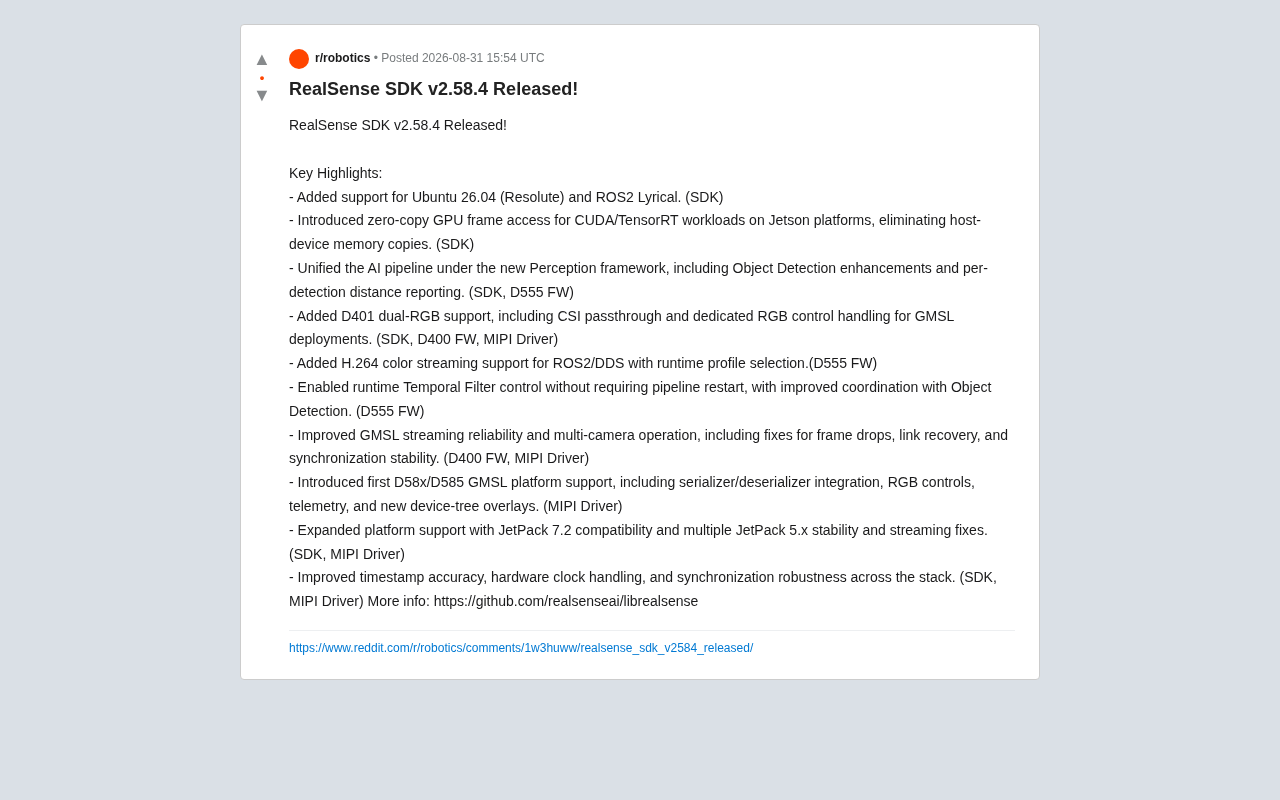
RealSense SDK v2.58.4 adds GPU zero-copy on Jetson, unified AI Perception framework, and GMSL multi-camera support.
RealSense SDK v2.58.4 delivers a systematic upgrade for edge AI perception. Key highlights include zero-copy GPU frame access on Jetson platforms eliminating host-device memory copy overhead, a unified Perception framework with per-detection distance reporting, runtime-configurable temporal filters, first-time D585 GMSL platform support for multi-camera deployments, and ROS2 H.264 streaming. The release also improves timestamp precision, multi-sensor synchronization, and adds JetPack 7.2 compatibility.
Overview: Key Changes in RealSense SDK v2.58.4
RealSense SDK v2.58.4 has been officially released, featuring deep optimizations across three major areas: edge computing performance, AI perception capabilities, and multi-camera deployment stability. As a widely used development kit in Intel's depth camera ecosystem, every update to librealsense directly impacts a large number of downstream applications in robotics, autonomous driving perception, industrial inspection, and more.
RealSense is Intel's depth-sensing camera product line, with core capabilities in capturing 3D depth information of scenes through structured light, stereo vision, or LiDAR technologies. librealsense is its open-source, cross-platform SDK supporting Windows, Linux, macOS, and various embedded platforms, providing developers with a complete toolchain from low-level drivers to high-level algorithms. In fields such as robot navigation, 3D scanning, gesture recognition, and augmented reality, RealSense has become one of the most widely adopted consumer/industrial-grade depth cameras.
The most noteworthy aspects of this update are the SDK's introduction of a zero-copy GPU frame access mechanism on the Jetson platform and the unified restructuring of the AI processing pipeline. These changes are not merely functional additions — they represent RealSense's architectural evolution toward real-time depth perception + AI inference integration.
GPU Zero-Copy Frame Access: Eliminating Performance Bottlenecks on Jetson
The Overhead Problem of Host-Device Memory Copies
The most engineering-significant improvement in this release is the introduction of zero-copy GPU frame access for CUDA/TensorRT workloads on the Jetson platform.
In traditional depth camera data processing pipelines, frame data captured by the camera must first enter host memory, then be copied to GPU (device) memory before CUDA acceleration or TensorRT inference can proceed. This host-device memory copy step introduces significant latency and bandwidth overhead in high-frame-rate, multi-camera scenarios.
The new SDK eliminates this redundant step through a zero-copy mechanism that allows the GPU to access frame data directly. Zero-copy is a technique that reduces redundant data copying between different memory regions. NVIDIA's Jetson series uses a SoC Unified Memory Architecture (UMA), where the CPU and GPU share the same physical memory — providing a natural hardware foundation for zero-copy. However, in the traditional CUDA programming model, developers typically still need to move data between host and device logical address spaces using APIs like cudaMemcpy. The zero-copy mechanism leverages CUDA's mapped pinned memory or unified memory features, allowing GPU kernels to directly access data at the same physical address without the copy step. At 640×480 resolution and 30fps depth streaming, a single frame is approximately 600KB. When running multiple cameras and RGB streams simultaneously, redundant copies can reach tens of MB per second, with accumulated latency in the millisecond range — unacceptable for real-time obstacle avoidance scenarios.
For real-time perception systems running on Jetson edge devices, this means lower end-to-end latency and higher throughput — critical in latency-sensitive scenarios such as robot obstacle avoidance and real-time 3D reconstruction.
It's worth noting that TensorRT is NVIDIA's high-performance deep learning inference optimizer and runtime engine. It can optimize trained neural network models through layer fusion, precision calibration (INT8/FP16 quantization), kernel auto-tuning, and other techniques, boosting inference speeds by several times on NVIDIA GPUs. On edge devices like Jetson, TensorRT is virtually the standard choice for deploying visual AI models such as object detection and semantic segmentation. The deep integration of RealSense SDK with TensorRT means the complete pipeline from camera capture to AI inference can run on a single device with extremely low latency, without relying on cloud computing resources.
Improved Timestamp Precision and Multi-Sensor Synchronization Robustness
Additionally, this release improves timestamp precision, hardware clock handling, and synchronization robustness across the entire stack. For multi-sensor fusion applications (such as joint calibration of depth cameras with IMUs and LiDARs), precise timestamps are the foundation for data alignment, and this improvement will directly enhance the reliability of downstream algorithms.
In multi-sensor fusion systems, different sensors (depth cameras, IMUs, LiDARs, GPS, etc.) operate independently at their own sampling frequencies, and the data they produce must be aligned under a unified time reference for effective fusion. Even a few milliseconds of timestamp error can cause spatial alignment deviations of centimeters in high-speed motion scenarios, seriously affecting the accuracy of algorithms like SLAM (Simultaneous Localization and Mapping) and Visual-Inertial Odometry (VIO). Hardware clock handling involves synchronization protocols between host and device clocks, with common approaches including PTP (Precision Time Protocol) and hardware trigger synchronization pulses. This update improves clock drift compensation and synchronization robustness, helping achieve more reliable data fusion in industrial-grade multi-sensor systems.
Perception Framework: Unified AI Perception Processing Pipeline
An important strategic change in this update is the unification of AI processing pipelines under the new Perception framework.
Object Detection and Per-Detection Distance Reporting
The new framework not only enhances Object Detection capabilities but also introduces per-detection distance reporting. The system can directly output distance information for each detected object while identifying it.
This is precisely the core advantage of depth cameras over regular RGB cameras — fusing semantic information (what is it) with geometric information (where is it, how far away) in the same inference pipeline. For applications like autonomous driving, drones, and warehouse robots, integrated "detection + ranging" output significantly simplifies the complexity of upper-layer algorithms. In traditional approaches, object detection and depth estimation are typically two independent processing pipelines that require mapping and alignment of 2D detection bounding boxes to 3D depth maps during post-processing. This not only increases system complexity but also introduces errors due to temporal desynchronization or spatial misalignment. The Perception framework unifies these two processes in the same pipeline, eliminating such issues at the architectural level.
Runtime-Configurable Temporal Filters
Alongside the AI pipeline, the new version supports runtime dynamic adjustment of Temporal Filters without restarting the entire pipeline, with improved coordination with the object detection module.
Temporal Filter is a commonly used noise reduction technique in depth image post-processing. Its basic principle leverages temporal correlation between consecutive depth frames, using weighted averaging or persistence strategies to smooth noise and holes in individual frames. In typical implementations, when a pixel lacks a depth value in the current frame, the filter falls back to valid values from previous frames to fill the gap; for pixels with existing values, it blends historical values with decay weights to reduce jitter. This filtering is highly effective in static or slowly moving scenes but may introduce ghosting or latency for fast-moving objects. Therefore, runtime configurability is very important — developers can dynamically adjust filter strength and persistence frame count for different operating conditions (such as static industrial inspection vs. dynamic robot navigation), achieving the optimal balance between image quality and real-time responsiveness.
Hardware Platform Expansion: D585 GMSL and Multi-Camera Deployment
New Device and GMSL Support Details
On the hardware support front, v2.58.4 brings several noteworthy expansions:
- D401 dual RGB support: including CSI passthrough and dedicated RGB control handling for GMSL deployments;
- First-time D58x/D585 GMSL platform support: integrating serializer/deserializer, RGB control, telemetry data, and new device-tree overlays;
- Improved GMSL streaming reliability: fixing issues with dropped frames, link recovery, and multi-camera synchronization stability.
GMSL (Gigabit Multimedia Serial Link) is a high-speed serial link technology developed by Maxim Integrated (now under Analog Devices), specifically designed for automotive and industrial environments. GMSL2 supports up to 6Gbps data bandwidth with transmission distances up to 15 meters, featuring excellent EMI resistance and cable diagnostics capabilities that meet AEC-Q100 automotive qualification requirements. Its architecture consists of a Serializer and Deserializer: the serializer converts the camera's parallel video output into differential serial signals transmitted over coaxial cables, while the deserializer on the host side restores the original data. In autonomous driving and ADAS systems, a single vehicle typically requires 8-12 cameras, making GMSL the de facto standard interface due to its long-distance, low-latency, and high-reliability characteristics. Device-tree overlays are a Linux kernel mechanism for dynamically describing hardware topology, crucial for multi-camera hot-plugging and flexible deployment.
The intensive GMSL improvements in this release indicate that RealSense is actively pushing into automotive-grade and industrial multi-camera deployment scenarios.
ROS2 Ecosystem and H.264 Streaming Enhancements
On the software ecosystem front, the new version adds support for Ubuntu 26.04 (Resolute) and ROS2 Lyrical, and introduces H.264 color stream transmission for ROS2/DDS with runtime configuration options.
ROS2 (Robot Operating System 2) is the most mainstream open-source middleware framework in the robotics field, with underlying communication based on the DDS (Data Distribution Service) standard, providing stronger real-time and security capabilities for inter-node communication. In distributed robot systems, multiple robots or sensor nodes share data over the network, and the bandwidth requirements for raw depth maps and RGB images are extremely high — a single 1080p RGB stream's raw data rate can exceed 3Gbps. With H.264 encoding, compression ratios of 50:1 to 200:1 can be achieved, making real-time transmission of multiple video streams possible over Wi-Fi or bandwidth-limited industrial Ethernet environments. Runtime-selectable encoding configurations allow developers to flexibly switch between raw and compressed streams based on network conditions and latency requirements — particularly important for bandwidth-constrained distributed robot systems.
Meanwhile, the SDK has expanded compatibility with JetPack 7.2 and fixed multiple stability and streaming issues with JetPack 5.x. JetPack is NVIDIA's complete development kit for the Jetson platform, including the Linux kernel (L4T), CUDA, cuDNN, TensorRT, and other core components — version compatibility directly determines whether developers can successfully deploy applications on target hardware.
Summary: A Systematic Upgrade for Edge AI Perception
Overall, RealSense SDK v2.58.4 is not a simple maintenance update but a systematic upgrade centered on edge AI perception. GPU zero-copy access addresses performance bottlenecks on the Jetson platform, the Perception framework unifies the AI processing pipeline, and continued investment in GMSL and ROS2 reflects a strategic focus on robotics and industrial markets.
From a technology trend perspective, this release's update direction closely aligns with several core demands in the edge AI space: maximizing on-device inference performance, multi-modal perception fusion, and system stability for large-scale deployment. With the rapid development of Embodied AI and autonomous robots, the depth camera SDK — as fundamental infrastructure for the perception layer — is expanding its capability boundary from being merely a "data acquisition tool" to becoming a "perception computing platform."
For developers building real-time perception systems on the Jetson platform, this release is worth evaluating for an upgrade as soon as possible. More details are available in the official GitHub repository.
Related articles

Chain of Thought Isn't Just for AI: How Humans Can Use CoT to Improve Thinking Quality
Chain of Thought isn't just a prompt trick for large models. Starting from a Hacker News discussion, this article analyzes why CoT works for human thinking too, breaks down actionable ways to transfer it, and highlights the key differences between human CoT and machine CoT.
Cloudflare Teams Up with OpenAI: Closi…
Cloudflare Teams Up with OpenAI: Closing the Loop from Vulnerability Discovery to Defense with AI
Cloudflare uses OpenAI Daybreak to investigate security vulnerabilities and generate reviewable remediation plans, while developers use Codex to boost coding efficiency and quality.

Orca Multi-Agent Orchestration in Practice: A Guide to Parallel Collaboration with Claude and Codex
Orca is Stable AI's free open-source agent workbench supporting 34 agents like Claude Code and Codex in parallel. Learn its Git worktree isolation, multi-model orchestration, and mobile management.