Reasoning Chain Theft Attacks on Closed-Source LLMs: Security Risks of API Side Channels

Research reveals API side channels can expose hidden reasoning chains of closed-source LLMs like OpenAI o1.
A new study shows that closed-source LLM providers' strategy of hiding reasoning chains behind APIs may not be secure. Attackers can exploit side-channel signals—including response latency, token counts, logprobs, and summary differences—to reconstruct models' full reasoning traces. This threatens providers' intellectual property, lowers the barrier for model distillation, and calls for more robust defenses like differential privacy and anomalous query detection.
Is the "Thinking" of Closed-Source Models Really Secure?
With the rise of reasoning LLMs like OpenAI o1 and DeepSeekAd R1, Chain-of-Thought (CoT) has become a core mechanism for enhancing model reasoning capabilities. These models undergo a hidden internal reasoning process before outputting their final answer.
Reasoning LLMs represent a significant paradigm shift in large language model development. Traditional LLMs use one-shot generation to directly produce answers, while reasoning models introduce a "slow thinking" mechanism—the model generates a large number of intermediate reasoning tokens before providing its final answer, simulating how humans analyze problems step by step. The theoretical foundation of this mechanism can be traced back to the Chain-of-Thought Prompting paper published by Google Brain in 2022, which demonstrated that letting models reason step by step significantly improves performance on math and logic tasks. OpenAI's o1 series internalized this idea as part of the model architecture, using reinforcement learning to train the model to autonomously generate high-quality reasoning chains rather than relying on external prompts.
To protect trade secrets and prevent model distillation, many closed-source providers deliberately hide the full reasoning process from users, returning only summaries or final results.
However, a study titled Stealing Reasoning Traces from Proprietary LLM APIs reveals that these reasoning chains, deliberately hidden by providers, are far less secure than imagined. Attackers may be able to reconstruct or even "steal" the model's complete reasoning traces through indirect signals returned by the API.
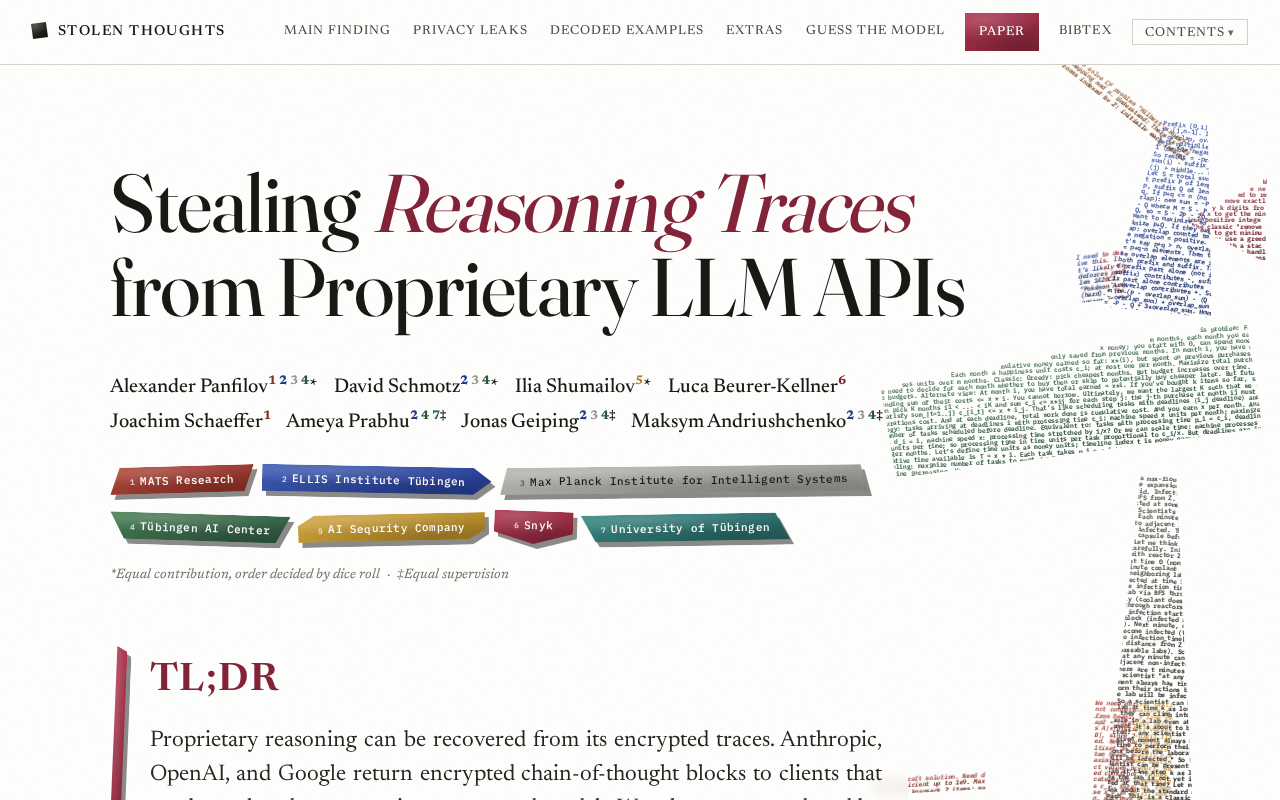
Why Reasoning Chains Are High-Value Attack Targets
Reasoning Traces have become attack targets because they possess both commercial and technical value.
Trade Secrets and Competitive Moats
For providers like OpenAI, hiding reasoning chains is a deliberate product decision. The o1 series explicitly stated from launch that raw thought chains would not be exposed to users for "safety and competitive" reasons. The rationale is straightforward:
- Preventing model distillation: High-quality reasoning traces are excellent training material for next-generation models. If competitors can harvest a model's complete reasoning processes at scale, they can train "student models" with comparable capabilities at minimal cost.
Knowledge Distillation is a model compression technique proposed by Geoffrey Hinton et al. in 2015, with the core idea of using the output of a large "teacher model" to train a smaller "student model." In the context of reasoning chain theft, distillation takes on a broader meaning: attackers collect input-output pairs (including intermediate reasoning processes) from the target model and use them as training data to replicate the target model's capabilities. Compared to training from scratch, distillation can reduce training costs by one to two orders of magnitude because the teacher model has already "digested" knowledge from massive amounts of data, and the student model only needs to learn these refined knowledge representations. This explains why high-quality reasoning chains have extremely high commercial value—they are essentially structured knowledge "distilled" through billions of dollars in compute investment.
- Protecting core methodologies: Reasoning chains often reveal the model's alignment approach and structured thinking guidance strategies, which are themselves core technical assets.
In short, reasoning chains are "implicit assets" that closed-source providers have trained through massive compute and data investments. Once this line of defense is breached, their technical moat faces erosion.
Technical Principles of Reasoning Chain Theft
The core insight of this research is that even when providers don't directly return reasoning chains, other information in the API output may still "leak" critical clues.
Side-Channel Attacks and Information Leakage
From the general approach of such attacks, attackers typically leverage the following types of signals to reconstruct hidden reasoning processes:
- Summary reverse engineering: Many models return summarized versions of the reasoning process. By making numerous queries and comparing differences across summaries, attackers can gradually infer the hidden original logical steps.
- Token-level side-channel signals: Including response latency, token probability distributions (logprobs), and billed token counts. The more complex the reasoning, the more "thinking tokens" consumed—these metrics themselves constitute exploitable side channels.
- Constructive prompt probing: Through carefully crafted prompts, inducing the model to indirectly reflect intermediate reasoning states in its final answer.
The concept of Side-Channel Attacks originates from cryptography, first proposed by Paul Kocher in 1996 as Timing Attacks, proving that encryption keys could be inferred by measuring the execution time of cryptographic algorithms. Subsequently, power analysis, electromagnetic radiation, and cache access patterns were all proven to be effective side channels. In the AI domain, this concept has been extended: API response time reflects the number of tokens generated by the model, logprobs expose the model's internal confidence distribution, and billing information directly leaks the number of hidden tokens. For example, if a math problem's API call consumes 2000 tokens but only returns 200 visible tokens, an attacker can infer the existence of approximately 1800 hidden reasoning tokens.
The essence of such attacks is consistent with traditional information security side-channel attacks—even when core data is encrypted or hidden, its byproducts (response time, resource consumption, output characteristics) still leak confidential information.
Far-Reaching Impact on the LLM Industry
This research touches on a security issue that is being severely underestimated, with implications across multiple dimensions.
Hiding Does Not Equal Security
The most direct lesson is: Hiding reasoning chains behind the API backend does not truly protect them. As long as a model's behavior can be externally observed and queried at scale, there is room for reverse engineering. This is identical to what the security community has long criticized as "security through obscurity."
"Security through obscurity" is a long-debated topic in information security. Kerckhoffs' principle (proposed in 1883) clearly states that a cryptographic system's security should not rely on the secrecy of the algorithm, but only on the secrecy of the key. Countless historical cases have validated this principle—the CSS encryption system for DVDs, GSM's A5/1 algorithm, and numerous proprietary encryption protocols all collapsed rapidly after being reverse-engineered. In the AI domain, this principle applies equally: merely hiding the existence of reasoning chains cannot prevent them from being indirectly inferred, just as hiding the details of encryption algorithms has never truly prevented cryptanalysis.
Model Distillation Arms Race Enters a New Phase
Previously, models like DeepSeek were accused of allegedly distilling OpenAI's outputs to enhance capabilities, sparking widespread industry discussion. If reasoning chains can be systematically stolen, the barrier to distillation will be further lowered—attackers no longer need the model to actively output its thinking process, but can instead use engineering methods to indirectly harvest complete reasoning traces.
This leads to two consequences: the capability gap between closed-source and open-source models may be narrowed more quickly, while providers' intellectual property protection will face unprecedented challenges.
Viable Defense Strategies
Facing reasoning chain theft threats, providers need to adopt more proactive defensive measures:
- Restrict fine-grained outputs like logprobs: Reduce the amount of side-channel information exposed by the API.
- Apply randomization or differential privacy to summaries: Increase the difficulty and cost of reverse reconstruction.
Differential Privacy is a privacy protection framework proposed by Cynthia Dwork in 2006, whose mathematical definition guarantees that when a single record is added to or removed from a dataset, the statistical distribution change in the algorithm's output does not exceed a controllable threshold ε. Applying differential privacy to reasoning chain summary protection means injecting calibrated random noise into the summary text—for example, randomly replacing the phrasing of certain logical steps, shuffling the order of non-critical steps, or omitting intermediate steps with a certain probability. This ensures that even with massive queries, attackers cannot precisely reconstruct the original reasoning chain through statistical aggregation, because each returned summary carries unpredictable variations. However, this approach requires balancing privacy protection (smaller ε values are more secure) against summary usability.
- Deploy anomalous query detection mechanisms: Identify automated probing behavior aimed at "bulk harvesting reasoning chains."
The Dilemma Between Transparency and Security
This research once again reveals a deep tension in the AI era: providers want to hide reasoning chains to protect commercial interests, but users and researchers are calling for more transparent, interpretable model behavior. Regardless of one's position, mere "hiding" may be a fragile illusion of security.
For teams building AI products, this is an important warning: Don't assume that what you haven't exposed is secure. In an API world that can be queried infinitely and measured precisely, any behavioral difference can become a breakthrough for attackers.
As reasoning LLMs gradually become mainstream, the offensive and defensive game around chains of thought has only just begun.
Key Takeaways
Related articles

Uber Deploys ChatGPT Work Company-Wide: AI in the Workplace Enters the Scaled Implementation Phase
Uber deploys ChatGPT Work to 30,000+ employees, extending it from engineering to all roles. We analyze its expert-engineer pairing, end-to-end automation, and questions of AI control and power concentration—insights for scaling AI in the workplace.

Shift at Midnight Hands-On: When "ID Verification" Becomes Alien Hunting
Shift at Midnight blends ID verification with horror survival in a four-player co-op game. We break down its inspection mechanics and chaotic humor.

Zelensky Recounts the Outbreak of War: I Need Ammunition, Not a Ride
Zelensky recalls the first day of war in a YouTube interview: farewell to family, rejecting Biden's evacuation offer with "I need ammunition, not a ride," and how Bucha shaped his stance on compromise and peace talks.