Reasoning Models Cross Disciplinary Boundaries in Scientific Argumentation: Strong Math and Code Skills Don't Mean Good Debate

Frontier reasoning models have significant gaps in scientific argumentation; explicit training can bridge them.
A systematic evaluation reveals that frontier language models excelling in math, code, and logic still struggle with scientific argumentation tasks like argument mining and rebuttal generation. General reasoning does not naturally transfer. An explicit training framework that decomposes argumentation into trainable steps enables compact models to approach or exceed large proprietary systems and generalize to unseen scenarios.
Title
Reasoning Models Cross Disciplinary Boundaries in Scientific Argumentation: Strong Math and Code Skills Don't Mean Good Debate
Meta Description
A new study systematically evaluates language models in scientific argumentation, finding that strong math and code abilities do not translate to scientific debate. An explicit reasoning training framework can significantly improve compact models' argumentation skills, approaching large proprietary systems.
Article Content
As language models continue to set records on math, programming, and logic benchmarks, a key question emerges: do these abilities naturally transfer to scientific argumentation? A recent study answers with a resounding no—even frontier models that excel on general reasoning tasks show significant capability gaps when faced with argument mining, rebuttal generation, and discourse-level reasoning in scientific discourse.
Scientific Argumentation: The "Blind Spot" of Reasoning Models
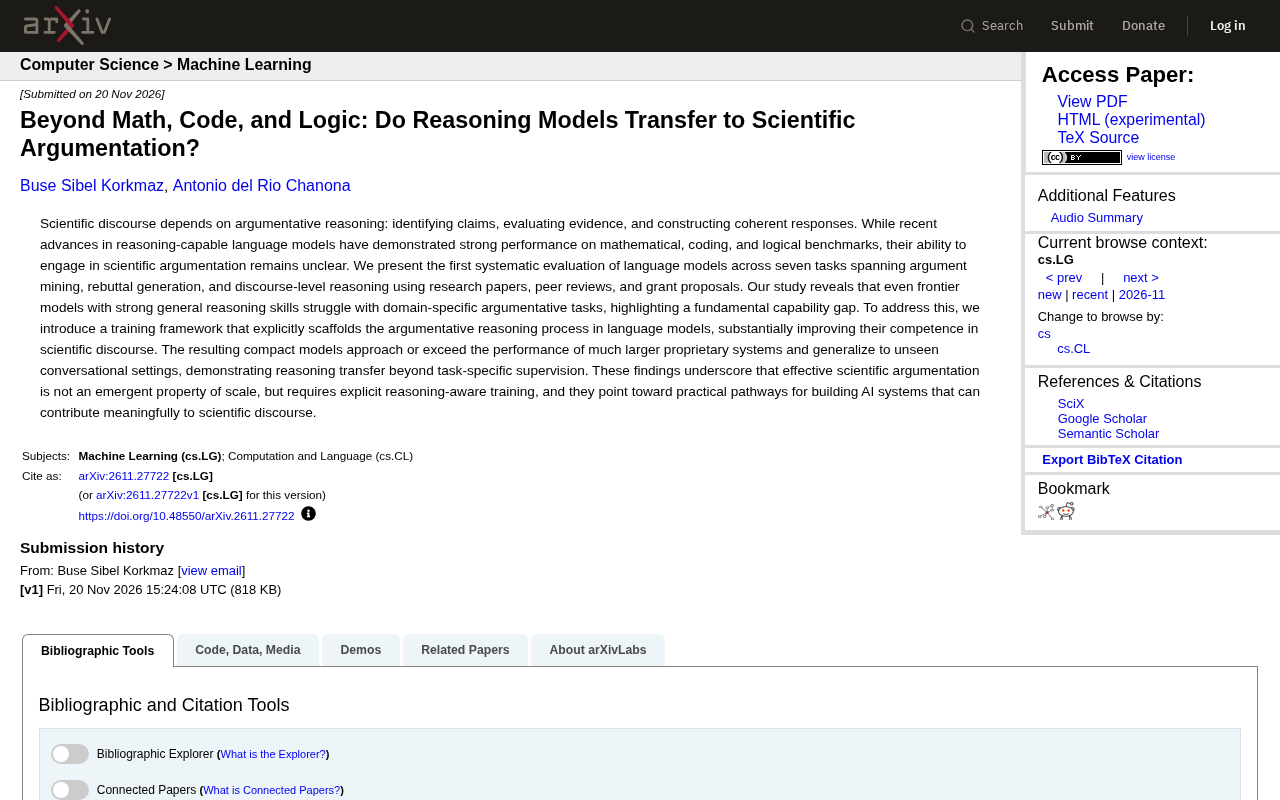
At the core of scientific discourse is argumentative reasoning—identifying claims, evaluating evidence, and constructing coherent responses. The research team conducted the first systematic evaluation of language models across seven tasks covering argument mining, rebuttal generation, and discourse-level reasoning, using materials including research papers, peer review comments, and grant proposals.
The results are not encouraging. Even frontier models with powerful general reasoning abilities struggle with domain-specific argumentation tasks. This finding directly challenges the assumption that "scaling naturally leads to emergent reasoning capabilities": high scores on math benchmarks do not automatically translate into competence in scientific argumentation.
Argument mining is a subfield of natural language processing that refers to automatically identifying argumentative structures from unstructured text, including claims, premises, evidence, and the support or attack relationships between them. In scientific texts, this typically means distinguishing an author's core claims from supporting data, identifying whether cited literature serves as support or rebuttal, and judging the completeness of argument chains. Unlike general text classification, scientific argument mining requires domain knowledge to assess the validity and relevance of evidence, thus placing higher demands on the model's depth of semantic understanding.
Discourse-level reasoning refers to the ability to understand and infer coherence across sentences and paragraphs, requiring models to grasp the overall argumentative thread of a text rather than the semantics of isolated sentences. In scientific contexts, this includes tracing the complete logical flow of a paper from problem formulation through method design to result interpretation, identifying implicit criticisms in peer reviews, and judging whether responses truly address the critiques. Discourse-level reasoning is a key bottleneck for models participating in scientific communication because it requires integrating long-range dependencies with domain knowledge, far exceeding the complexity of single-sentence reasoning.
Explicit Training Framework: From "General" to "Specialized"
To bridge this gap, researchers propose a training framework that explicitly scaffolds argumentative reasoning for language models. Unlike relying solely on scaling, this framework decomposes the argumentation process into trainable intermediate steps, teaching models to identify argument structures, evaluate evidence strength, and generate targeted rebuttals in scientific contexts.
The results are immediate: trained compact models perform close to or even exceed much larger proprietary systems. More importantly, these models generalize to unseen dialogue scenarios, indicating that reasoning ability has transferred rather than merely memorizing task-specific supervision signals.
Scaffolding in machine learning is borrowed from educational psychology, referring to structured intermediate support provided to complete complex tasks. In language model training, explicit scaffolding means decomposing high-level capabilities (such as scientific argumentation) into supervisable intermediate steps—for example, first identifying argument components, then evaluating evidence relationships, and finally generating rebuttals—with training signals designed for each step. This differs from end-to-end fine-tuning, which only provides final outputs and requires the model to implicitly learn reasoning paths on its own. Scaffolded training reduces learning difficulty by exposing the reasoning process and also makes capabilities more transferable to new tasks.
Key Insight: Scale Is Not a Panacea
This study sends a clear signal: effective scientific argumentation is not a natural product of scaling, but requires explicit reasoning-aware training. For building AI systems that can truly participate in scientific discourse, this means that training strategy design is more critical than simply stacking parameters.
The conclusion also has practical implications for AI's role in research assistance. If models are only good at computation and code but cannot weigh evidence and identify logical flaws like a peer reviewer, their role in scientific communication will remain limited. Explicit argumentation training offers a practical path for compact models to contribute to high-quality scientific dialogue.
Limitations and Outlook
Interestingly, the study focuses on seven specific tasks, and the disciplinary domains and argument types covered still have boundaries. Model performance in open-domain scientific debate and adaptability to non-English scientific literature remain to be further verified. Nevertheless, this systematic evaluation has drawn a clear warning line for the "reasoning transfer" issue: progress in math, code, and logic cannot be simply equated with improved scientific argumentation ability.
One-line Summary
Frontier reasoning models have significant capability gaps in scientific argumentation tasks, and an explicit training framework can effectively bridge them.
Paragraph Summary
A systematic evaluation found that even frontier language models excelling on math, programming, and logic benchmarks struggle with argument mining, rebuttal generation, and discourse-level reasoning in scientific argumentation, indicating that general reasoning abilities do not naturally transfer to scientific argumentation scenarios. The study covers seven tasks using papers, peer reviews, and grant proposals as materials. The proposed explicit training framework decomposes the argumentation process into trainable intermediate steps, enabling compact models to perform close to or even exceed large proprietary systems and generalize to unseen dialogue scenarios. The conclusion points out that scientific argumentation ability requires explicit reasoning-aware training rather than simply scaling up.
Related articles

From 0 to 1: Vibe Coding an AI Knowledge Base — A Practical Retrospective and Tech Stack Breakdown
A retrospective on building the AI knowledge base OilBook from scratch with Vibe Coding: Next.js+Neon stack, Oil Dev Skill workflow, Stripe paywall security, interview-style writing, AI-flavor control, and Vercel deployment.

GLM-5.4 Hands-On: Native Vision Meets a New Vibe Coding Workflow
Hands-on with Zhipu GLM-5.4: native vision tested across a 3D product demo, pure-code video generation, and remote-control Vibe Coding, compared with GPT-6.2 and Gemini Neon.

AI and Humans Claim to Prove the Riemann Hypothesis: Machine-Verified, Yet Nobody Can Understand It
Anthropic mathematician and AI Claude claim to prove the Riemann Hypothesis with 17 million lines of Lean code, machine-verified but unreadable by humans. This article analyzes the event, the zero proportion record from 41.6% to 67.2%, and the gap between machine verification and human understanding.