Rebuilding a Voice After Losing One: Uhura Bionics Is Building AI Speech Devices with Emotion

A cancer survivor founded Uhura Bionics to build voice assistive devices that carry real emotional expression.
Uhura Bionics is a startup founded by a person who lost their voice to cancer, selected for TechCrunch Disrupt 2026 Battlefield 200. Using the analogy of "glasses for voice," the company aims not just to help voiceless users produce sound, but to restore emotionally expressive speech that reflects the speaker's unique tone and feeling. This represents a shift in assistive technology — from functional intelligibility toward experiential restoration of identity and dignity. The product combines speech synthesis, emotion modeling, and voice cloning, with challenges like the uncanny valley effect still to be tested once the device reaches real users.
When Technology Meets the Reality of Voicelessness
For people who lose their vocal cords to laryngeal cancer or other conditions, regaining the ability to speak often means accepting a mechanical, flat, emotionless electronic voice. Mainstream voice assistance devices on the market can convert text or lip movements into speech, but they consistently fail to convey the speaker's true emotional range — anger, joy, exhaustion, tenderness — the emotional nuances that form the very essence of human communication are almost entirely stripped away.
Startup Uhura Bionics was founded specifically to address this gap. Selected for the TechCrunch Disrupt 2026 Battlefield 200, the company's founder lost his own voice to cancer, and that personal experience is the direct source of the company's mission. Their stated goal is straightforward: replace cold, robotic speech devices with a voice product capable of carrying genuine emotion.
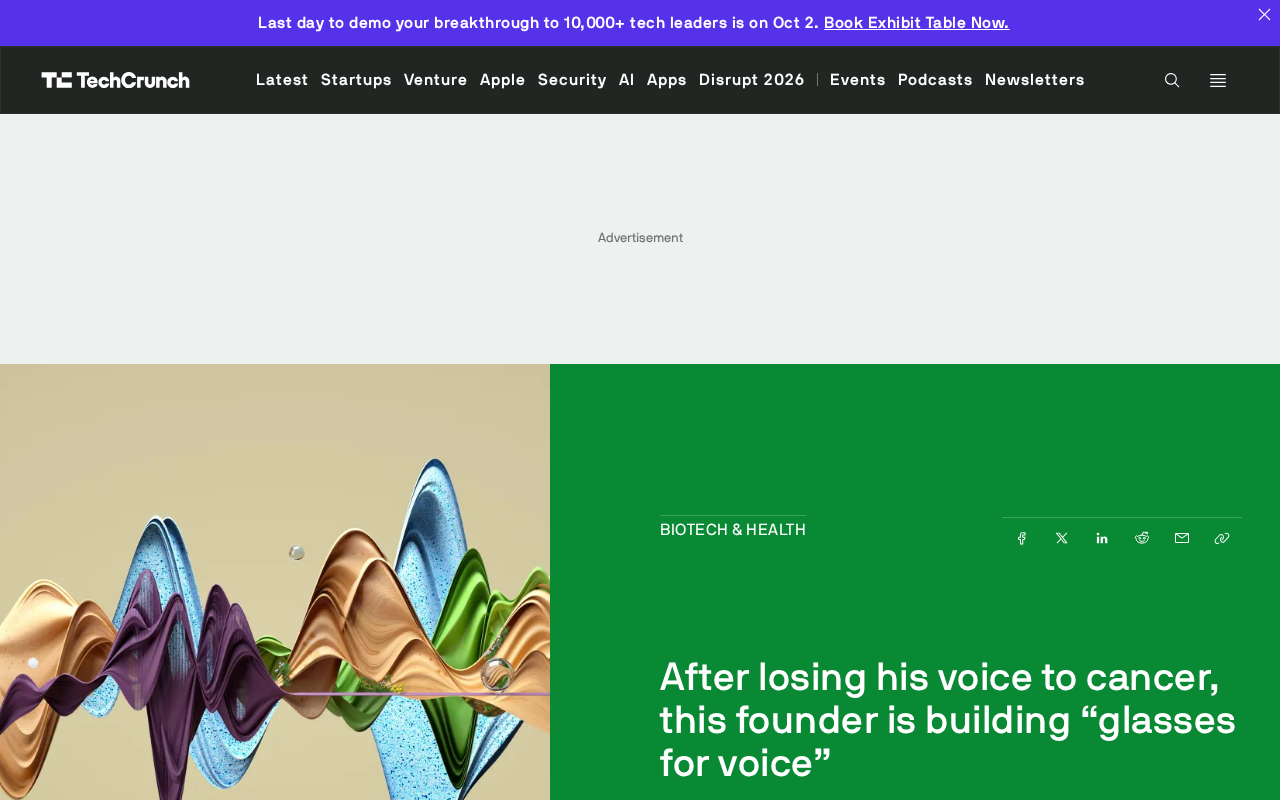
What "Glasses for Your Voice" Actually Means
The founder uses the analogy of "glasses for voice" to describe their product — a remarkably apt comparison. Glasses for people with visual impairments don't simply let them "see"; they make the visual experience as natural, unobtrusive, and integrated into daily life as possible. Similarly, Uhura Bionics isn't just trying to help people who've lost their voice "make a sound" — they want the resulting voice to feel like it genuinely belongs to the speaker, complete with their unique tone, rhythm, and emotional expression.
The technical challenges behind this are far more complex than they appear on the surface. Generating intelligible speech is just the baseline. The real difficulty lies in dynamically injecting emotion into real-time conversation while reconstructing a person's individual vocal identity. Systems like this typically require a combination of speech synthesis, emotion modeling, and personalized voice cloning — incorporating the user's past vocal characteristics or their preferred expressive style into the output.
The dominant technical approaches in speech synthesis today include end-to-end deep learning models (such as Tacotron and VITS) and large-scale pretrained neural TTS (Text-to-Speech) systems. Emotional speech synthesis builds on these foundations by introducing emotion labels, prosody control, or style transfer modules, allowing models to modulate speech rate, pitch contour, and energy distribution to simulate emotional states like anger, joy, or sadness. Personalized voice cloning uses a small number of recordings from the target speaker to transfer their vocal characteristics into the synthesized output, making the generated voice sound like a specific individual rather than a generic machine voice. For people who have lost their voices, the combination of these technologies is especially critical — the system must infer the speaker's emotional intent in real time without live acoustic input, relying instead on residual muscle signals, facial movements, or text input, then dynamically adjust synthesis parameters accordingly. This imposes far higher demands on latency and accuracy than standard TTS applications.
Why Emotional Expression Is the Real Issue
The voice assistance device industry has long focused on "intelligibility" — as long as the listener can understand the content, the job is done. But for users, what's lost isn't just the ability to produce sound; it's the ability to express oneself through voice. The phrase "I'm fine" delivered in a flat, mechanical tone carries an entirely different message than the same words spoken with weariness or quiet relief.
Uhura Bionics' approach reframes "emotional conveyance" from a nice-to-have into a core feature. In many ways, this represents a philosophical shift within assistive technology: moving from functional compensation toward experiential restoration — putting technology in service of human dignity and identity, rather than simply meeting the minimum threshold for communication.
How the Founder's Experience Shapes the Product
The founder's firsthand experience with voice loss gives the company an insight that's difficult to replicate from the outside. He knows precisely what each shortcoming of existing devices means in terms of daily frustration — not as a pain point lifted from a market research report, but as a reality he faces every day. This "user-as-creator" model has a strong track record in assistive technology and medical devices for producing solutions that are genuinely aligned with real-world needs.
Being selected for TechCrunch Disrupt Battlefield 200 also signals meaningful attention from the industry and investor community. As AI speech synthesis technology has matured rapidly in recent years, applying high-quality, emotionally expressive voice generation to assistive medical contexts is emerging as a space with both significant social value and commercial potential.
Worth Watching, But Still Unproven
It's worth noting that publicly available information remains quite limited. The product's specific form factor, technical implementation, the real-world effectiveness of its emotional rendering, and ultimately its price and accessibility are all still unknown. For a voice device that centers emotion as its core value proposition, the ultimate test will be how users actually feel when they use it — whether the emotion sounds natural, whether it falls into the uncanny valley, whether it holds up over extended conversations. None of these questions can be answered until the product actually ships.
That said, the question Uhura Bionics is asking is itself valuable: assistive technology shouldn't stop at making something "usable" — it should aspire to make something people want to use, and can use with dignity. That direction deserves far more attention from the industry as a whole.
The "Uncanny Valley" effect was originally proposed by Japanese roboticist Masahiro Mori to describe the strong sense of unease observers experience when a humanoid appearance or behavior approaches — but doesn't quite reach — genuine human-level realism. A similar phenomenon exists in emotional voice synthesis: if a synthesized voice is nearly indistinguishable from a natural human voice across most dimensions, but exhibits an anomaly in some specific detail — such as the smoothness of emotional transitions, breathing rhythm, or subtle pauses — it can feel even more unsettling to the listener than a purely mechanical voice. This means developing emotional voice devices is not a matter of simply maximizing "emotional expressiveness" along a linear scale. It requires finding a carefully calibrated balance between naturalness and controllability — and that is one of the central challenges facing researchers and engineering teams in this field.
Related articles

Workbuddy for Absolute Beginners: How a Desktop AI Agent Fits Into Real Workflows
A beginner's guide to the Workbuddy desktop AI agent: installation, claiming credits, file management, and building automated workflows—compared with CodeX for fit and cost, helping professionals shift from AI question-askers to AI managers.

OpenAI's New Agent Stack: Computer Use, Decisions API, and Ultra-Fast Workflows
OpenAI Dev Day unveiled a new agent stack: Computer Use outperforms humans, Decisions API delivers ultra-low-latency classification via Luna, Agents API opens the same Computer Use capabilities, and GPT-6.1 Sol costs only one-seventh of Astra. Core updates, benchmark data, and developer insights.

Liang Wenfeng Open-Sources DeepInfo Inference Framework, Takes On U.S. Ban
DeepSeek open-sources its DeepInfo inference framework after its models, featuring GPU/CPU cross-pipelining, small-model prediction with large-model verification, and full Huawei Ascend and NVIDIA chip support—facing the U.S. federal ban head-on. This article analyzes its significance for AI deployment and open-source strategy.